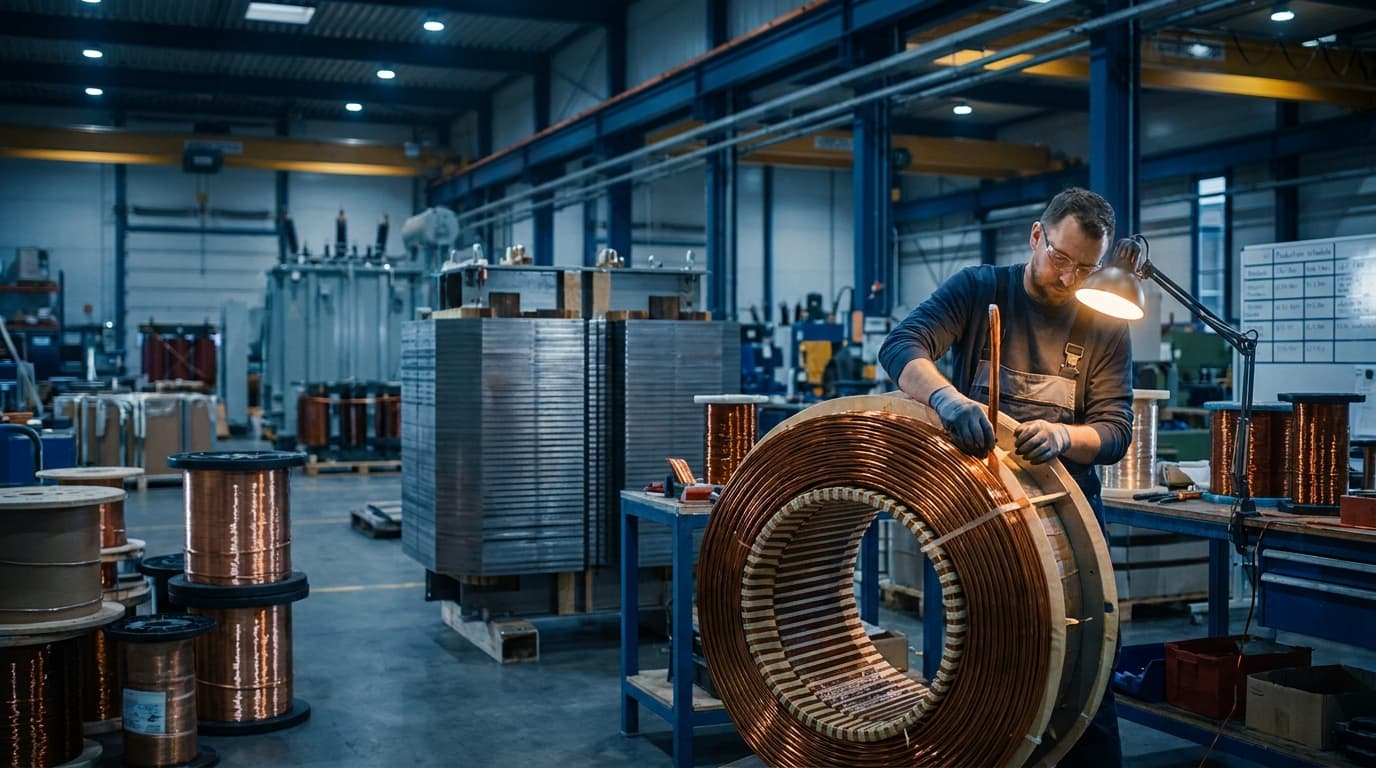
A utility procurement officer placing an order for a generator step-up transformer in mid-2026 is being quoted delivery in 2029. A specialty large power transformer can run to four years. Those are not numbers that get fixed by pouring concrete or signing checks. They are numbers that describe a manufacturing-labor problem dressed up as a grid problem.
The headline-grabbing version of this story is steel — grain-oriented electrical steel (GOES), the magnetic core material that has roughly doubled in price since January 2020 and is produced domestically at a single mill in Butler, Pennsylvania. The steel is a real constraint. But the deeper, less reversible one is human: a roughly 15,000-person U.S. transformer workforce that would need to roughly triple to meet decarbonization-era demand, anchored by coil winders whose craft trade-press describes as "almost an art form." That workforce is aging out, and the vocational pipeline that used to refill it has been gone for a generation.
1. The numbers
Standard power transformer lead times in the United States averaged about 128 weeks in 2026. Generator step-up units (GSUs), the high-voltage workhorses that connect generation to the bulk transmission system, averaged roughly 144 weeks. Specialty units are quoted as high as four years. Five years ago, comparable units shipped in 50–80 weeks.
The price column has moved in parallel. Distribution transformer prices are up 78–95% since 2019, power transformers are up roughly 77%, and GSUs are up about 45%. GOES is up about 100% over that span and copper is up around 50%, according to Wood Mackenzie.
On the order-book side, the cleanest data point comes from GE Vernova, which disclosed a total company backlog above $100 billion — the largest power-equipment backlog ever reported — with $38.6 billion of that specifically in equipment, in its Q1 FY2026 8-K filed April 22, 2026. That is not a demand-signaling problem. It is a throughput problem.
2. Why the OEMs can't sprint
The global oligopoly — Hitachi Energy, Siemens Energy, GE Vernova, and ABB — is running 48–60 month lead times after absorbing the first wave of U.S. data-center-driven demand, per POWER Magazine's trade-press synthesis. Each of them has announced expansion.
Hitachi Energy has committed more than $1 billion to North America, including a Virginia large power transformer plant the company has billed as the largest in the U.S. Siemens Energy has committed more than $1 billion to U.S. grid infrastructure, including a Charlotte, North Carolina LPT facility targeting a 2027 production start. Across the OEMs and mid-tier players, roughly $2 billion in transformer capacity expansion has been announced across North America.
Almost none of that capacity is a 2026 event. Buildings rise quickly. Qualifying a winding line — the people, the test bays, the dielectric and short-circuit acceptance procedures — does not. New capacity will be material to the supply picture in 2027 and 2028, not before.
3. Match supplier capability to transformer class
Supplier-scope correction, October 5, 2026: An earlier version grouped Delta Star, ERMCO and Virginia Transformer together and said these manufacturers could not fill the generator step-up (GSU) and large power transformer (LPT) gap. That was too broad: Delta Star explicitly lists GSU products, and Virginia Transformer lists both GSU and large power transformers. Product capability does not establish available factory capacity or a delivery date.
-
Delta Star: Its manufacturer capability table lists generator step-up transformers at 7–300 MVA and high-side voltage up to 345 kV. Ask which configuration and manufacturing location can support the required duty; do not infer a reserved production slot from the catalog.
-
Virginia Transformer: Its utility product brochure includes medium power, large power and GSU transformers. It should not be excluded from an initial capability inquiry solely because it was grouped with distribution-transformer suppliers in this article.
-
ERMCO: Its distribution-transformer product page lists single- and three-phase pole-mount and pad-mount products. That page does not establish GSU or LPT capability, and its product availability should not be substituted for a quote on a different transformer class.
What to request before comparing delivery promises
For procurement teams, the practical next step is a comparable written response from each technically suitable supplier. The following is an editorial purchasing checklist, not a manufacturer guarantee or an engineering specification:
-
Define the unit: provide the required transformer duty, MVA and voltage ratings, installation constraints and project specification. Have the responsible engineer resolve technical suitability.
-
Separate the milestones: ask for engineering approval, material availability, a production slot, factory testing, shipment and site-delivery dates. Record whether each date is an estimate or a contractual commitment.
-
Name the constraints: ask which components, manufacturing steps and tests govern the quoted schedule, and what changes would move it.
-
Compare the same scope: identify included testing, transport, installation support, exclusions and quote expiry. A shorter lead time with different scope is not a like-for-like alternative.
A published product range can help build the inquiry list. It cannot prove that a supplier can meet this project's specification, price or in-service date. The rest of this article's historical market figures were not reverified as part of this supplier-scope correction.
4. The steel: a single Pennsylvania line
Grain-oriented electrical steel is the magnetic core of every power transformer. In the United States, it is produced at exactly one facility: Cleveland-Cliffs' Butler Works in Pennsylvania, whose output meets roughly one-fifth of domestic demand. The rest is imported.
Cleveland-Cliffs is investing $195 million to upgrade Butler Works' steel processing line, supported by up to $75 million in DOE grant funding. The intended operational date is July 2028, and recent reporting confirms the project remains on schedule. For a hyperscale campus breaking ground in 2026, that timing matters: the GSU it needs is being quoted today against a steel supply that won't expand for another two years.
5. The actual story: hand-winding copper
Inside a power transformer is a copper winding — long runs of insulated wire that have to be laid, tensioned, and secured on each unit. The work is described in industry coverage as "almost an art form": machines feed and shape the wire, but the placement, the dressing, the bracing, and the final assembly are still done by hand. A misplaced turn or a sloppy lead becomes a dielectric failure on the test floor — or, worse, in service.
The U.S. transformer manufacturing workforce is roughly 15,000 people, per Niskanen Center analysis. Meeting projected demand would require something close to a tripling of that headcount. The federal occupational data — BLS OES for coil winders, tapers, and finishers — describes a small, aging cohort that has been shrinking for two decades as winding production followed broader electrical manufacturing offshore and as vocational programs collapsed in the schools that used to feed it.
State apprenticeship efforts in Virginia and Alabama are trying to refill the pipeline, with Delta Star's Lynchburg expansion explicitly tied to local workforce development. But coil winders cannot be summoned by purchase order. A welder qualified to weld a transformer tank is not, on day one, a coil winder. Training timelines run in years, not weeks.
6. The demand-side fire hose
The reason any of this is acute is data centers. NERC's 2025 ten-year forecast projects U.S. summer peak demand growth of 224 GW — a 24% jump versus the prior year's forecast — driven primarily by data-center load. NERC has also issued a rare Level 3 alert over data-center load oscillations that have been stressing reliability.
On the policy side, FERC has scheduled action on its large load interconnection docket by June 2026, which will shape how hyperscaler campuses connect to the bulk system. Whichever way that rulemaking lands, it does not change the number of coil winders on the floor.
7. The policy gap
Section 45X — the Inflation Reduction Act's advanced manufacturing production credit — covers solar wafers, wind components, inverters, battery cells, and critical minerals. It does not cover transformers. The final regulations issued October 28, 2024, and the IRS guidance, are explicit about the eligible component list. The One Big Beautiful Bill Act, signed July 4, 2025, preserved §45X with new guardrails but did not add transformers.
Two bipartisan bills aim to close that gap. The CIRCUIT Act (S.448 / H.R.4128), introduced by Sens. Catherine Cortez Masto (D-NV) and Jerry Moran (R-KS), would extend §45X eligibility to distribution transformers. A separate Brown–Cruz bill targets transformer supply-chain resilience more broadly. Neither has been enacted as of mid-2026. The Congressional Research Service's R48933 lays out the policy landscape in detail, and R Street commentary ties DOE efficiency rulemaking into the same supply story.
A production credit reduces the unit economics of building transformers in the U.S. It does not, on its own, produce coil winders. If Congress wants the §45X lever to bind on the actual bottleneck, the design choice is whether the credit subsidizes materials cost or the labor hours required to wind and finish a unit. Today's eligible-component template is closer to the former.
8. What this means for IIoT and operations readers
The instinct in any manufacturing audience is to ask where automation absorbs the labor gap. The answer is partial and unsatisfying. Automated winding machines exist and are in use. They do not eliminate the human role in lead dressing, bracing, final assembly, and — critically — the qualification testing sequence that signs a unit off the floor. Dielectric, impulse, and short-circuit tests gate every unit, and the engineers who run them are themselves scarce.
The honest forecast is that transformer manufacturing has a labor-intensity floor that will not move in this cycle. Capex announcements will keep arriving; new plants in Virginia, North Carolina, and elsewhere will come online in 2027 and 2028; Butler Works will ramp its GOES line in mid-2028. None of those events shortens a 144-week GSU quote in 2026.
The kicker
Until the United States graduates coil winders faster than it permits data centers, no amount of grid spend solves the bottleneck. The transformer shortage is not a story about a missing metal or a missing tax credit. It is a story about a missing trade.
Related reading
-
Substation Gear, Not Gensets, Is Now the Real Cap on AI Power Buildouts
-
Anduril's Arsenal-1 in Pickaway County Is About to Out-Hire Every Defense Prime in Ohio
Sources
-
GE Vernova Inc. Form 8-K, Q1 FY2026 press release (April 22, 2026)
-
U.S. transformer market faces severe supply constraints — pv magazine USA
-
Transformers in 2026: Shortage, Scramble, or Self-Inflicted Crisis? — POWER Magazine
-
Power Transformer Lead Times Hit 128 Weeks in 2026 — Industrial Sage
-
Powering the nation: how to fix the transformer shortage — Niskanen Center
-
How a transformer shortage threatens the grid — Governors' Wind Energy Coalition
-
[Distribution Transformers: Supply, Tariffs, Policy — CRS R48933](https://www.congress.gov/crs-product/R48933)
-
Low-Energy Fridays: The Transformer Shortage — R Street Institute