
A SMED changeover study on a stamping press follows six steps:
-
Charter the study and write the safety rules.
-
Film and time the change from last part to first good part.
-
Break the video into elements.
-
Sort each element as internal or external.
-
Move work to external, then streamline what is left.
-
Standardize, train and re-time.
On a press line, the minutes between the last part of one run and the first good part of the next are capacity you have already paid for. The press, the floor space and the crew are all on the books, and while the die change runs, none of them produce anything. A SMED study is how you get those minutes back on purpose. When it is done well, it gives you three things: a timed baseline, a list of setup elements split into internal and external work, and a worksheet that tells you whether to spend the recovered time on more output or on smaller batches.
This guide covers the method, the history behind it, the safety rules that apply to die setting, and the arithmetic you need before you take hardware requests to the capex committee.
The terms, in plain language
The Lean Enterprise Institute (LEI) Lexicon defines SMED, single-minute exchange of die, as "a process for changing over production equipment from one part number to another in as little time as possible." "Single minute" means a single-digit number of minutes, so the target is a changeover under 10 minutes.
LEI splits setup work into two kinds:
-
Internal setup is work that can only be done with the machine stopped. LEI's example is inserting a new die.
-
External setup is work that can be done while the machine is still running the previous job. LEI's example is moving the new die to the press.
The core strategy is to turn as much internal work as possible into external work, then shorten whatever internal work is left.
The stopwatch rule matters more than most teams expect. In LEI's changeover entry, which uses a stamping press as its example: "Changeover time is measured as the time elapsed between the last piece in the run just completed and the first good piece from the process after the changeover." The clock stops at the first good piece, not when the die is clamped and not when the press first cycles. Tryout, adjustment and first-piece approval are part of the changeover. Write the start and stop points into the study charter before anyone starts filming. If you don't, the baseline and the re-time will not measure the same thing.
A short, honest history
SMED is usually credited to Shigeo Shingo. The record is more complicated than that, and the details are useful to a stamping plant, because the method grew up on presses.
LEI's Lexicon credits Shingo's setup-reduction insights, "developed in the 1950s and 1960s," with two ideas: separating internal from external setup, and then converting internal work to external. Shingo set out the system in his 1985 book, A Revolution in Manufacturing: The SMED System. It was first published by Productivity Press and is now published by Routledge, which lists Andrew P. Dillon with Shingo. The publisher's page says the book contains twelve case studies, including Toyota, Matsushita and Bridgestone. The page also quotes a Ford Cleveland Engine Plants testimonial that changeover was cut "from 4 to 5 hours to an average of 2.5 to 4 minutes."
A former Toyota trainer tells it differently. In a 2006 interview with Art Smalley published by LEI, Isao Kato says that from the late 1940s, long changeovers at Toyota fell "from four hours to one hour and 40 minutes." He adds: "By 1962 average changeover time was 15 minutes and by 1971 it was down to 3 minutes company wide in the stamping department." Kato says Shingo "really only participated in one workshop in 1969 long after the single minute mark was actually broken internally by others." On the machine in that workshop, Kato says, the combined ideas cut setup "from one hour and forty minutes initially down to just about forty minutes." In Kato's view, Shingo's "main successes with set up reduction came in companies outside of Toyota on much smaller machines." This is one insider's account, and it should be read that way.
Christoph Roser's history of quick changeover on AllAboutLean traces the method back further. According to Roser, Taiichi Ohno saw Danly stamping presses on a US trip that could change dies quickly, and Toyota then bought several Danly presses for its Motomachi plant. Roser also says Toyota built its approach on the US World War II Training Within Industry framework known as ECRS: Eliminate, Combine, Rearrange, Simplify. Roser's article does not cite academic sources, so these points are his.
The practical lesson is that quick die change on stamping presses came from steady, plant-level work over many years. No single workshop produced it. Expect your own results to come the same way.
Step 1: Set up the study
Pick one press and one frequent die pair. Choose a changeover that happens often enough that savings add up and that you can film several times within a few weeks. A die pair that changes over weekly or more often is a good starting point.
Build a cross-functional team. Include die setters, press operators, toolroom, quality (they own first-piece approval) and maintenance. The setters know where the time goes. Quality decides when a part counts as "good," and that is when the clock stops.
Write the safety rules down first. A die change on a mechanical power press is regulated work. Speed is never a reason to take shortcuts on it.
-
Under OSHA 29 CFR 1910.217(d)(9)(i), "the employer shall establish a diesetting procedure that will insure compliance with paragraph (c) of this section." Under (d)(9)(iv), "the employer shall provide and enforce the use of safety blocks for use whenever dies are being adjusted or repaired in the press."
-
Section 1910.217(d)(8) requires that "handling equipment attach points shall be provided on all dies requiring mechanical handling." Under (d)(7), both the upper and lower shoes must have provision for secure mounting to the bolster and slide.
-
The lockout/tagout standard, 1910.147, defines servicing and maintenance to include setting up and adjusting equipment. Its exception for minor tool changes during normal production is narrow. It covers only routine, repetitive work that is integral to production and is done with alternative effective protection. Plan a full die change under the plant's lockout procedures.
Any streamlined sequence the team designs must still include lockout, safety blocks and the diesetting procedure. Treat these as fixed elements in the study, not as candidates for cutting. Whoever is filming stays out of the die area and must not slow the crew down or get in its way.
Step 2: Film and time the changeover
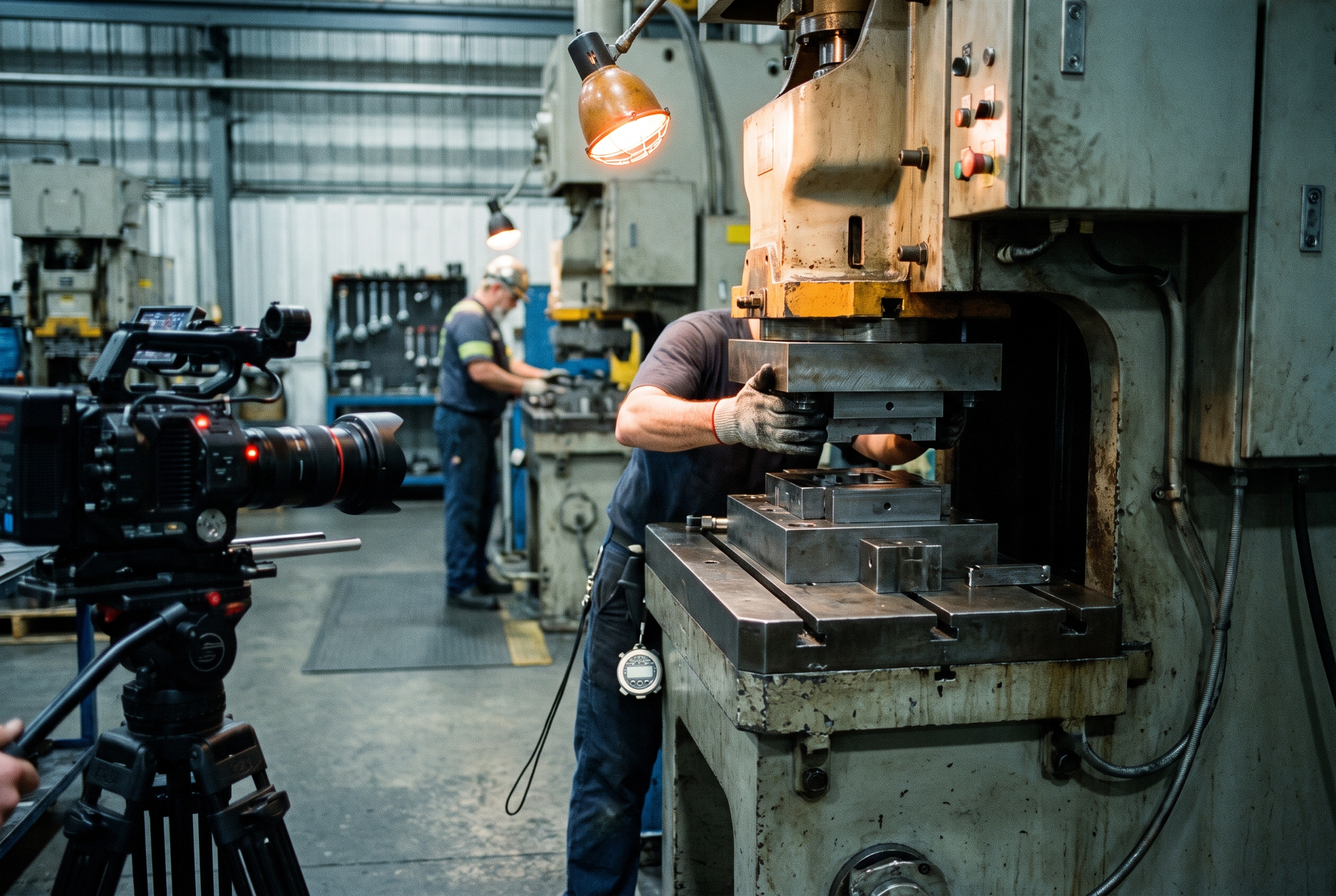
Record the whole changeover, from the last good part of the outgoing job to the first approved part of the incoming one. Video is the standard way to start. Tennessee MEP, part of the University of Tennessee, describes a typical 3-5 day SMED event in which day 1 is video recording and analysis of the current changeover.
Some method advice:
-
Film more than one changeover, and more than one crew. A single recording can catch an unusually good or bad day. A baseline built from several changeovers and different setters shows what typically happens and how much it varies between crews. The variation between crews is often where the first easy gains are.
-
Use two cameras. One wide shot shows walking, waiting and crane or forklift movements. A second camera follows the lead setter. Make sure both have timestamps, or sync them to a clock that is visible in the frame.
-
Do not coach during the baseline. Film the changeover as it is normally done. Improvements come later.
-
Tell the crew why you are filming. The study is about the method, not about individual setters. If people feel watched, they work differently, and the baseline is no longer accurate.
Step 3: Break the video into elements
Go through the footage with the setters and list every element with its start time, end time, who did it, and whether the press was stopped. A spreadsheet is enough. Then group the elements into categories that make sense on a press:
| Group | Typical elements | | --- | --- | | Prep and fetch | Finding the next die, tools, bolts, shims, paperwork, first-piece gauges | | Die out | Unclamping, lifting or rolling the old die off the bolster, moving it away | | Die in | Bringing the new die to the press, locating it on the bolster | | Clamp and shut height | Clamping upper and lower shoes, setting shut height | | Feed and coil setup | Coil change, feed length, straightener and pilot settings | | Tryout and first-piece approval | Inching, first hits, measurement, quality sign-off | | Adjustments | Shimming, re-setting shut height, re-hitting until the part is good |
As you go, flag four kinds of waste: walking, searching, waiting (for the crane, forklift, toolroom or quality) and repeated adjustments. Repeated adjustment is the one to watch most closely on presses. A die that needs three hits and two shim changes to make a good part is a sign that shut height, locating or die maintenance is not under control.
Step 4: Sort internal from external
For every element, ask one question: does this really need the press stopped? Many elements are done with the press down only out of habit. On a stamping press, common candidates to move to external work include:

-
Moving the next die to the press and staging it before the last part of the current run. This is LEI's own example of external setup.
-
Checking the incoming die beforehand: confirming it was repaired after its last run, and checking shims and parts.
-
Preparing the next coil and presetting feed parameters where the equipment allows it.
-
Putting the right tools, fasteners and first-piece gauges at the press before shutdown.
-
Calling quality before the last part, so the inspector is waiting at the press instead of the press waiting for the inspector.
Write the result as two lists. The internal list is the target for Step 5. The external list becomes a pre-changeover checklist, with an owner and a trigger, such as "complete before last 200 parts."
Step 5: Convert and streamline
Once the external work is out of the downtime window, work on what remains. Use ECRS as the checklist: for each internal element, can it be eliminated, combined with another, rearranged, or simplified?
Standardize clamping. PFA Inc., a maker of quick die change equipment, advises plants to "standardize the clamping method and clamping height for a particular press or group of presses" in its quick die change guidance. If every die clamps at the same height with the same method, setters stop looking for the right bolt, block and wrench.
Size clamps properly if you buy them. PFA's vendor rule of thumb for hydraulic or quick clamps is: required force per clamp = (maximum die weight × 4) ÷ number of clamps. Round the clamp count up to the nearest even number. This is a supplier's sizing guide. Have your own engineering review confirm it for your presses and dies.
Fix die handling. PFA lists three ways to remove dies: a mobile platform such as a forklift, a permanently mounted die table, or a bolster extension with integrated rollers. The right choice depends on die weight, floor layout and how many presses share the equipment. If dies need mechanical handling, they must have handling attach points under OSHA 1910.217(d)(8).
Work in parallel. Two people working on opposite sides of the press, each following a written sequence, can cut elapsed internal time without cutting any steps, as long as the lockout procedure covers both of them.
Get rid of adjustments. Standard shut height across a die family, fixed locators on the bolster and good die maintenance between runs all reduce the number of hits before a good part. Adjustment is often the largest element that teams underestimate.
Separate no-cost fixes from capex. Put every idea in one of two columns. Staging, checklists, tool carts, a quality call-ahead and a fixed sequence cost little or nothing. Hydraulic clamps, die carts, bolster extensions and subplates are capital spending. Do the no-cost column first and re-time. Then justify hardware against the changeover that is left, not against the original baseline.
Step 6: Standardize, train and re-time
Write the new sequence as standard work: the external checklist, the internal steps in order with who does each, the safety steps included, and the target time. Train every crew on it, then film again using the same start and stop points as the baseline.
Tennessee MEP schedules this as part of the event itself. Days 2-3 redesign and test the sequence on-site, and days 4-5 standardize and train. The provider says a single event achieves "30-70%" changeover reduction and lists smaller batch sizes among the outcomes. Treat that as the provider's claim about its own events, not as a benchmark your press should reach. Your re-timed result is the only number that counts.
The worksheet: what are the recovered minutes worth?
A shorter changeover gives you minutes. You can spend them in one of two ways: more output, or more changeovers with smaller batches. The worksheet below covers both. All numbers are illustrative. The arithmetic is ours, not sourced data. Replace the figures with your own.
Part A: capacity
| Line | Input | Illustration | | --- | --- | --- | | A1 | Baseline changeover (min) | 45 | | A2 | New changeover (min) | 20 | | A3 | Minutes recovered per change (A1 minus A2) | 25 | | A4 | Changeovers per week | 10 | | A5 | Press minutes freed per week (A3 × A4) | 250 | | A6 | Good parts per running minute | 20 | | A7 | Extra parts per week (A5 × A6) | 5,000 | | A8 | Contribution margin per part | $0.40 | | A9 | Weekly value (A7 × A8) | $2,000 |
A9 only counts if the extra parts can be sold. Freed minutes on a press that is not a constraint are worth little in contribution. Price the minutes at contribution margin, not at revenue. Keep incremental costs separate (coil, overtime you avoid or add, expedited freight you no longer pay). ManufacturingMag's free downtime cost calculator keeps lost contribution and incremental recovery costs in separate lines, which helps when you compare the value of the freed time against a quote for clamps or a die cart.
Part B: smaller batches
The second way to use the gain is to keep total weekly changeover time the same and change over more often. LEI's EPEI entry (every product every interval) defines EPEI as "the frequency with which different part numbers are produced in a production process or system." If every part number is made every three days, EPEI is three days. LEI notes that "a machine with long changeovers (and large minimum batch sizes) running many part numbers will inevitably have a large EPEx unless changeover times or the number of part numbers can be reduced."
| Line | Input | Before | After | | --- | --- | --- | --- | | B1 | Weekly changeover budget (min) | 600 | 600 | | B2 | Minutes per changeover | 60 | 20 | | B3 | Changeovers per week (B1 ÷ B2) | 10 | 30 | | B4 | Part numbers on the press | 10 | 10 | | B5 | Times each part runs per 5-day week (B3 ÷ B4) | 1 | 3 | | B6 | Illustrative EPEI (5 days ÷ B5) | 5 days | About 1.7 days | | B7 | Run length per part, relative to before | 1 | About one-third |
Going from 60 to 20 minutes per change allows three times as many changeovers in the same downtime budget. If demand stays the same, each run is about one-third as long. Cycle stock, the inventory you build in one run and draw down until the next, shrinks roughly in proportion. The press runs the same number of hours. What you gain is less finished-goods and WIP inventory, less floor space for racks, and a faster response when a customer changes the schedule.
Decision guide: capacity or batch size?
-
Choose capacity (Part A) when the press is a bottleneck with a backlog, you are paying overtime or outsourcing work to meet demand, or a second press is in next year's capex plan. Recovered minutes can delay or eliminate that purchase.
-
Choose smaller batches (Part B) when the problem is inventory: high finished-goods or WIP days, racks taking up floor space, die-changed parts sitting for weeks, or customers whose releases change faster than your run cycle.
-
Split the gain when both apply. Many plants put part of the recovered minutes into output and part into an extra changeover cycle each week.
Whatever you choose, track three numbers over time: changeover minutes (measured last piece to first good piece), EPEI for the press, and inventory days for the parts it makes. If changeover minutes fall but neither output nor inventory moves, the gain is being lost somewhere, usually in waiting or in a schedule that was never changed.
Common pitfalls
-
Filming only once. One changeover is an anecdote. Film several, with different crews.
-
Not defining start and stop. If the baseline stops the clock at "die clamped" and the re-time stops at "first good part," the comparison is meaningless.
-
Treating tryout as outside the changeover. Adjustment and first-piece approval are inside the window by LEI's definition, and they are often where the most time goes.
-
Buying QDC hardware before fixing the external work. Hydraulic clamps will not help if the press sits idle waiting for the die to arrive. Do the staging, checklists and no-cost fixes first, then justify capex against what is left.
-
Skipping the safety procedure. The diesetting procedure and safety blocks under 1910.217 and lockout under 1910.147 are part of standard work. A changeover that is faster because a step was skipped is a violation, not an improvement.
-
Not re-timing. Without a second video under the same rules, you have a plan and no result.
Related reading
-
How Suppliers Should Plan Around the Stellantis Windsor Plant Shutdown
-
How to Find the Cost Crossover Between Binder Jetting and Metal Injection Molding
-
How to Answer a 30% Price-Down Letter Without Losing the Program
-
Ford Just Retired the Moving Assembly Line at Louisville — and Turned 146 Parts Into 2
Sources
-
Single Minute Exchange of Die, Lean Enterprise Institute Lexicon
-
Every Product Every Interval, Lean Enterprise Institute Lexicon
-
Isao Kato Interview on Shigeo Shingo's Influence on TPS (Art Smalley, LEI, 2006)
-
The History of Quick Changeover (SMED), AllAboutLean (Christoph Roser)
-
SMED, Quick Changeover for Tennessee Manufacturers (Tennessee MEP)
-
OSHA 29 CFR 1910.147, The control of hazardous energy (lockout/tagout)