
Adding a third shift costs more than the base wage times the hours. A supplier pays the shift differential, which under federal rules also raises the overtime rate, plus per-head benefits, recruiting and training, extra supervision and support staff, higher fatigue-related error risk, and lost preventive maintenance time once the plant runs around the clock.
That question is now in front of every supplier feeding Nissan's US plants. At a September 28, 2026 media roundtable in Yokohama, Christian Meunier, chairperson of the Management Committee for Nissan Americas, said Nissan is targeting 80% localization of its US sales by the end of 2030. That is up from about 65% today and about 40% before the US tariffs of early 2025, according to Reuters, Automotive World and Just Auto, which cited Nikkei Asia.
"In April of last year, we had significant headwinds from the tariffs [...] we pivoted toward building more US cars and localising all the cars and the parts," Meunier said, as quoted by Automotive World.
A week earlier, Quartz quoted him on how Nissan intends to get there: "We're now maxing out the production capacity in the U.S. The next step is going to be three shifts." On a new plant: "I think we're very well equipped to succeed without major investment and a new factory and everything else. Maybe after 2030."
No new factory means the added volume has to come out of existing assets, at Nissan and at its supply base. For a tier-1 or tier-2 shop running two shifts, the request will arrive as a volume number. The decision behind it is whether to cover that number with overtime, a third crew or new equipment. This article lays out the math, with every assumption labeled so you can replace it with your own.
First, discount the volume signal
Quartz reports that adding a third shift at both Smyrna, Tennessee and Canton, Mississippi could lift Nissan's US output to roughly 1 million vehicles a year, up from nearly 487,000 in 2025. Treat that as a capacity ceiling, not a production schedule. It is roughly double last year's output, and nothing in the reporting puts a date on it.
Suppliers also have reason to be wary of direction changes. Consider the past 18 months:
-
Early 2025: shifts cut. Manufacturing Dive reported that Nissan planned to cut one shift at each site by mid-April 2025. At Smyrna, the Rogue line went from two shifts to one while the Murano, Pathfinder and QX60 line stayed on two. At Canton, the Altima lines went from two shifts to one while the Frontier line stayed on two. Nissan said there would be no job cuts and offered voluntary buyouts.
-
Spring 2026: EVs cancelled. WLBT reported on May 1, 2026 that Nissan told suppliers it "will not move forward with previously announced EV programs at its Canton, Mississippi, facility." Nissan had announced $500 million for Canton EVs in 2022.
-
2026: PHEV dropped. Automotive World reports that Nissan has stopped North American production of the Rogue plug-in hybrid. "Plug-in hybrid in the US has almost disappeared because the incentives are gone from the government," Meunier said.
-
Now: three shifts. The same lines that lost a shift in 2025 are the ones Meunier now says will run three.
Headcount moved too. Manufacturing Dive reported 5,700 employees at Smyrna and 4,300 at Canton in early 2025. WLBT reported Canton at 3,200 in May 2026. A supplier that sized its own crew to those cuts has to rebuild it before it can add to it.
Timing matters for hybrid content as well. The Rogue e-Power hybrid goes on sale in the US in November 2026, imported from Japan at first. Reuters reports that US production "could begin as early as 2028." Meunier wants hybrids to reach 30-40% of US C-segment sales "very quickly," per Reuters. Suppliers of hybrid-specific parts should not staff for US volume ahead of that.
Where the volume lands
Nissan is concentrating on three US-built models, the Rogue, Pathfinder and Frontier, which make up 55% of its US sales, according to Just Auto citing Nikkei Asia. That tells suppliers which commodities get stressed first.
-
Smyrna. Quartz describes it as a 6 million-square-foot plant running two shifts, building the Rogue alongside other Nissan and Infiniti crossovers. Meunier tied the third shift to the new Rogue launch "in the next couple months."
-
Canton. It builds the Altima and Frontier. A Nissan spokesperson told WLBT that Canton is "the leading candidate to produce body-on-frame vehicles." Frame, chassis and truck-specific suppliers should watch that line closely, but a "leading candidate" is not an awarded program.
Labor math, step 1: separate per-head costs from per-hour costs
Start with the Bureau of Labor Statistics Employer Costs for Employee Compensation for private-industry manufacturing, June 2026, measured per hour worked:
| Component | Cost per hour worked | Share | | --- | --- | --- | | Total compensation | $48.62 | 100% | | Wages and salaries | $32.50 | 66.9% | | Total benefits | $16.12 | 33.1% | | Insurance | $4.72 | 9.7% | | Paid leave | $3.64 | | | Legally required benefits | $3.53 | 7.3% | | Supplemental pay | $2.62 | 5.4% | | Retirement | $1.60 | |
These are industry averages, not your plant's numbers. Their value is in the structure. Some lines are mostly per-head: insurance and much of paid leave are incurred for each person on the payroll, regardless of how many hours they work. Others are mostly per-hour: wages, and benefits calculated as a share of pay.
That split drives the overtime-versus-new-crew decision:
-
Overtime adds no new per-head costs, but under the Fair Labor Standards Act covered employees must be paid "at a rate not less than time and one-half their regular rates of pay" for hours over 40 in a workweek. You pay a 50% wage premium on every added hour.
-
A new crew works at straight time but brings a full set of per-head costs, plus one-time recruiting and training.
One detail matters for the model. Supplemental pay ($2.62) already includes premium pay such as overtime and shift differentials in the average. If you build a loaded rate for new hires and then add a differential separately, take supplemental pay out of the benefits figure first, or you will count premium pay twice. Benefits excluding supplemental pay come to $13.50 per hour worked.
Labor math, step 2: the differential raises your overtime rate
Third-shift work usually carries a differential, and federal rules treat it as part of pay for overtime purposes. Under 29 CFR 778.207(b), "the Act requires the inclusion in the regular rate of such extra premiums as nightshift differentials (whether they take the form of a percent of the base rate or an addition of so many cents per hour)." The DOL fact sheet adds that the regular rate "includes all remuneration for employment except certain payments excluded by the Act itself."
In practice, a third-shift worker who also works overtime gets time-and-a-half on the base rate plus the differential. Third-shift overtime costs more per hour than day-shift overtime, by 1.5 times the differential.
No verified source gives a standard third-shift differential for manufacturing, so the example below uses a $3.00 per hour differential as an illustrative input. It is not a market figure. Replace it with your own.
| Illustrative rate (assumed $32.50 base, $3.00 differential) | Day shift | Third shift | | --- | --- | --- | | Straight-time regular rate | $32.50 | $35.50 | | Overtime rate (1.5 x regular rate) | $48.75 | $53.25 | | Overtime premium over day-shift overtime | n/a | $4.50 |
Staffing a third shift partly with overtime from the day crew, which is a common bridge while hiring catches up, costs the most per hour of any option in this model.
A worked example, with every number labeled
Assume a supplier needs 2,000 additional direct labor hours a week to keep pace with a customer's higher rate. All inputs below are illustrative: BLS averages for wages and benefits, the assumed $3.00 differential, and an assumed support crew.
Option A: overtime on existing crews (day-shift rate)
-
2,000 hours x $48.75 = $97,500 a week in wages
-
Plus payroll taxes and wage-linked benefits on those wages (per your plan)
-
No new per-head costs, no hiring or training
Option B: a new third-shift crew (50 operators x 40 hours)
-
2,000 hours x ($35.50 wage including differential + $13.50 benefits excluding supplemental pay) = $98,000 a week
-
Support staff, assumed one lead, one quality tech, one maintenance tech and one material handler, at the same loaded rate: 4 x 40 x $49.00 = $7,840 a week
-
Running total: about $105,840 a week, before one-time recruiting and training
On paper, overtime looks slightly cheaper. That is why many suppliers default to it, and why the comparison is misleading if it stops there. Two things break it.
Overtime runs out of people. Spread 2,000 hours across a 100-person crew and each person works 60-hour weeks indefinitely. NIOSH training material says that, compared with 8-hour shifts, the risk of accidents and errors rises 13% on 10-hour shifts and 28% on 12-hour shifts. Compared with day shifts starting after 7 a.m., it rises 15% on evening shifts and 28% on night shifts. Covering sustained volume with 12-hour overtime days stacks fatigue risk on top of the cost, and in automotive that risk shows up as quality escapes, containment and chargebacks.
The support crew is the honest cost of a third shift. A third shift without its own lead, quality coverage, maintenance tech and material handling is a shift that calls days in when something goes wrong. Build those roles into the model as inputs for your plant. Don't leave them out to make the third shift look cheaper.
The maintenance window disappears
A two-shift plant gets its preventive maintenance window at no cost: the idle third shift and weekends. A three-shift plant loses most of that time, and PM has to come out of production hours or be scheduled more tightly.
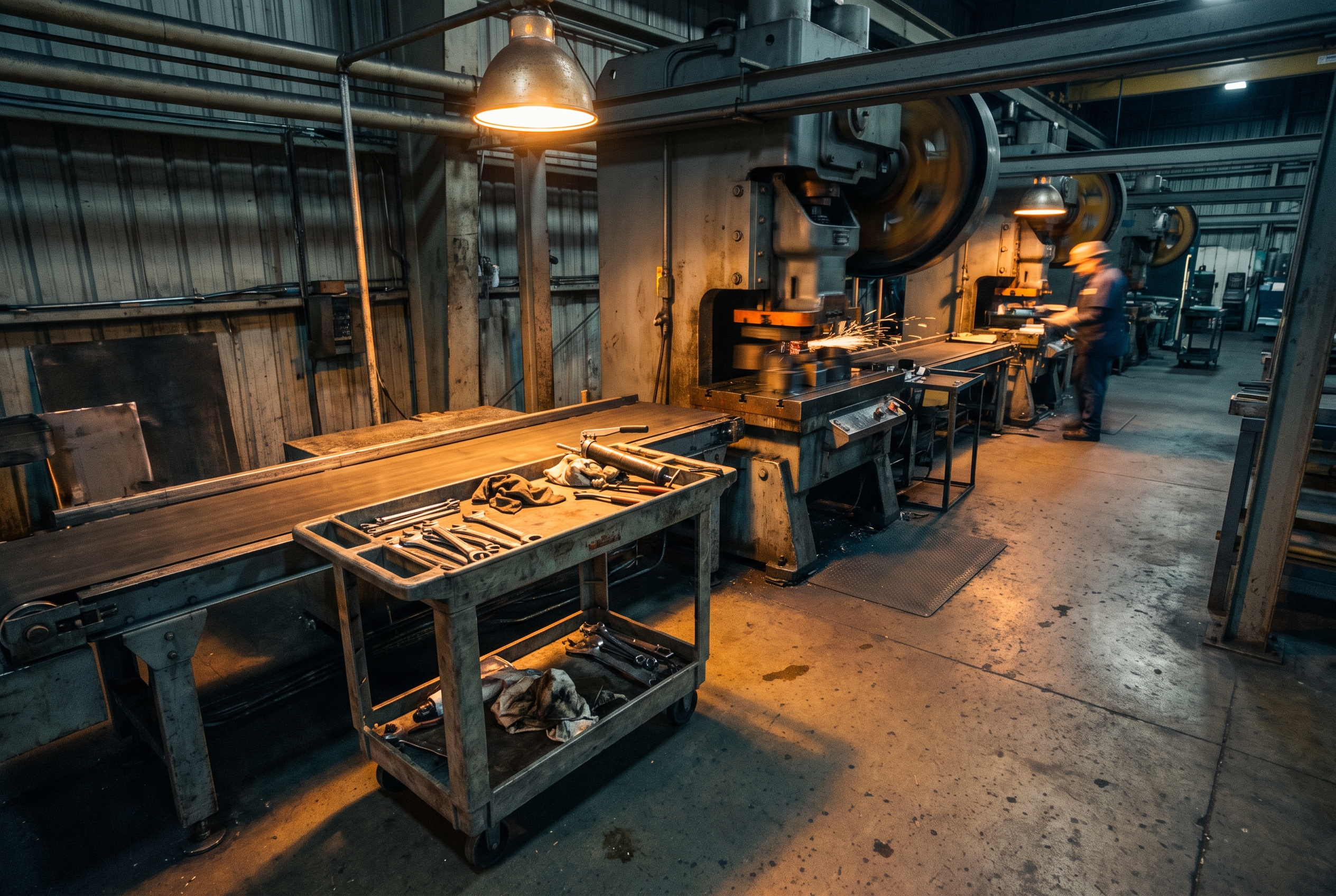
The best documented case in our research is old and comes from a single plant, so treat it as an illustration rather than a benchmark. In 2001, Material Handling & Logistics reported that after Cooper Tire's Texarkana plant went to 24/7 operation, preventive maintenance moved from every 30 days to every 24 because equipment was running an extra 36 hours a week. Core maintenance staff stayed on days, a skeleton crew covered the rest of the week, and the plant stocked pre-assembled replacement components so a failed unit could be swapped quickly instead of repaired in place. The plant's maintenance manager said continuous operation could raise production capability and profit margin by 40%, provided in-process inventory stayed low and processes were synchronized. That was one manager's claim for one plant.
The practical lessons still apply:
-
Recalculate PM intervals on runtime hours, not calendar days.
-
Pre-stage swap components for constraint assets so repairs happen off the line.
-
Decide explicitly who covers breakdowns on nights and weekends, and at what rate.
When PM must come out of production time, price it properly. Our free downtime cost calculator separates lost contribution margin from incremental recovery costs such as overtime, expediting and scrap. On a constrained asset running three shifts, lost contribution is usually the larger number, because there is no idle shift left to make up the volume.
Decision framework: overtime, third shift or capex
Use overtime when demand is short or uncertain. Given Nissan's record of cutting shifts, cancelling programs and dropping a powertrain within 18 months, overtime is the right first response until volume is committed in writing. It avoids per-head costs you cannot easily unwind. Cap it in hours per person per week so fatigue risk does not build up.
Add a third shift when the volume commitment outlasts the payback on hiring and training. The test:
Months to recover = (recruiting + training + ramp-up scrap and inefficiency) / (monthly overtime cost avoided - monthly third-shift cost)
If the result is longer than the volume commitment you can get in writing, stay on overtime. In the illustrative example above, the third shift costs more per week than overtime, so it never pays back on labor cost alone. It only makes sense once you put a price on fatigue, quality risk and the hard limit on overtime hours. That is a judgment, so make it explicitly.
Choose capex when one constrained asset is the risk. A second press, cell or tool set makes sense when a single asset running three shifts has no PM window left, or when the third-shift premium over the program life exceeds the equipment cost. The new asset still needs operators, so the savings are the premiums, not the full wage:
Payback months = (equipment + installation + PPAP and qualification) / (monthly third-shift or overtime premium avoided + monthly downtime risk avoided - monthly operating cost of added asset)
Count the qualification time. A second asset that takes most of a year to approve will not help with a launch that is a couple of months away.
What to ask Nissan purchasing before you commit
-
Volume and duration in writing. A capacity planning volume is not a release. Ask for the program volume and how long it runs, and what happens if it changes.
-
Hybrid timing. Is your part tied to US Rogue e-Power production, which Reuters says could begin as early as 2028, or to the imported launch? Hybrid-specific content should be staffed to the later date.
-
Capacity cost recovery. If you add a shift or equipment at Nissan's request, ask whether the piece price, a capacity payment or a volume guarantee covers it.
-
Tooling ownership. If a second tool set solves the constraint, find out who owns and pays for it, and what happens to it if the program is cut.
-
Program changes. Ask what Nissan will cover if the program changes again, as the Canton EV programs did.
Nissan's plan is sensible for Nissan: Meunier's no-new-factory approach gets more output from paid-for buildings. The risk is that the capital avoided at the OEM shows up at the supplier as differential-loaded overtime, a third crew hired for an unconfirmed volume, and equipment run without a maintenance window. Run the numbers with your own inputs and get the volume commitment in writing before you hire.
Related reading
-
How to Choose Predictive vs Preventive Maintenance for Each Asset
-
How Suppliers Should Plan Around the Stellantis Windsor Plant Shutdown
-
How to Find the Cost Crossover Between Binder Jetting and Metal Injection Molding
-
How to Answer a 30% Price-Down Letter Without Losing the Program
-
Ford Just Retired the Moving Assembly Line at Louisville — and Turned 146 Parts Into 2
Sources
-
Quartz via Yahoo Finance, Sept 21, 2026: Meunier's three-shift and no-new-factory quotes; roughly 1 million units vs. nearly 487,000 in 2025; Smyrna on two shifts
-
Automotive World: 80% localization target; Sept 28, 2026 Yokohama roundtable; Rogue PHEV production stopped
-
Just Auto, citing Nikkei Asia: 65% now, 40% before tariffs; Rogue, Pathfinder and Frontier at 55% of US sales
-
Reuters via Investing.com: Rogue e-Power launch timing; US production as early as 2028; hybrid share goal
-
Manufacturing Dive: 2025 shift cuts by line; 2025 headcounts
-
WLBT, May 1, 2026: Canton EV cancellation; body-on-frame candidate; 3,200 employees
-
BLS Employer Costs for Employee Compensation, Table 4, June 2026
-
US DOL Fact Sheet #23: Overtime Pay Requirements of the FLSA
-
Material Handling & Logistics, 2001: Install Maintenance Into Your 24/7 Schedule