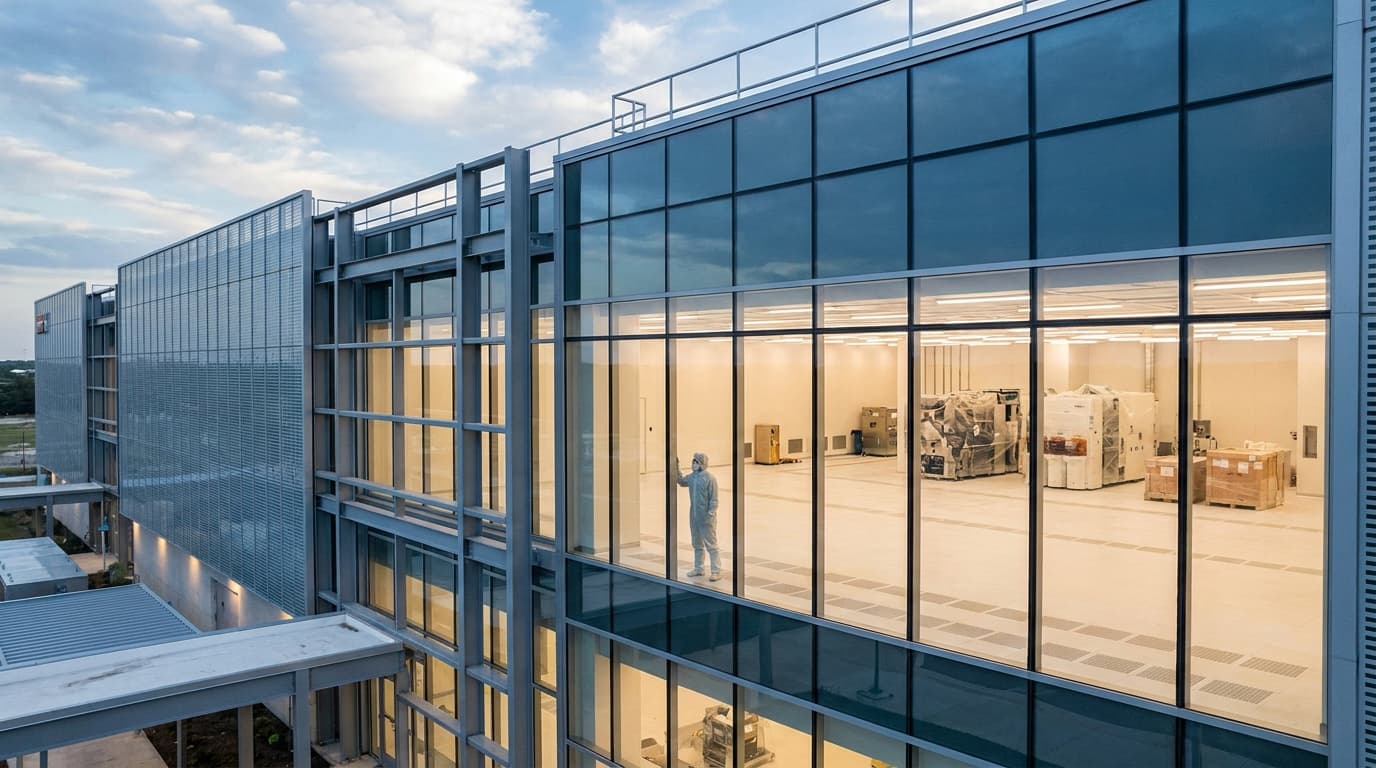
Samsung has quietly redrawn the finish line at its $44 billion megafab in Taylor, Texas. What was once billed as a 2026 "production start" has been recharacterized as "completing preparations for mass production" — pilot or risk production, not volume output. Full-scale 2nm-class manufacturing has slipped to early 2027. The distinction is more than corporate semantics: it marks the difference between a fab that is making chips for customers and one that is merely ready to.
The more important point for operators is why it slipped. According to reporting from Nikkei Asia, Korea JoongAng Daily, and ET News, the delay was not driven by construction setbacks or yield problems. It was driven by demand. With the building shell substantially complete, Samsung held off on moving in its most expensive equipment because it lacked the committed customer volume to justify the spend. The order book, not the groundbreaking, has become the gate.
What Actually Slipped
The Taylor timeline has a long history of moving to the right. The site was originally targeted for roughly 2024 output, then 2025, then the second half of 2026, and now early 2027 — a multi-year pattern that has tracked client commitments more closely than build progress.
The latest reframing matters because of what "production start" actually means in foundry terms. A leading-edge ramp moves through stages: tool installation, pilot runs, risk production (limited volume to qualify the process), and finally high-volume mass production. By relabeling the end-2026 milestone as "completing mass-production preparations," Samsung effectively moved the meaningful event — customers running real volume — into 2027, while keeping a 2026 checkpoint on the calendar. As TrendForce summarized in March 2026, citing Korea JoongAng Daily and ET News, the slip pushes mass production to 2027 and raised concerns for the fab's most exposed customer.
The Real Cause: The Order Book, Not the Building
The Taylor project is enormous in scope: two fab modules, an advanced packaging line, and an R&D center, targeting roughly 50,000 wafer starts per month — Samsung's largest planned logic site. The node is SF2-class (2nm, gate-all-around), and the fab is slated to be the company's first to deploy EUV pellicles at production scale, a departure from its prior pellicle-free approach.
None of that was the bottleneck. The bottleneck was committing the capital to fill the building with wafer-fab equipment. With the shell finished in late 2024 to early 2025, Samsung delayed installing costly tools amid uncertainty over node strategy, volume demand, and — most pointedly — the absence of a big-ticket anchor customer. Nikkei Asia's origin reporting framed it bluntly: Samsung was "not in a situation where it can bring equipment in" without committed orders. Tom's Hardware, citing the same Nikkei and Korea JoongAng reporting, characterized the halt as a function of there being "no customers," and Engadget independently confirmed the demand-driven framing for a general audience.
This is the inverse of how most observers narrate a fab delay. The building was ready; the demand was not.
Tesla as the Pivot
The customer most exposed to the timing was Tesla. Samsung Foundry is set to produce Tesla's AI5 and AI6 chips at Taylor, and Elon Musk has estimated the AI6-through-2033 arrangement at more than $16 billion. According to Tom's Hardware's technical account, it was precisely this kind of large, durable commitment that resolved the volume uncertainty and justified bringing tools in — converting Taylor from stalled to "preparing for 2027."
By June 2026, Samsung was publicly reaffirming the schedule and pushing back on the "delay" narrative. Samsung Foundry VP Margaret Han said at the SAFE Forum on May 28, 2026 that customers begin production at Taylor in 2027, and TrendForce reported the company reframing the project around a 2027 customer-production target. The disagreement over the word "delay" is real, but the underlying mechanism is not in dispute: the equipment buildout waited on the order book, and the order book arrived with Tesla.
The TSMC Arizona Mirror
The cleanest way to see what happened at Taylor is to hold it against TSMC's Arizona project, which runs on the same CHIPS-era incentives and targets the same leading-edge generation for roughly 2027 output — but faces the opposite demand reality.
TSMC Arizona has been in volume production since late 2024 on 4nm/5nm. Rather than slipping, it is installing 3nm tools (Fab 21 Phase 2) in Q3 2026 to begin production in 2027 — several quarters ahead of the original 2028 plan — and explicitly cites strong customer demand as the reason. TSMC's total planned U.S. investment stands at $165 billion, backed by [up to $6.6 billion in CHIPS Act direct funding](https://pr.tsmc.com/english/news/3122) and a third Phoenix fab, with the company pointing to "strong customer demand" as the rationale for the expansion.
Same incentives. Same leading-edge ambition. Same ~2027 horizon. The divergence is demand: TSMC demand-pulled its ramp forward, while Samsung was demand-constrained into a slip.
Why This Is a Foundry-Economics Story
The lesson here is not about Texas construction crews or Korean engineering. It is about the capital structure of leading-edge manufacturing. EUV-class tools are too expensive to install on speculation. Moving them in, installing them, and qualifying a 2nm process flow represents an enormous outlay that produces nothing until customers run wafers through it. A foundry that installs that capacity without an order book is converting cash into the single most expensive form of idle asset in manufacturing: idle EUV capacity.
That reframes how to read every U.S. leading-edge announcement. The groundbreaking and the building shell are necessary but no longer the binding constraint. The binding constraint is committed volume — the order book that justifies tool installation. Viability at the leading edge in the United States is increasingly a customer-commitment problem, not a construction one.
Open Questions
Several questions remain for anyone tracking Taylor's economics. Whether Tesla's volume alone is sufficient to fill the targeted ~50,000 wafer starts per month is unclear; a fab anchored to a single large customer carries concentration risk that a diversified order book would not. The timing of the second fab module, the conditions attached to CHIPS-era subsidies, and what happens to the ramp if a single anchor customer's roadmap shifts are all unresolved. For now, the Taylor story stands as a clean case study: in U.S. leading-edge manufacturing, the order book — not the building — sets the schedule.
Related reading
-
The $1.77 Trillion Reshoring Boom Isn't Showing Up in the Concrete
-
[Micron Breaks Ground on Clay, NY Megafab — and the Onondaga Workforce Pipeline Is Counting Graduates in Dozens](/article/micron-clay-megafab-groundbreaking-onondaga-workforce-gap)
-
Wolfspeed's Mohawk Valley SiC Fab Is Ramping Just as the Market It Was Built For Cools
Sources
-
Samsung delaying completion of US chip plant due to lack of customers (Nikkei Asia)
-
Samsung's Texas chip plant is reportedly delayed due to lack of customers (Engadget)
-
Samsung Accelerates U.S. Expansion as Taylor Fab Targets 2027 Start (TrendForce)
-
[TSMC Arizona and U.S. Dept. of Commerce Announce up to $6.6B in CHIPS Act Direct Funding; Third Phoenix Fab Planned (TSMC)](https://pr.tsmc.com/english/news/3122)