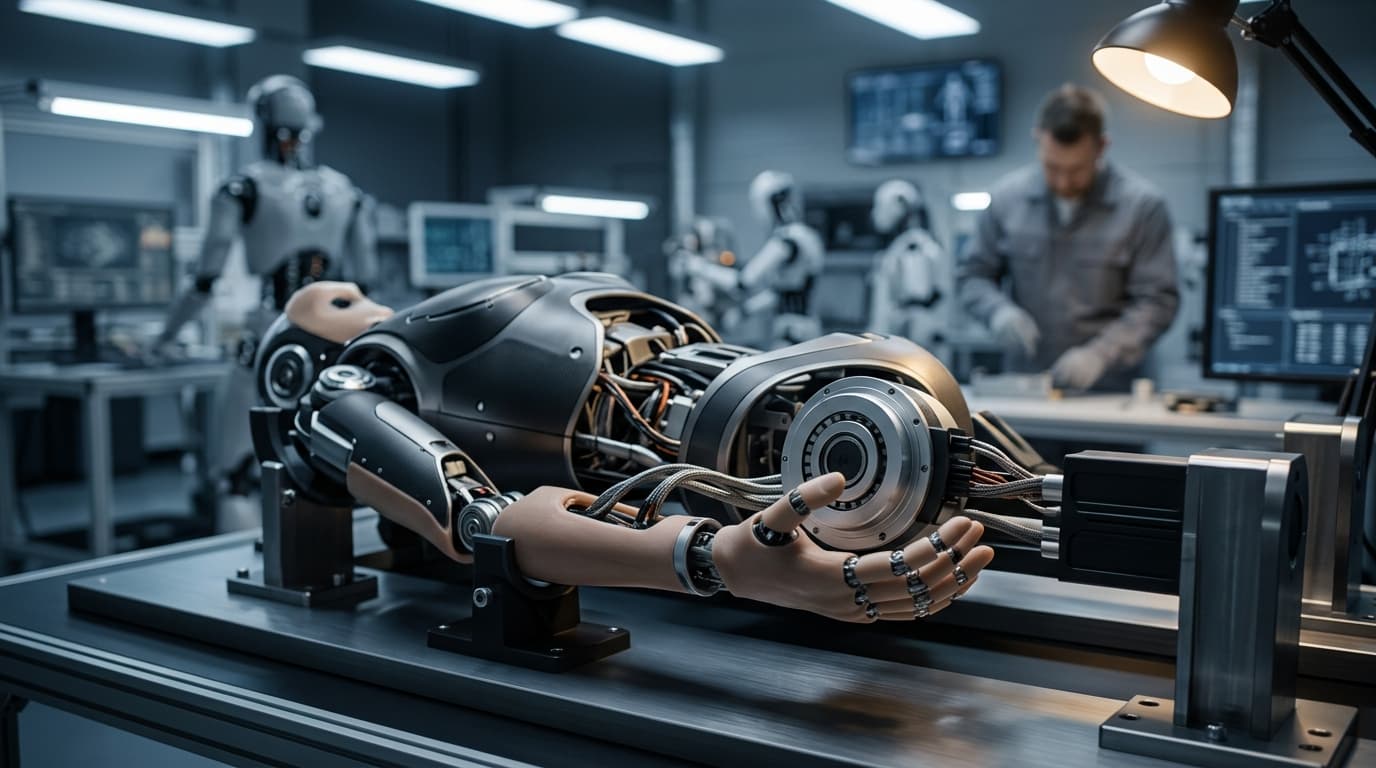
The headline number — a four-digit fleet of humanoid robots inside one of Germany's largest motion-technology suppliers — is the least interesting part of the agreement Schaeffler and London-based Humanoid signed on May 13, 2026. Two structural details matter more. First, Schaeffler is not buying the robots; it is subscribing to them. Second, the company supplying the robots has also signed Schaeffler up to manufacture the joints those robots move on. A Tier 1 customer just folded itself into the supply chain of the machine it is renting.
Strip away the science-fiction framing and what is left is a procurement decision and a sourcing decision, each of which is more consequential for how factories will actually adopt humanoids than the robot count itself.
What was actually signed
The May 13 deal is a binding, phased agreement that bundles two distinct transactions. The first is a deployment: a four-digit number of wheeled HMND humanoids across Schaeffler's global facilities by 2032, with Reuters estimating roughly 1,000 to 2,000 units. The first systems are scheduled to go live at Schaeffler sites in Germany by the end of 2026.
The second is a reciprocal, five-year supply agreement that runs in the opposite direction — Schaeffler selling components back into the robots. Together the two halves convert what had been a loosely framed strategic intent into specific, binding terms.
That distinction matters because the two companies had already announced a partnership earlier in the year. On January 13, 2026, Schaeffler and Humanoid disclosed an initial strategic partnership framed around "hundreds of robots," joint development of next-generation actuators, and a Robot-as-a-Service model penciled in for a later "gamma" phase. The May agreement scales that intent to thousands of units, fixes the commercial structure, and makes the commitments binding.
From a capex line to an opex contract
Under the deployment, Schaeffler does not take ownership of the hardware. It pays for the robotic systems plus a service bundle: connection to fleet-management software, maintenance, 24/7 technical support, software updates, and ongoing performance management. This is the Robot-as-a-Service model the two firms had flagged in January, now committed.
The accounting consequence is the real story. A purchased robot is a capital asset that lands on the balance sheet, gets depreciated over years, and carries obsolescence risk — a problem in a category where the underlying autonomy software is improving on a quarterly cadence. A subscribed robot is an operating expense: a recurring line item that can be scaled up or down and that does not strand capital if a newer model supersedes it.
That re-prices both the return calculation and the risk allocation. Schaeffler offloads the uptime, reliability, and software-maintenance burden onto the vendor, whose revenue now depends on keeping the fleet performing rather than on closing a one-time sale. For operators evaluating humanoids, the question shifts from "can we justify the capital outlay against an uncertain payback?" to "does the per-period service cost beat the labor and throughput it displaces?" — a far easier number to underwrite, and one that lowers the barrier to a first deployment.
The customer that builds the joints
The reciprocal half of the deal is where the structure turns genuinely unusual. The same five-year agreement makes Schaeffler the preferred supplier for more than 50% of Humanoid's joint-actuator demand for its wheeled platforms through 2031, a commitment expected to translate into a seven-digit number of actuators.
The industrial logic is straightforward once you look at what a humanoid actually costs. The joint actuator — the precision motor-and-gearing assembly that gives each joint its motion — is the dominant cost driver and the principal reliability bottleneck in a humanoid robot. Schaeffler's core business is exactly this: bearings, precision motion components, and the high-volume manufacturing discipline that turns them out at scale and consistent quality. A robotics startup buying actuators from a motion-technology Tier 1 is buying down its own biggest unit-cost and quality risk.
But the template it establishes is the notable part. The customer is becoming the critical-component vendor. Schaeffler is simultaneously the buyer of a robot fleet and the supplier of the most important parts inside those robots. That vertical entanglement gives the supplier a direct hand in the cost curve and reliability of the very machines it is deploying on its own floors — and it hints at how incumbent industrial firms may insert themselves into the humanoid value chain rather than simply purchasing from it.
A German industrial cluster around a UK startup
Schaeffler is not the only German giant wrapped around Humanoid. Separately, Bosch acts as Humanoid's contract manufacturer for the European market and plans to integrate Bosch actuators, drives, and sensors into future versions of the robot. The two completed a proof-of-concept autonomous box-handling demonstration at a German Bosch facility in March 2026.
Stack the relationships and a pattern emerges: a startup founded in 2024 in London has assembled a manufacturing and component base across two of Germany's largest industrial suppliers. Bosch provides contract manufacturing and components; Schaeffler provides actuators and a marquee deployment customer. For Humanoid, that is production capacity and a reference account without building either from scratch. For the German firms, it is a low-risk way to take a position in humanoid robotics — as suppliers, manufacturers, and customers — without funding a robotics program of their own.
Deployment specifics and the path to scale
The initial phase runs from December 2026 through June 2027 at two German Schaeffler sites. At Herzogenaurach, the robots take on box-handling in a live production environment. At Schweinfurt, the rollout is split: a roughly three-month capability demonstration and integration-testing period, followed by a roughly three-month on-site phase aimed at validating stable, continuous operation near full production scale.
That phasing is a tell. The Schweinfurt structure — demonstrate, then prove sustained near-production operation — is the gate that separates a pilot from a fleet commitment, and it is where the four-digit 2032 target will be confirmed or quietly walked back.
Humanoid's broader roadmap targets a Beta stage in late 2026, a Gamma stage in 2027, and the start of mass production in 2028. On reliability, the company is targeting a 95% autonomous success rate initially, progressing toward 99.5%. The gap between those two figures is the gap between a robot that needs frequent human intervention and one that can run a shift on its own — and closing it is the central technical risk in the entire program.
Context and caveats
Several caveats temper the scale. The robots are still maturing: the deal is anchored to a beta-stage platform, the HMND 01 wheeled mobile manipulator, and the deployment timeline assumes Humanoid hits its autonomy and integration milestones on schedule. The Schweinfurt validation phase exists precisely because that is not yet proven at production scale.
Humanoid's own profile adds risk and ambition in equal measure. The company is London-based, founded in 2024 (originally as SKL Robotics Ltd.), and runs a team of roughly 175 with hires drawn from Apple, Tesla, Google, Boston Dynamics, Sanctuary AI, and Nvidia. It is founder-funded and has reported ambitions to pursue a US IPO. A founder-funded startup committing to deliver thousands of units and supply seven figures' worth of actuator demand over a multi-year horizon is making promises that depend on capital and execution it has not yet fully demonstrated.
Anyone reading the May announcement should also keep it separate from the January one. The earlier partnership was the framing; the May deal is the contract. Conflating "hundreds" with "thousands," or treating the RaaS structure as new when it was telegraphed in January, misreads what changed — which is specificity and bindingness, not the existence of the relationship.
Why manufacturers should care
Two signals are worth tracking even for operators with no humanoid on their roadmap. The first is the actuator commitment. A seven-digit, multi-year order for precision joint actuators routed through an established Tier 1 is a leading indicator of where humanoid economics are heading: it implies enough confidence in volume to justify locking a major supplier into the supply chain. Watch actuator order books, not press-release robot counts, for the real demand signal.
The second is the procurement model. Robot-as-a-Service moves factory automation from a capital decision made once to an operating contract revisited continuously, and it shifts performance risk onto the vendor. If the Schaeffler deployment validates that structure at scale, expect it to spread beyond humanoids to automation procurement broadly — and expect more incumbent component suppliers to do what Schaeffler did here: deploy the technology and supply it at the same time.
Related reading
Sources
-
[Humanoid Secures Landmark Deal with Schaeffler to Deploy Thousands of Humanoid Robots](https://thehumanoid.ai/humanoid-secures-landmark-deal-with-schaeffler-to-deploy-thousands-of-humanoid-robots/) — Humanoid official press release (primary source for the May 13, 2026 deal terms).
-
Schaeffler and Humanoid enter strategic technology partnership — Schaeffler Group press release.
-
[Schaeffler to deploy hundreds of Humanoid robots in its factories](https://www.therobotreport.com/schaeffler-humanoid-partner-build-deploy-hundreds-robots/) — The Robot Report, January 13, 2026 (the earlier partnership).
-
Humanoid partners with Bosch, Schaeffler to scale robot production — The Robot Report (company background and the Bosch tie-up).
-
Humanoid Secures Landmark Deal with Schaeffler to Deploy Thousands of Humanoid Robots — RoboticsTomorrow (trade-press coverage of the May 13 announcement).
-
U.K.-based startup Humanoid unveils HMND 01 Alpha mobile manipulator — The Robot Report (background on the HMND 01 platform).