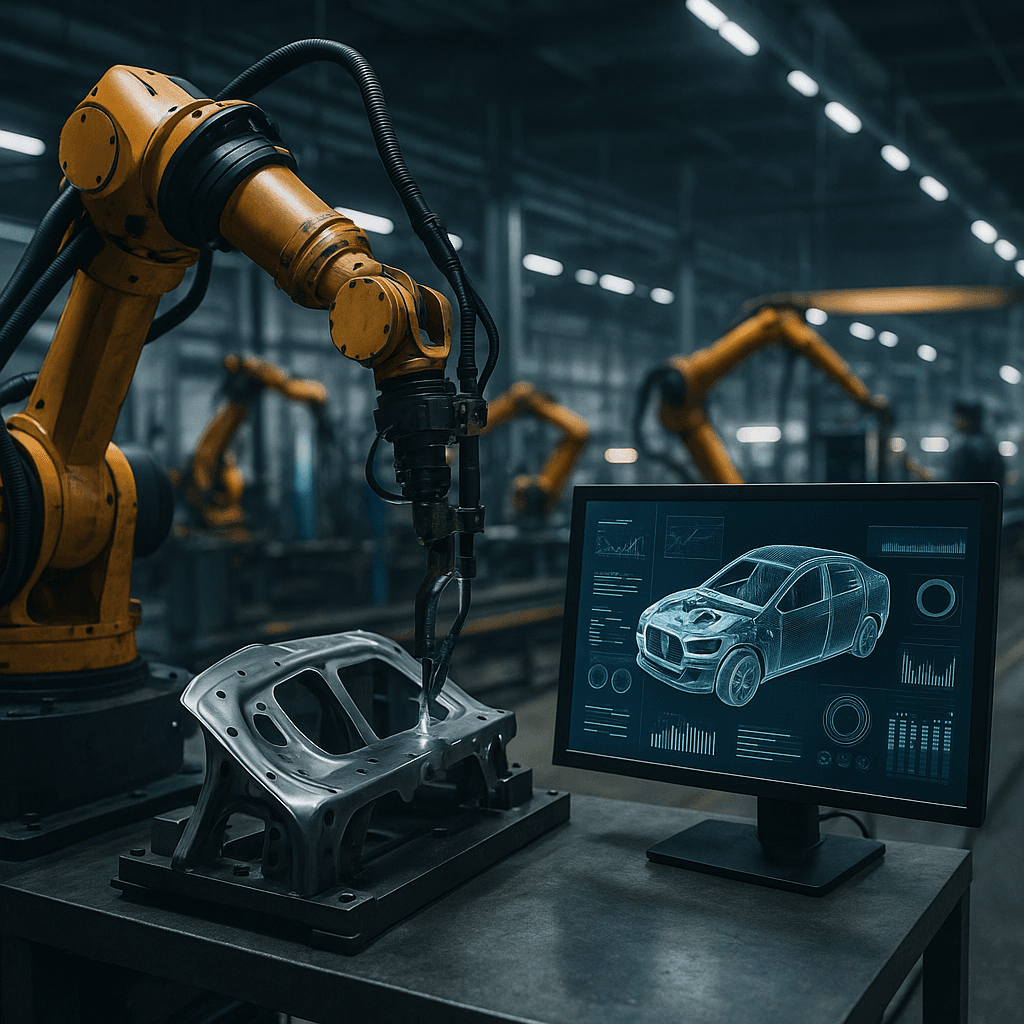
On May 18, 2026, Stellantis and Accenture announced plans for a strategic partnership to build AI-enabled industrial digital twins across Stellantis's manufacturing footprint, using NVIDIA's Omniverse libraries and accelerated computing alongside Accenture's digital-manufacturing and "physical AI" practice. Read the release the way a plant manager reads a capital request and two things stand out. First, what was announced is "plans for" a partnership — not a signed contract, not a closed deal. Second, for an announcement about manufacturing performance, it contains no manufacturing numbers: no overall equipment effectiveness (OEE) target, no scrap-rate goal, no unplanned-downtime figure, no cost case. The work begins as pilots at selected North American plants in 2026, after which the companies say they will assess whether to scale across the network.
The operator's question is not "is it ambitious"
The named scope is credible on its face: closed-loop optimization between the virtual and physical line, agentic orchestration for dynamic throughput, physics-informed predictive quality and maintenance, and pre-deployment process validation before tooling is committed. Those are the right verbs. But ambition is not the question an operator should ask. The question is narrower and harder: which of these numbers — throughput, scrap, unplanned downtime, and the OEE they roll up into — have deployments like this historically moved, on what timeline, and at what integration cost? An announcement that names use cases but discloses no baseline and no target is, for now, a statement of intent rather than a performance commitment.
Why this lands now: a turnaround, not a tech showcase
Context changes how to read it. Stellantis's full-year 2025 results show a net loss of €22.3 billion on €25.4 billion of charges, net revenues of €153.5 billion (down 2%), and industrial free cash flow of negative €4.5 billion. The 2026 dividend is suspended, the board authorized up to €5 billion in hybrid bonds, and CEO Antonio Filosa has guided that free cash flow is not expected to turn positive until 2027. An AI digital-twin program launched into that backdrop is not a discretionary innovation budget — it is a cost-and-quality turnaround lever under capital discipline. That cuts both ways: it raises the bar for demonstrable ROI, and it raises the temptation to over-claim early wins against a P&L that badly needs a story.
It also complicates attribution. Stellantis already reports quality progress that predates this partnership: first-month-of-service issues fell more than 50% in North America and more than 30% in Enlarged Europe in 2025, driven by existing quality and total-productive-maintenance work. Any quality gain claimed for the AI program in 2026–2027 will have to be separated from that ongoing trend line, not layered on top of it rhetorically.
What "AI-driven manufacturing" has actually delivered elsewhere
The closest automaker benchmark is BMW's NVIDIA Omniverse "Virtual Factory." Per BMW Group, the stated value is up to a 30% reduction in production planning costs — explicitly labeled "projected" — across 30-plus sites and 40-plus vehicle launches through 2027. The concrete, realized example is narrower and more honest: collision checks that used to take roughly four weeks of physical testing now take about three days in simulation. That is a real and valuable result. It is also a planning and industrialization-phase result. It compresses the time and cost of bringing a line up — not the real-time OEE of a line already running at volume. The distinction matters because Stellantis's announcement gestures at the latter (agentic throughput orchestration, predictive maintenance on live equipment) while the comparable evidence base is strongest on the former. Faster validation and cheaper launch are the documented payoff; a step-change in running-line throughput is not.
For the underlying capability set — photoreal real-time twins, robot and vision-AI pre-deployment testing — NVIDIA's own Omniverse Enterprise case studies describe what the stack is designed to do. Useful for understanding the technology; not a source of outcome claims, since it is the vendor's.
The under-delivery pattern is the base rate
Industrial-AI programs under-delivering versus the press release is not the exception — it is the norm. McKinsey's 2025 manufacturing COO work, "From pilots to performance," finds only about 2% of companies have AI fully embedded across operations, with roughly two-thirds still in exploration or targeted implementation. "Pilot purgatory" is the default outcome of a pilot, not a risk on the margin.
And the failure mode is specific. As analysis of digital-twin failures lays out, a large majority of digital-twin projects fail to return ROI because of the data layer, not the AI model. The canonical failure is a twin that cannot pull real-time data from the manufacturing execution system (MES) or write work orders back into the CMMS — a beautiful simulation with no live connection to the floor it is supposed to optimize. The cautionary archetype is a UK automotive paint-shop twin shelved after roughly £1.8 million, defeated by integration, not by math. MES, ERP, and IoT data standardization is the binding prerequisite; everything Omniverse renders sits downstream of it.
The OEE reality check
Hold the program to the metric operators actually budget against. Per Evocon's cross-country OEE benchmarks, automotive assembly and stamping average roughly 70–75% OEE; "world-class" is about 85–90%; only around 6% of manufacturers clear 85%. The typical path to 85% takes 12–24 months and depends on disciplined TPM plus real-time loss visibility — not on a model alone. Against that, the credible year-one outcome of an AI-assisted program is low-single-digit OEE points on selected lines, plus industrialization-time savings of the BMW "four-weeks-to-three-days" variety. A 65-to-85 leap inside twelve months would be an outlier against every benchmark in the reference set; readers should treat any such claim as a flag, not a result.
The prerequisites that decide the outcome
What separates the BMW-style win from the £1.8M write-off is unglamorous and known in advance:
-
Data standardization across MES/ERP/IoT — the twin is only as live as the systems it reads.
-
Closed-loop write-back — optimization that flows back into execution and maintenance systems (work orders, schedules), not a dashboard that humans must re-key.
-
Scope discipline — start with data that already exists and a single use case with a defensible ROI, rather than a network-wide twin built before one line has paid back.
-
Honest attribution — separate AI-attributable gains from the existing TPM and quality trend already lowering Stellantis's first-month defect rates.
A scorecard for readers
This announcement is, today, a plan without a number. That is not damning — early-stage partnerships often are — but it sets the terms for judging it. Watch for four things as the 2026 pilots run:
-
Named pilot plants. Specific North American sites, not "selected facilities," signal a real deployment plan.
-
A published baseline and target. A stated current OEE (or scrap/downtime) and a committed delta is the difference between a program and a slogan.
-
Integration milestones. MES read and CMMS write-back going live is the leading indicator; rendering quality is not.
-
"Realized" versus "projected." Track the exact word attached to every figure. BMW's most-cited number is "projected"; its most credible one (four weeks to three days) is realized. Apply the same test to Stellantis.
The realistic year-one read: process validation and lower planning and industrialization cost are achievable and worth doing, especially for an automaker rebuilding cash flow. A measurable step-change in running-line throughput is not the likely 2026 outcome, and the financial pressure that makes this program attractive is the same pressure that makes its early claims worth reading skeptically.
Related reading
Sources
-
Stellantis and Accenture Announce Plans for a Strategic Partnership to Advance AI-Driven Manufacturing with NVIDIA — Accenture Newsroom
-
Stellantis Full Year 2025 Results — Stellantis
-
BMW Group scales Virtual Factory — BMW Group PressClub
-
From pilots to performance: How COOs can scale AI in manufacturing — McKinsey
-
Why Digital Twin Projects Fail and How to Fix the Data Layer — Context-Clue
-
World-Class OEE: Industry Benchmarks From 50+ Countries — Evocon
-
Paving the Future of Factories with NVIDIA Omniverse Enterprise — NVIDIA (background)