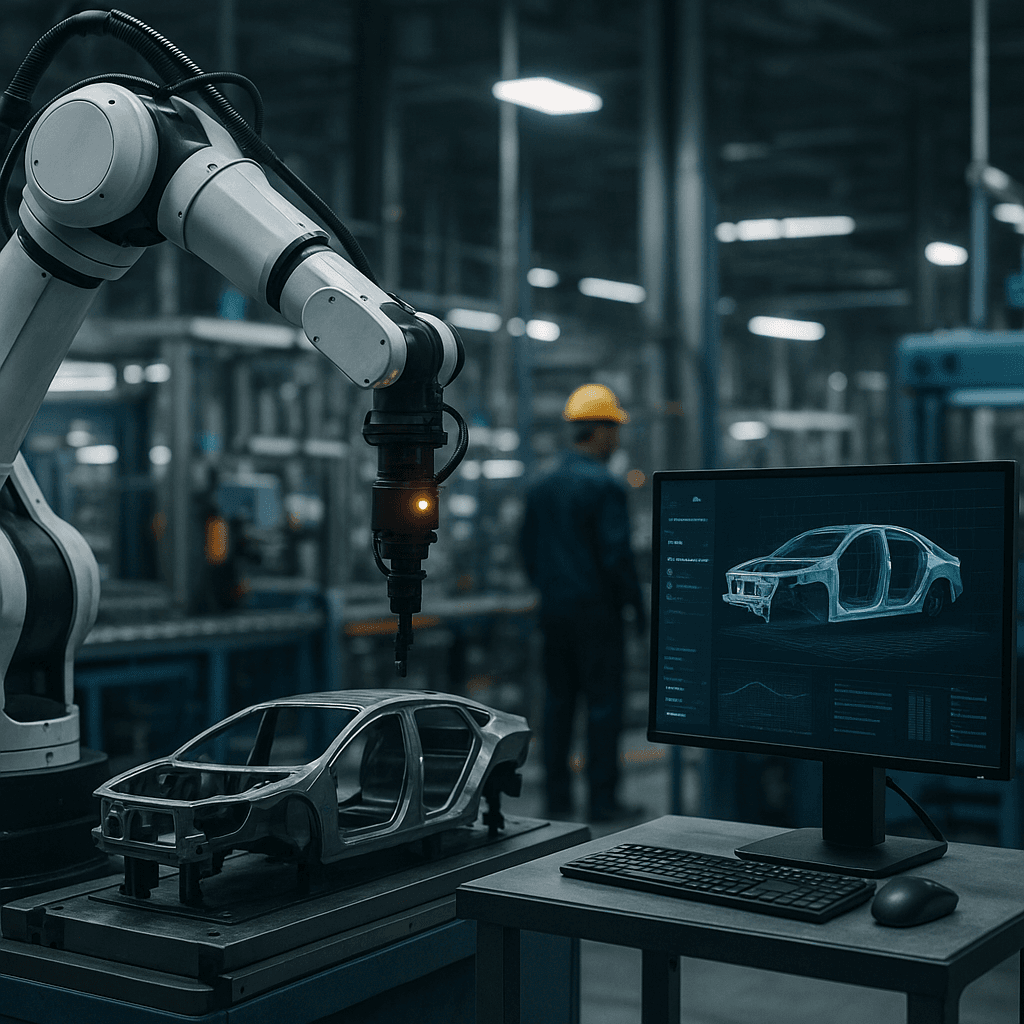
On May 18, 2026, Stellantis and Accenture announced plans for a strategic partnership to scale AI-enabled digital twins across Stellantis' global manufacturing footprint, built on NVIDIA accelerated computing and Omniverse simulation libraries. The easy read is "another automaker adopts AI." That read misses what operators should actually take from this.
The more useful framing: a volume OEM has publicly named a systems integrator (Accenture) and a GPU and simulation vendor (NVIDIA) as the architects of the closed-loop layer that will orchestrate its plant floor. The capabilities being described — virtual plant replicas, closed-loop optimization, and "agentic orchestration for dynamic throughput optimization" — do not sit in a swappable box bolted onto a line. They sit in the coordination layer itself. That is a different category of dependency than buying a sensor or a vision camera, and it is the part worth pressure-testing before anyone copies the template.
One caveat up front, because it governs everything below: this is announced as plans and pilots, not a signed multi-year manufacturing-execution outsourcing contract. The releases use exploratory language — "explore the development of next-generation virtual manufacturing environments." Treat the strategic conclusion as a thesis to test, not a settled fact.
What was actually announced — and what is inference
Here is what the two primary releases — Stellantis Media and the Accenture newsroom — actually state:
-
The role split. Stellantis brings industrial expertise and global manufacturing footprint and scale. Accenture brings physical-AI and digital-manufacturing capabilities plus integration and implementation. NVIDIA brings accelerated computing and Omniverse simulation libraries.
-
The stated capabilities. High-fidelity virtual plant replicas (digital twins); closed-loop optimization where virtual and physical systems continuously inform each other; agentic orchestration for dynamic throughput optimization; physics-informed quality and predictive maintenance; and validating processes virtually before physical deployment to reduce industrialization risk.
-
The deployment scope. Pilots in selected plants starting in North America in 2026, framed as a foundation to assess value creation and scalability across the broader network. No total plant count was given.
-
The omissions. No financial terms, no investment figure, and no named pilot plants. Francesco Ciancia, Head of Manufacturing at Stellantis, is quoted on "rethinking how we design, operate and continuously improve our production systems"; Tracey Countryman, Supply Chain and Engineering Global Lead at Accenture, is the named Accenture executive.
Now the line operators must not blur. Neither primary release says who owns or operates the resulting execution and orchestration stack, and neither mentions Tier 1 suppliers. The argument in this article — that the durable value migrates into an orchestration layer co-architected by an SI and a single simulation platform, creating integrator-dependency and lock-in — is analytical inference. It is the right question to ask. It is not a quoted fact, and you should hold it as a hypothesis to interrogate, not a disclosure to react to.
Where the capex actually lands
Digital-twin programs do not spend like line-retooling programs. The money concentrates in compute, data infrastructure, simulation environments, and integration labor — not in physical conveyors, fixtures, and robots. That changes the shape of the investment and where the recurring cost sits.
The upside is real and is the reason the template is spreading. The stated objective — validate processes virtually before committing physical capital — attacks one of the largest sources of waste in industrialization: changes discovered after steel is cut. An industry comparable cited in a 2026 digital-twin playbook is PepsiCo's Siemens/NVIDIA digital-twin work, where the company publicly estimated roughly a 10–15% capex reduction by validating designs virtually before committing capital. That is a defensible payback narrative for a Stellantis-scale footprint, where a single avoided line redesign is a material number.
But notice the structural fact underneath the spend. The simulation substrate is NVIDIA Omniverse, and the integrator layer increasingly sits on top of it. Siemens' Digital Twin Composer is built on NVIDIA Omniverse, and per industry coverage, BMW, Mercedes-Benz, and Jaguar Land Rover already run factory and vehicle digital twins on Omniverse. The integrator-on-GPU pattern is now standardized across the sector. Standardization lowers integration risk — and concentrates platform dependency at the same time.
The lock-in is in the orchestration layer, not the cameras
Closed-loop, agentic orchestration is, by design, the sticky part. A point solution observes a machine and emits an alert; you can rip it out and the line still runs. An orchestration layer that continuously reconciles a virtual plant against the physical one and adjusts throughput is woven into how the factory makes decisions. Once production planning, quality gating, and maintenance scheduling route through that layer, the cost of leaving it is not a license cancellation — it is re-architecting how the plant runs.
If the design and integration of that layer are owned by a systems integrator sitting on a single simulation platform, the dependency runs in two directions at once: on the SI's integration knowledge and on the platform's runtime. For a company the size of Stellantis, with Tier 1 suppliers whose processes may eventually be modeled inside the same twins, the questions that decide the five-year outcome are not technical capability questions. They are ownership questions:
-
IP and model ownership. Who owns the trained models, the plant topology, the process parameters, and the optimization logic — Stellantis, or the integrator?
-
Data portability. Can the twins, telemetry, and learned models be exported in a usable form and re-hosted, or are they effectively captive to the platform?
-
Exit cost. What does it cost — in time, integration hours, and production risk — to operate the orchestration layer without this specific SI, or off this specific simulation substrate?
-
Tier 1 exposure. If supplier processes are co-modeled, whose contractual environment governs that supplier data?
None of these are answered by the announcement. That is precisely why the announcement is interesting.
The margin pool moves toward the integrator
Execution-stack programs and point-solution licenses distribute value differently. A licensed point solution caps the vendor's claim at a fee you can re-tender. An execution-stack program embeds the integrator in the orchestration layer, where the recurring work — tuning, extending, re-validating, scaling plant to plant — is continuous and specialized. That recurring integration demand is the margin pool, and it accrues to Accenture-type SIs over the life of the program, not in a one-time installation.
This is not an argument against the deal. It is an argument for being clear-eyed that the structure transfers a recurring share of manufacturing value to the integration layer in a way a swappable license does not — and for pricing that into the business case before scaling.
The divergence: bounded modalities carry lower strategic risk
The cleanest way to see what makes the Stellantis model different is to contrast it with two industrial-AI businesses that deliberately stay narrow.
Augury raised $75 million — the first tranche of an approximately $100 million Series F — at a $1B+ valuation, led by Lightrock, in February 2025. Its product is AI machine-health sensing: vibration, sound, and temperature analyzed for fault detection. It is explicitly scoped to predictive maintenance and is separate from plant-floor execution or digital-twin orchestration. Customers include PepsiCo, Nestlé, and DuPont, with a Baker Hughes partnership. The vendor owns a narrow, well-bounded slice; if you replace it, the factory's decision logic is untouched.
Cognex OneVision is a cloud-to-edge AI vision platform — beta in June 2025, general availability on May 13, 2026, with 100+ customers. Models are trained and governed in the cloud; inspection runs at the edge. It is scoped specifically to visual quality inspection and is described explicitly as not a complete manufacturing execution system. Customer-reported outcomes include up to 50% lower scaling cost and doubled yield in a Schneider Electric case. Again: bounded modality, low strategic lock-in.
The contrast is the whole point. Augury and Cognex own a narrow function with a clean seam around it; the buyer keeps the orchestration layer. The Stellantis program, as described, puts the orchestration layer itself into a partnership. Bounded point solutions can be swapped; an embedded execution stack is a strategic commitment. Both can be the right call — but they should be evaluated on entirely different risk axes, and operators conflate them at their peril.
An operator playbook before you copy the template
For operators tempted to replicate this — and many will be, because the validate-before-you-build logic is sound — a disciplined version of the same move:
-
Demand throughput and first-pass-quality metrics from the pilot, not narrative. The stated benefit is dynamic throughput optimization and physics-informed quality. Gate scale-up on measured throughput and first-pass yield deltas against a real baseline, plant by plant.
-
Separate the substrate decision from the integrator decision. Standardizing on a simulation platform can be rational; outsourcing the orchestration design on top of it is a distinct decision with distinct exit economics. Decide each on its own merits.
-
Write the guardrails into the contract before the pilot, not after. Model and data IP ownership, export rights in a usable format, and a defined exit path — including the cost to run the layer without this SI — belong in the agreement while you still have leverage.
-
Set a payback window and hold it. Using the PepsiCo-class 10–15% capex-reduction comparable as a sanity check, a credible program should show line-of-sight to payback within roughly two to three years on the avoided-capex and throughput case. If the model only pencils on soft benefits, treat that as a signal, not a rounding error.
-
Pressure-test the Tier 1 question early. If supplier processes will eventually be modeled, resolve data governance and ownership before, not after, the network scales.
Bottom line
The Stellantis–Accenture–NVIDIA template may well be sound. Validating production virtually before committing physical capital is one of the few industrial-AI theses with a clean economic argument behind it. But the news worth acting on is not the digital twins. It is that a volume automaker is building its plant-floor orchestration layer with a systems integrator and a single simulation platform — and the announcement is silent on who owns that layer.
That silence is the question to settle before replicating the model: not whether the technology works in a pilot, but who owns the orchestration layer five years out, and what it costs to leave.
Related reading
Sources
-
Stellantis and Accenture Announce Plans for a Strategic Partnership to Advance AI-Driven Manufacturing with NVIDIA — Accenture Newsroom (primary, corroborating)
-
Augury raises $75M at $1B+ valuation for AI to detect malfunctions in factory machines — TechCrunch (divergence contrast)
-
Cognex OneVision Adoption Ramps as Manufacturers Scale AI Vision Globally — PR Newswire (divergence contrast)
-
Siemens unveils Digital Twin Composer, built on NVIDIA Omniverse — Siemens Newsroom (background)
-
What is NVIDIA Omniverse and How Will It Affect U.S. Manufacturing — A3 / Automate.org (background)
-
The Digital Twin Playbook: How Manufacturers Are Unlocking Hidden Capacity and Reducing CAPEX in 2026 — American Industrial Magazine (background, PepsiCo capex comparable)