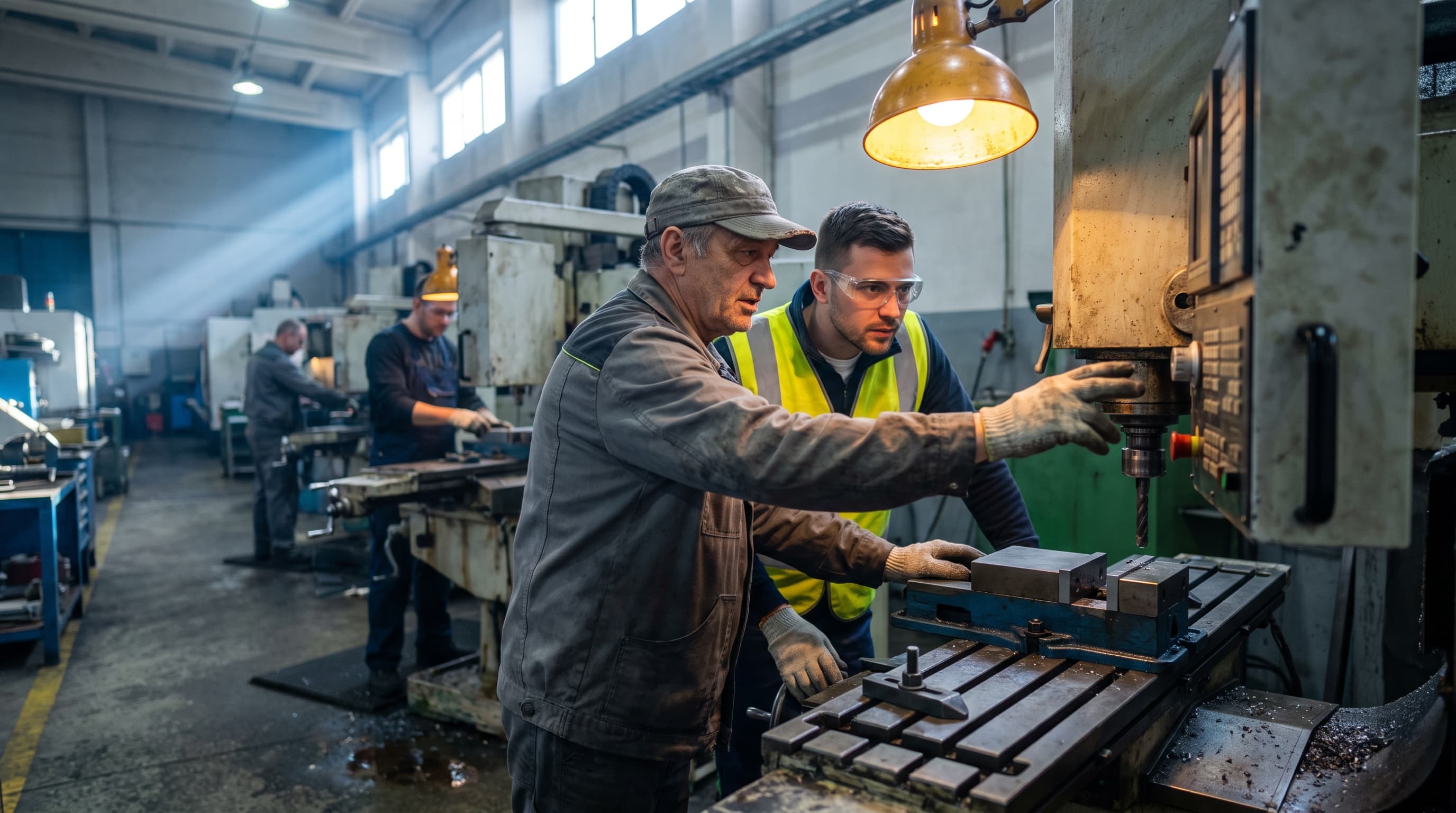
Few mid-size plants have to decide whether they want apprentices. Most want them. The real choice is who holds the paperwork. Before a plant puts a registered apprenticeship program manufacturing leaders can run in-house into the 2027 budget, it should answer three questions. Does it have enough qualified mentors? Does it need standards written for its own occupations? Can it carry the compliance load without help from an intermediary?
The policy timing favors acting soon. An April 23, 2025 executive order told the Labor, Commerce and Education secretaries to plan "to achieve and exceed the goal of one million new active apprentices." In March 2026, the Department of Labor committed to deciding on registrations within 30 days. A $35.8 million federal incentive fund now pays sponsors $3,500 for each new advanced manufacturing apprentice who gets through 90 days. Manufacturing is still a small slice of the system, though. HR Dive reports 678,014 apprentices nationwide in FY2025, and only 30,479 of them in manufacturing.
This guide covers what registration commits a plant to, where the real capacity limit sits, how sponsoring compares with joining a group sponsor, what the return evidence says, and when waiting is the right call.
What does a registered apprenticeship program require?
A registered program has to meet the federal standards in 29 CFR 29.5: a defined training term, related instruction, a rising wage schedule, a supervision ratio and a capped probationary period. These are the items that hit the budget:
-
Term. The term can be time-based, meaning "the completion of the industry standard for on-the-job learning (at least 2,000 hours)." It can also be competency-based, or a hybrid of the two.
-
Related instruction. "A minimum of 144 hours for each year of apprenticeship is recommended." That is classroom or technical instruction on top of floor time. The plant has to decide whether to pay for those hours.
-
Wages. Standards must include "a progressively increasing schedule of wages to be paid to the apprentice consistent with the skill acquired."
-
Ratio. Standards must set "a numeric ratio of apprentices to journeyworkers consistent with proper supervision, training, safety, and continuity of employment."
-
Probation. "The probationary period cannot exceed 25 percent of the length of the program, or 1 year, whichever is shorter."
Who registers the program depends on the state. Under 29 CFR 29.2, the registration agency is either the DOL Office of Apprenticeship or a recognized State Apprenticeship Agency. The first practical step is to find out which one covers your plant's state, because that tells you whose forms, review queue and staff you will deal with.
Is there a minimum company size to sponsor an apprenticeship?
No. None of the 29.5 standards reviewed for this article sets a minimum headcount for employers. The limit in practice is the ratio and supervision requirement, which comes down to how many qualified journeyworkers a plant has who can actually mentor.
Walt Pozgay, manufacturing training manager at GE Appliances, put it plainly to HR Dive: "It's not that we don't want to take more. It's that I can only take as many apprentices as I can get good mentors." If a company the size of GE Appliances hits that limit, a 300-person plant will hit it sooner.
A mentor count test for mid-size plants
Before you look at incentive money, do this exercise for each occupation you are considering, such as maintenance technician, CNC machinist or tool and die maker:
-
List the journeyworkers in that occupation who are good at the work and also willing and able to teach it.
-
Take out anyone who is retiring within the program term, working mandatory overtime most weeks, or the only cover for a critical asset.
-
Apply the ratio you plan to write into your standards. What is left is your real cohort size.
-
Check that cohort size against the hiring need. If you can only support one or two apprentices a year in each occupation, the admin work of standalone sponsorship is spread over very few people.
If the count reaches zero in an occupation, you have learned that a program there will not run well yet, whoever sponsors it.
Should you sponsor your own program or join a group sponsor?
Sponsor yourself if you have mentor depth across several cohorts and need standards built around your own occupations. Join a group sponsor if you have few mentors, are starting your first cohort, or would rather someone else handle registration and compliance.
The legal basis for the split
29 CFR 29.2 separates two roles. A sponsor is "any person, association, committee, or organization operating an apprenticeship program and in whose name the program is (or is to be) registered or approved." An employer is any organization employing an apprentice "whether or not such person or organization is a party to an Apprenticeship Agreement with the apprentice." That separation is what makes the group-sponsor model work. An association can hold the registered standards while your plant hires, pays and trains on the floor.
What group sponsors look like in manufacturing
-
Manufacturing Skills Institute (Virginia). A federally funded industry intermediary. It offers group-sponsored programs for CNC Machinist, Electrical Technician, Maintenance Technician, Mechatronics/Automation Technician, Quality Inspector, Robotics Technician, Tool and Die Maker, and Welder. Pricing is listed as "Contact for Pricing."
-
Idaho Manufacturing Alliance. Acts as group sponsor so member employers do not have to manage federal registration and compliance alone.
-
MACNY (New York). Acts as group sponsor and intermediary for New York State registered apprenticeships.
-
FAME. Managed by the Manufacturing Institute. A multi-employer chapter model in which students attend community college two days a week and work at least 24 hours a week, over three days, for a sponsoring employer while they earn an associate degree.
The trade-off
| Factor | Sponsor your own | Group sponsor / intermediary |
|---|---|---|
| Who holds the registered standards | Your plant | The association or intermediary |
| Control over occupations and competencies | Full | You work within the occupations the sponsor already offers |
| Registration and compliance work | Yours (Standards Builder submission, records, reporting) | Largely handled by the sponsor |
| Hiring, wages, on-the-job learning | Yours | Still yours |
| Speed to first cohort | Depends on drafting standards and the registration queue | Usually faster when the occupation is already registered |
| Cost visibility | Internal staff time | Fees are often unpublished; ask for a quote |
Some things stay with the plant whichever path it takes: hiring, the wage bill and floor mentoring. Those are most of the real cost. A group sponsor reduces the administrative overhead, but it does not reduce the mentor requirement.
Do registered apprenticeships pay back for employers?
The best evidence says they usually do. The returns typically arrive over several years, not within the apprenticeship itself. Three studies are worth knowing:
-
DOL synthesis. Kevin Hollenbeck's 2024 review for DOL's Chief Evaluation Office finds that the most rigorous estimates put employer ROI at 40 to 90 percent: "for each $1.00 invested, employers can expect to reap a benefit of $1.40 to $1.90." He concludes that employers underinvest in apprenticeship.
-
American Apprenticeship Initiative employers. An October 2022 Urban Institute study surveyed 68 employers. "Of the 68 employers surveyed, 46 (68 percent) achieved a positive net return over the 5 years," and "the median return on investment is $144 for every $100 invested." Even during the apprenticeship, 60 percent recouped at least 80 percent of their costs and almost 40 percent recouped their full costs.
-
Manufacturing specifically. A 2020 Jobs for the Future study of the Industrial Manufacturing Technician apprenticeship across six sponsors found that "on average, every $1.00 invested in apprenticeship returned $1.48."
Read these numbers carefully. In the Urban sample, about a third of employers did not reach a positive return within five years. For a CFO, the useful way to frame it is a race between two curves: how quickly apprentice output rises, and how quickly the wage schedule rises. Wages are the largest cost line. A plant with strong mentors and well-defined competencies gets apprentices to productive work sooner. A plant that puts apprentices on a short-staffed shift with no one to teach them usually does not.
What incentives offset apprenticeship costs?
There are two layers: a federal per-apprentice payment for advanced manufacturing, and state tax credits that differ a lot from state to state.
Federal manufacturing incentive
According to HR Dive, a $35.8 million federal incentive fund run by the Arkansas Department of Commerce pays sponsors $3,500 for every new advanced manufacturing apprentice who completes a 90-day probationary period. It recognizes programs run by groups of employers, trade associations and intermediaries such as FAME, so plants in group-sponsor arrangements are not shut out. Demand is high. Cody Waits, executive director of Arkansas' Division of Workforce Connections, told HR Dive: "We've received over 115 applications from over 33 states for 2,500 apprentices." Assume the money is limited and could be used up.
The 90-day condition matters for how you run the first few months. You only get the payment for apprentices who get through probation, and early drop-out is the most common way programs lose people (see below).
State tax credits
Apprenticeship.gov's state tax credit page lists per-apprentice credits from $750 in Montana ($1,500 for veterans) up to $7,500 or 50 percent of wages in Connecticut. Here is a selection of states with large manufacturing bases:
| State | Credit per apprentice (as listed) |
|---|---|
| Ohio | $5,000 or 15% of wages |
| New Jersey | $5,000, plus $5,000 for key industries |
| Massachusetts | $4,800 or 50% of wages |
| Illinois | $3,500 |
| Kansas | $2,500 (up to 20 apprentices) |
| Texas | $2,500 |
| Tennessee | $2,000 or 10% of wages |
| Alabama | $1,250 (up to 10 apprentices) |
| South Carolina | $1,000 per apprentice employed at least seven months |
The page does not show when it was last updated. Before you build a credit into a payback model, have your tax adviser confirm the current terms and eligibility with the state agency.
How should the apprentice wage schedule be designed?
The rule requires wages that rise "consistent with the skill acquired." The simplest way to defend the schedule, and to keep it affordable, is to tie each wage step to a documented skill milestone instead of to time served alone.
-
Time-based steps are simple to run. They raise pay on the calendar whether or not output has improved.
-
Competency-based or hybrid steps tie each raise to skills that have been demonstrated and signed off, for example qualifying on a machine family, completing PM routes on its own, or running first-article inspection. Faster learners move up sooner, and the plant pays for skill it can actually use.
DOL's March 2026 guidance, reported by CMM, includes Circular 2026-01 on program design under all three completion approaches. Read it before you draft. If you join a group sponsor, ask whether its standards allow competency-based progression in the occupations you need.
Look at the start of the schedule as well. NPR's profile of Virco Manufacturing notes that its apprentice is paid for class days at Pulaski Technical College as well as for plant hours. Whether you pay for related instruction affects both the cost model and who will apply.
How do you keep apprentices through completion?
Retention is the weakest point in the national system. Social Finance's analysis of DOL RAPIDS data found that "of the ~167,000 apprentices who started a registered apprenticeship program in 2017, just ~78,000, or 46.8%, completed the program within 6 years." Cancellations "tend to spike in the early months of apprenticeship and decline sharply thereafter." The supports it recommends include pre-apprenticeship, mentorship and living stipends.

For a plant, this means the first months need the most attention. That is when the assigned mentor, the shift schedule and the first wage step need to be working as planned, and it overlaps with the 90-day window for the federal incentive.
Stay-or-pay agreements
Some employers try to protect their investment with repayment agreements. California's AB 692 took effect January 1, 2026 and applies to new contracts only. It bans most employment-contract terms that require repayment when a worker leaves. Mayer Brown notes that it "does not apply to contracts for repayment of enrollment costs associated with enrollment in apprenticeship programs approved by the California Division of Apprenticeship Standards." Rules in other states were outside the scope of this article. Have employment counsel review any repayment clause before you use it, and treat it as a backstop. Mentoring and a credible wage path are what keep people.
Is it better to wait or move now?
The argument for moving now is mostly about process and money. Under Bulletin 2026-35, the Office of Apprenticeship committed to registration decisions within 30 days of a sponsor's final submission of signed local standards in Standards Builder. A public "shot clock" page tracks monthly registrations and average time to register in OA-administered states. Labor Secretary Lori Chavez-DeRemer said when the guidance came out: "We're removing the administrative roadblocks that have prevented Registered Apprenticeship from scaling to meet demand," as reported by CMM. Add the per-apprentice federal incentive and state credits, and the offsets are larger now than they have been.
The argument for caution is about capacity at DOL. Washington Monthly reported in December 2025 that Office of Apprenticeship staffing was "down by as much as 30 percent," that at least $30 million appropriated the year before went unspent, and that new-apprentice growth in 2025 was "only about 3 percent so far," compared with double-digit annual gains from 2016 to 2020. By that outlet's count, active apprentices grew from roughly 359,000 in FY2015 to more than 670,000 at the end of FY2024. The 30-day commitment covers OA's own determinations. If your state runs a State Apprenticeship Agency, ask that agency what timeline it expects.
Neither argument settles the question for a given plant. Mentor capacity and demand stability do.
A decision framework for mid-size plants
Sponsor your own program when:
-
You have enough qualified mentors to run more than one cohort in an occupation, or several occupations at once.
-
You need standards built around your own equipment, processes or occupations that existing group sponsors do not cover.
-
You have, or will assign, someone to own registration, records and reporting.
-
You expect hiring demand to hold steady for longer than the program term.
Join a group sponsor or intermediary when:
-
This is your first cohort and you only have a few mentors.
-
The occupation you need, such as maintenance technician, CNC machinist or welder, is already offered by a regional sponsor like MSI, the Idaho Manufacturing Alliance or MACNY, or by a FAME chapter.
-
Speed matters more to you than control over the standards.
-
Nobody on staff can take on compliance. Get a written fee quote, since intermediaries often do not publish pricing.
Wait when:
-
The mentor count test comes out at zero or one for the occupation you need.
-
Demand in that occupation is uncertain enough that you might lay off the people you would be training.
-
You cannot fund the wage schedule through the full term without depending on incentives that may run out.
Virco shows the incremental route. NPR reports that the school-furniture maker in Conway, Arkansas started with a single three-year registered tool and die apprenticeship and now plans to add 20 more apprentices in other departments. For most mid-size plants, starting with one occupation where mentors and demand are both strong, then expanding once the first cohort reaches its wage steps on schedule, is lower risk than designing a program for the whole plant up front.
Related reading
-
Is Your Motor Supplier Ready for the January DFARS Magnet Rule?
-
Amazon Plans to Hire Welders for Its Greenwood, Indiana Plant
-
Machinery and Fabricated Metal Carried August's Factory Hiring
Sources
-
Hollenbeck, The Return on Investment to Employers from Registered Apprenticeships, DOL (2024)
-
Urban Institute, Do Employers Earn Positive Returns to Investments in Apprenticeship? (Oct 2022)
-
JFF, The Next-Gen IMT Apprenticeship: A Return on Investment Study (July 2020)
-
HR Dive, Updated federal guidance and funds may boost manufacturing apprenticeships (May 4, 2026)
-
CMM, Labor Department Offers New Apprenticeship Guidance (March 12, 2026)
-
Washington Monthly, Trump's Broken Promise of "One Million Apprentices" (Dec 4, 2025)
-
Social Finance, Reaching One Million Active Apprentices Starts with Retention (Nov 7, 2025)
-
Manufacturing Skills Institute, Registered Apprenticeship Program
-
Idaho Manufacturing Alliance, Build your workforce with an apprenticeship program