
A contractor arrives to rebuild a press or service a compressor, and someone on the floor asks the obvious question: whose locks, and whose procedure? Contractor lockout tagout responsibilities fall under 29 CFR 1910.147(f)(2), and the short answer is "both of you, coordinated." The standard requires the host and the outside employer to share their procedures with each other. It does not say which procedure wins. That decision belongs to the two employers, and they need to make it and write it down before anyone touches an isolation point.
This explainer covers what the regulation says, how OSHA has interpreted it, how group lockout works when crews from more than one company share a job, and where host plants actually get cited.
What does OSHA require when outside contractors do lockout/tagout?
The standard sets two duties. Both employers must exchange procedures, and the host must make sure its own employees respect the contractor's program. The official text of 1910.147 reads:
(f)(2)(i): "Whenever outside servicing personnel are to be engaged in activities covered by the scope and application of this standard, the on-site employer and the outside employer shall inform each other of their respective lockout or tagout procedures."
(f)(2)(ii): "The on-site employer shall ensure that his/her employees understand and comply with the restrictions and prohibitions of the outside employer's energy control program."
The second paragraph is the one hosts tend to overlook. While the contractor is working, your operators and anyone else in the area are typically affected employees under the definitions in 1910.147(b): people who operate or use the machine being serviced, or who work where the servicing happens. You have to make sure they understand the contractor's lockout rules and follow them. Telling them to stay away from the press for the day doesn't cover it.
Contractors don't get a lighter version of the rule either. OSHA's lockout/tagout eTool page on outside personnel says contractors and other outside servicing personnel doing covered work "must adhere to all the standard's requirements."
Whose lockout procedure applies, the host's or the contractor's?
The regulation sets no default. It requires the two employers to disclose their procedures to each other and leaves the choice to them. In practice that makes it a coordination decision both companies should document, not a rule you can look up.
OSHA's Nov. 16, 2000 interpretation letter (Richard E. Fairfax, then Director of the Directorate of Compliance Programs) sets the frame. Three points from it matter on the floor:
-
The host knows the site best. "The host employer often will have greater familiarity with the energy control procedures used at the host facility." Your stored-energy sources, valve lineups and odd isolation points are things a visiting technician may not know.
-
Each employer is responsible for its own people. "Both the host employer and the contractor employer have independent obligations to provide the protection under the standard for their respective employees." Neither company can hand that duty to the other.
-
The contractor can't simply defer to the host. "The contractor employer must take reasonable steps consistent with its authority to protect its employees if the contractor knows, or has reason to know, that the host employer's energy control procedures are deficient or otherwise insufficient."
The practical approach: before the job, agree in writing which procedure governs which isolation points. Often the host's machine-specific procedure handles isolation and the contractor's program handles its own crew's locks. Then confirm the combined arrangement still gives every worker the protection of a personal lock. If the contractor reviews your procedure and finds a gap, expect them to raise it. Under the 2000 letter, they have to.
What must the host and contractor tell each other?
The (f)(2)(i) exchange is the minimum. Several other parts of the standard decide what that conversation needs to cover. The full text is available from the Legal Information Institute:
-
Notifying affected employees. Under 1910.147(c)(9), affected employees "shall be notified by the employer or authorized employee of the application and removal of lockout devices or tagout devices," before controls go on and after they come off. Decide who makes those notifications, your supervisor or the contractor's lead, and how operators will hear them.
-
Device identification. Under (c)(5)(ii)(C), devices "shall indicate the identity of the employee applying the device(s)." Under (c)(5)(ii)(B), devices must be standardized within the facility by color, shape or size. If the contractor's locks look different from yours, agree how your operators will recognize them and know not to touch them.
-
Who removes locks. Under (e)(3), each device "shall be removed from each energy isolating device by the employee who applied the device." The only exception covers an employee who is unavailable, and it requires documented procedures. Agree in advance what happens if a contractor technician leaves the site with a lock still on.
Training stays with each employer
A common shortcut is to brief the contractor on arrival and assign a host employee to escort them. OSHA addressed that directly in an April 23, 2007 interpretation letter. A company asked whether a pre-job briefing plus an "authorized employee" escort was enough for a vendor doing a single job. OSHA's answer: "No, your suggested approach does not fulfill all the requirements for training employees in LOTO procedures as specified in §1910.147(c)(7)."
Contractor technicians are authorized employees, and their own employer must make sure they get (c)(7) training. According to the letter, a briefing and an escort "may partially satisfy the communication requirements" but don't relieve the contract employer of its training duty. For the host, the takeaway is to ask for evidence of that training before the job, not after an incident.
How does group lockout work with mixed crews?
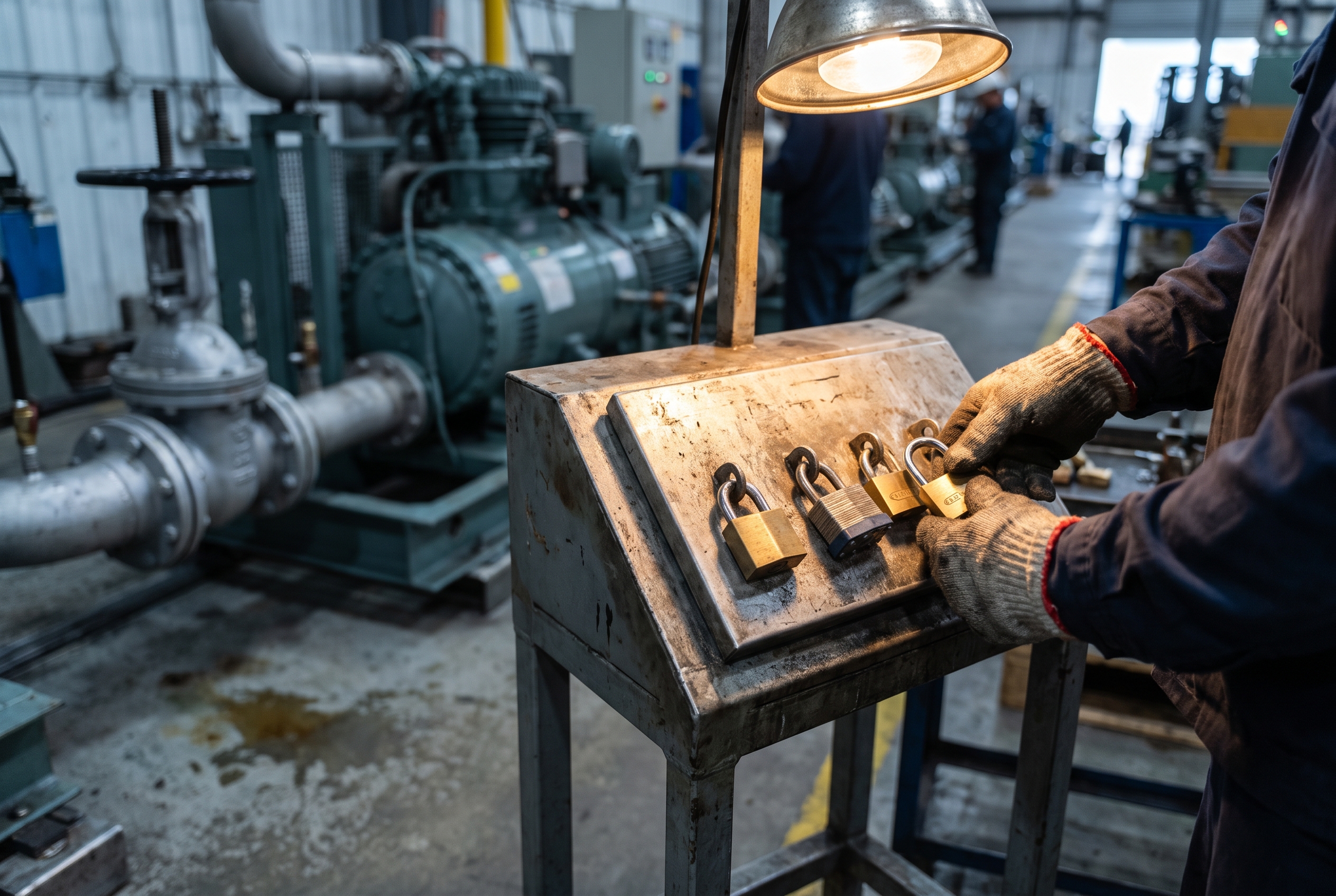
When more than one person or crew services the same equipment, 1910.147(f)(3)(i) requires a procedure that gives employees "a level of protection equivalent to that provided by the implementation of a personal lockout or tagout device." Paragraphs (f)(3)(ii)(A) through (D) set out the elements:
-
One primary authorized employee. Primary responsibility sits with one authorized employee for a set number of workers under a group device, such as an operations lock.
-
A way to track exposure. That person must have a way to ascertain the exposure status of each group member.
-
One overall coordinator for multi-crew jobs. When more than one crew, craft or department is involved, overall job-associated lockout or tagout control goes to an authorized employee designated "to coordinate affected work forces and ensure continuity of protection." On a contractor job, that could be someone from the host or from the contractor. What matters is that it is one named person.
-
Every worker hangs a personal lock. "Each authorized employee shall affix a personal lockout or tagout device to the group lockout device, group lockbox, or comparable mechanism when he or she begins work, and shall remove those devices when he or she stops working."
A supervisor's lock plus a log is not enough
OSHA's May 21, 2021 interpretation (Patrick J. Kapust, Acting Director, Directorate of Enforcement Programs) rejected an arrangement in which a supervisor put a single lock on the group lockbox and kept a written log of the authorized employees. Each authorized employee has to apply a personal lock. The same letter accepted a satellite-lockbox setup, in which each authorized employee locks a satellite box so the supervisor can't retrieve the key to the operations lockbox. That design is useful when contractor and host crews come and go at different times.
Verification: a right, not a requirement
Under OSHA's July 27, 2023 interpretation (Kimberly A. Stille, Director, Directorate of Enforcement Programs), when the primary authorized employee verifies isolation, other group members don't each have to verify. However, every authorized employee in the group "must be informed of their right also to verify" and "must be allowed to personally verify that hazardous energy sources have been effectively isolated, if they so choose." For a contractor technician who doesn't know your equipment, that right matters. Build time for it into the pre-job plan. The same letter says the group lockbox doesn't have to be at the isolation point and has no specific mounting requirement.
What happens at shift change on a multi-day contractor job?
Section 1910.147(f)(4) requires specific procedures during shift or personnel changes to ensure continuity of protection, "including provision for the orderly transfer of lockout or tagout device protection between off-going and oncoming employees." Contractor jobs that run past the planned window are a common place for this to break down. The contractor's crew rotates, the host's coordinator goes home, and nobody owns the handoff.

Plan the transfer before the job starts: who the oncoming coordinator is, how new locks go on before old ones come off, and how affected operators on the next shift get notified. If schedule pressure is what tempts people to skip steps on a long outage, put a realistic number on that pressure first. ManufacturingMag's downtime cost calculator separates lost contribution from incremental recovery costs, which helps when deciding whether a longer, properly staffed outage is worth it.
Where do lockout/tagout citations actually come from?
Control of Hazardous Energy (1910.147) ranks No. 3 on OSHA's preliminary FY2026 Top 10, which covers Oct. 1, 2025, through Aug. 31, 2026. Safety+Health magazine reported 1,863 lockout/tagout violations, up from No. 4 the year before. The data was presented by Prent Cline, Acting Deputy Director of OSHA's Directorate of Enforcement Programs. Only fall protection (4,041) and hazard communication (1,961) were cited more often.
The most recent subsection breakdown is for FY2025. That year, per Safety+Health, lockout/tagout drew 2,177 violations. The most-cited subsections were:
| Subsection | Requirement | FY2025 violations |
|---|---|---|
| (c)(4) | Energy control procedure | 675 |
| (c)(7) | Training and communication | 422 |
| (c)(6) | Periodic inspection | 345 |
| (c)(1) | Energy control program | 208 |
| (d) | Application of control | 152 |
The contractor clause, (f)(2), isn't in the top five. Most citations are for program basics: written procedures, training and periodic inspections. That's the real exposure for a host. If you bring in an outside technician to service equipment that has no documented procedure, the citation risk is mostly about your own program, whatever the contractor does. The same Safety+Health report ranked lockout/tagout second in FY2025 for cumulative proposed penalties ($13,134,743.26), second among serious violations (1,688) and second among willful violations (15).
One detail matters for contractor work. Under (c)(6)(i)(A), the at-least-annual periodic inspection "shall be perfomed by an authorized employee other than the ones(s) utilizing the energy control procedure being inspected" (the misspelling is in the official text). If contractors regularly use a procedure on your equipment, include that work in the inspection.
Can the host employer be cited for a contractor's lockout violation?
Yes. OSHA's Multi-Employer Citation Policy, CPL 2-0.124, effective Dec. 10, 1999, says that "on multi-employer worksites (in all industry sectors), more than one employer may be citable for a hazardous condition." It isn't limited to construction. The policy defines four roles:
-
Creating: the employer that caused the hazardous condition.
-
Exposing: an employer whose own employees are exposed to the hazard.
-
Correcting: an employer responsible for correcting the hazard.
-
Controlling: an employer with "general supervisory authority over the worksite, including the power to correct safety and health violations itself or require others to correct them."
A host plant can fit several of these at once. It controls the site, its operators may be exposed, and its own procedure may be what created the gap. Hiring a contractor doesn't move liability off the host. OSHA's current lockout/tagout enforcement directive is CPL 02-00-147, The Control of Hazardous Energy: Enforcement Policy and Inspection Procedures, effective Feb. 11, 2008.
What does a lockout/tagout violation cost in 2026?
According to an OSHA memo dated May 21, 2026 (Erin Gilmore, Acting Director, Directorate of Enforcement Programs), "There are no inflation-based increases to OSHA civil penalties for 2026." The 2025 amounts carry over because the government shutdown kept BLS from producing October 2025 CPI-U data.
| Violation type | Minimum | Maximum |
|---|---|---|
| Serious | $1,085 | $16,550 per violation |
| Other-than-serious | $0 | $16,550 per violation |
| Willful | $11,823 | $165,514 per violation |
| Repeat | $4,256 | $165,514 per violation |
| Failure to abate | $16,550 per day |
Because multiple employers can be cited for the same hazard, one bad contractor job can produce citations for both companies.
Floor checklist before the contractor arrives
-
Put the procedure exchange in writing up front. Make the (f)(2)(i) disclosure part of the purchase order or contractor prequalification, not a conversation at the gate.
-
Decide whose procedure covers which isolation points. Document it, and confirm every worker still has personal-lock protection.
-
Ask for evidence of (c)(7) training. The contractor's employer owes its technicians full authorized-employee training. Your briefing and escort don't replace it.
-
Choose the group lockout method and the coordinator. Name the primary authorized employee and, for multi-crew jobs, the overall coordinator. No supervisor-lock-plus-log setups.
-
Tell workers about their right to verify. Make sure contractor and host authorized employees know they can verify isolation themselves.
-
Brief and notify affected operators. Cover the contractor's restrictions under (f)(2)(ii), what their devices look like, and who gives the (c)(9) notices when locks go on and come off.
-
Plan the shift-change transfer. Write down the (f)(4) handoff before the job, especially if it might run long.
-
Close the loop. Include the contractor job in the next annual periodic inspection of that procedure.
Related reading
Sources
-
29 CFR 1910.147, The control of hazardous energy (lockout/tagout), OSHA
-
29 CFR § 1910.147, Legal Information Institute, Cornell Law School
-
OSHA Interpretation, April 23, 2007: Application of LOTO requirements to compressed gas cylinders
-
OSHA: Top 10 Most Frequently Cited Standards (FY2026, preliminary)
-
Safety+Health: Fall Protection remains atop OSHA's annual "Top 10" list (Sept. 15, 2026)
-
Safety+Health: The most frequently cited standards in FY 2025 (Nov. 24, 2025)
-
OSHA Memo: 2026 Annual Adjustments to OSHA Civil Penalties (May 21, 2026)