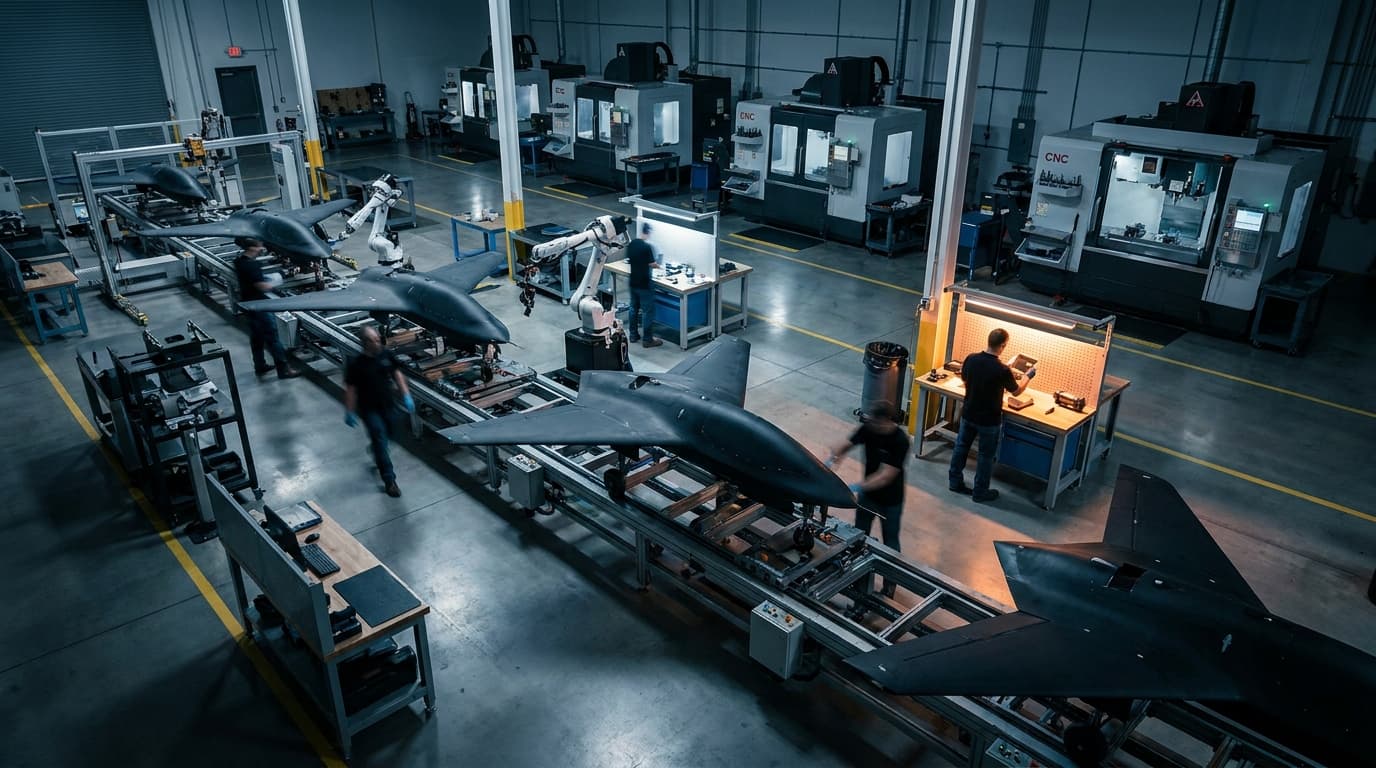
The floor went hot four months early.
Anduril Industries began Fury drone production at its Arsenal-1 mega-factory in Pickaway County in late March 2026, roughly four months ahead of the July 2026 target the company had publicly committed to. COO Matt Grimm called the project "ahead of schedule and under budget." Behind the Fury line - the YFQ-44A airframe Anduril is offering for the U.S. Air Force's Collaborative Combat Aircraft program - Roadrunner interceptor crews and Barracuda cruise-missile teams are already being hired.
The headline-grabbing facts are by now familiar: roughly 5 million square feet on a 500-acre site near Rickenbacker International Airport, a campus investment in the $900 million-to-$1 billion range, and a JobsOhio commitment of 4,008 direct jobs by 2035 - the largest single new-payroll project in Ohio history when Gov. Mike DeWine announced it in January 2025. What is less obvious, and what makes Arsenal-1 worth watching from a manufacturing-strategy perspective, is the model behind it: capex ahead of contracts, commercial-style "hyperscale" munitions economics, and a direct labor draw on the same Tier 1 machinist and electronics-assembly pool Boeing, Honeywell, and the Army's own Joint Systems Manufacturing Center already compete for.
Scoreboard
The ramp profile inside Arsenal-1 is layered. A Fury "core team" of roughly 250 hires by the end of 2026 is being trained in Costa Mesa, California, before returning to Ohio to run the line. A second wave of more than 14 positions - manufacturing engineers, quality engineers, production technicians, and acceptance-test-procedure (ATP) technicians - has already been posted for Roadrunner, the company's solid-fuel interceptor. Barracuda hiring is the next ramp.
Worth noting on the labor mix: airframes and seekers leave Arsenal-1 to be weaponized elsewhere. No explosives load on-site. That pushes the in-Pickaway skill demand toward mechatronics, composites, and electronics assembly rather than the more constrained ammunition-plant trades.
The capex model
This is the part that breaks with prime-contractor convention. Anduril is building Arsenal-1 against its own balance sheet, not against a signed program of record.
The August 2024 $1.5 billion raise was explicitly earmarked to "rebuild the arsenal of democracy" - Arsenal-1 capex. A $5 billion Series H in mid-2025, led by Founders Fund, Thrive Capital, and Andreessen Horowitz, pushed the company's valuation to $61 billion and refilled the runway. According to data tracked by Sacra, Anduril is running an operating loss of roughly $1.2 billion in 2026 to fund Arsenal-1 alongside a new California campus and a Mississippi solid-rocket-motor plant.
That posture is the inverse of the Lockheed, RTX, and Northrop playbook, where capital deployment of this scale typically follows a signed multi-year program contract. Anduril is betting that if it builds the capacity first, the demand signal will form around it - the "different production approach" the company has been pitching to defense trade press for two years.
Demand-side validation
That bet got materially stronger in March 2026, when the U.S. Army awarded Anduril a 10-year enterprise contract with a ceiling of up to $20 billion, consolidating more than 120 separate procurement actions into a single vehicle. Pair that with the CCA program - where Fury (YFQ-44A) is one of two surviving competitors - and the speculative capex has at least two anchor demand signals beneath it.
The strategic logic now reads as a wager that the Pentagon, having spent two years signaling appetite for attritable autonomy and low-cost mass-produced effects, will keep that demand on the table through the FY27 budget cycle.
Unit-cost economics
The Barracuda program is the clearest expression of the hyperscale thesis. Anduril has publicly positioned Barracuda as a commercial-parts cruise-missile family designed for hyperscale production, with a target unit cost of roughly $200,000 to $250,000 for Barracuda-500, against the $1.5 million to $2 million per round that the Tomahawk Block V and Lockheed's JASSM run. The design choices behind that gap are deliberate: simplified seekers, modular airframes, and a parts list pulled from commercial automotive and consumer-electronics supply chains rather than the bespoke milspec tiers that drive prime cost structures.
If those numbers hold at volume, the implication for magazine depth is significant. For roughly the cost of a single Tomahawk, an operator could field seven to ten Barracuda-class effects - a ratio that matters in any contested scenario where stockpile is the binding constraint.
The Ohio labor squeeze
Arsenal-1 does not land on greenfield. Central and northwest Ohio already host a dense set of defense and high-precision manufacturing employers competing for the same skilled-labor pool.
Boeing's Heath facility, focused on guidance and satellite work, has long been a fixture of the Licking County labor market. Honeywell Aerospace runs sites in Clearwater, Lima, and Fostoria. The Army's Joint Systems Manufacturing Center in Lima - the country's only heavy-armor plant, building Abrams and Stryker variants - has been working through its own workforce headwinds; Sen. Sherrod Brown's office documented more than $3 million in federal resources, including a DoD Office of Economic Adjustment grant, tied to workforce and process modernization in the Allen County manufacturing base. Task Force Lima continues to advocate for sustained JSMC investment.
Add in Intel's still-ramping Licking County fab and [a national manufacturing labor market that remains structurally short on skilled trades through 2026](https://mie-solutions.com/u-s-manufacturing-labor-shortages-and-hiring-pressures-in-2026/), and Anduril's 4,008-job target stops looking like simple addition. The Costa Mesa training shuttle is one signal that the company knows it cannot fully recruit the skill mix it needs out of the central Ohio commuter shed at the wages prime-contractor incumbents are paying.
Supply-chain ripple
The Tier 2 and Tier 3 implications follow the cadence question. JSMC operates on a slower DoD rhythm - heavy-armor procurement is measured in years per vehicle batch. A hyperscale missile and drone line runs on a different clock entirely. Composites suppliers, propulsion subcomponent shops, and electronics-assembly houses across central Ohio that get pulled into Anduril's cadence will need to retool for higher-volume, lower-margin work than the cost-plus prime ecosystem has historically demanded.
That retooling is an opportunity for the same suppliers and a stress test for the ones that cannot accommodate two different production rhythms simultaneously.
FY27 budget implications
A working hyperscale line in Ohio changes what OSD and the services can credibly request. Until Arsenal-1 produces hardware at volume, attritable autonomy and low-cost cruise-missile programs sit on the budget side of the ledger as aspirational line items. A factory running Fury today and Barracuda within the year converts those line items into capacity that can be cited in budget justification.
The political cover is non-trivial: 4,008 Ohio jobs and a projected $1 billion GDP impact across a Senate map where Ohio has been a swing state through multiple cycles is the kind of constituency math congressional appropriators tend to internalize.
Risk register
The capex-ahead-of-contracts model is the central risk. If the Air Force's CCA award goes elsewhere, if the Army's $20 billion ceiling fills more slowly than projected, or if a successor administration trims attritable-autonomy budgets, Anduril is sitting on 5 million square feet of dedicated manufacturing capacity without the program throughput to amortize it.
Other risks worth tracking: ITAR and clearance bottlenecks in the hiring pipeline, which constrain how fast even a well-funded employer can scale a defense workforce; community and zoning friction in Pickaway County as the campus footprint expands; and the Series H runway question if 2026's roughly $1.2 billion operating loss compounds without a corresponding revenue ramp.
The bet on Pickaway County
One year into construction, Arsenal-1 is not just another factory announcement. It is a live experiment in whether venture-financed, commercial-style munitions production can out-recruit, out-build, and out-cost the primes in their own backyard. The Fury line went hot four months early. An on-the-ground look at the Rickenbacker site suggests the campus build-out is tracking the same curve. The next eighteen months will determine whether Roadrunner and Barracuda follow - and whether the FY27 budget arrives in time to validate the bet.
Related reading
-
Wolfspeed's Mohawk Valley SiC Fab Is Ramping Just as the Market It Was Built For Cools
-
Substation Gear, Not Gensets, Is Now the Real Cap on AI Power Buildouts
Sources
-
Defense News - Anduril to build Arsenal-1 autonomous weapons plant in central Ohio
-
Ohio Capital Journal - Gov. DeWine lands biggest jobs deal in Ohio history
-
Manufacturing Dive - Anduril chooses Ohio for $1B manufacturing facility
-
Breaking Defense - A different production approach at Arsenal-1
-
Defense One - Anduril's new factory to start making drone wingman in days
-
NBC4 - Anduril begins hiring second team for Pickaway County factory
-
Air & Space Forces Magazine - Anduril picks Ohio site for Arsenal plant to build CCAs
-
FlightGlobal - Anduril unveils low-cost Barracuda cruise missile
-
United24 Media - Barracuda missile: a cheap alternative to Tomahawk
-
Sen. Sherrod Brown - Federal resources to support manufacturing in Allen County