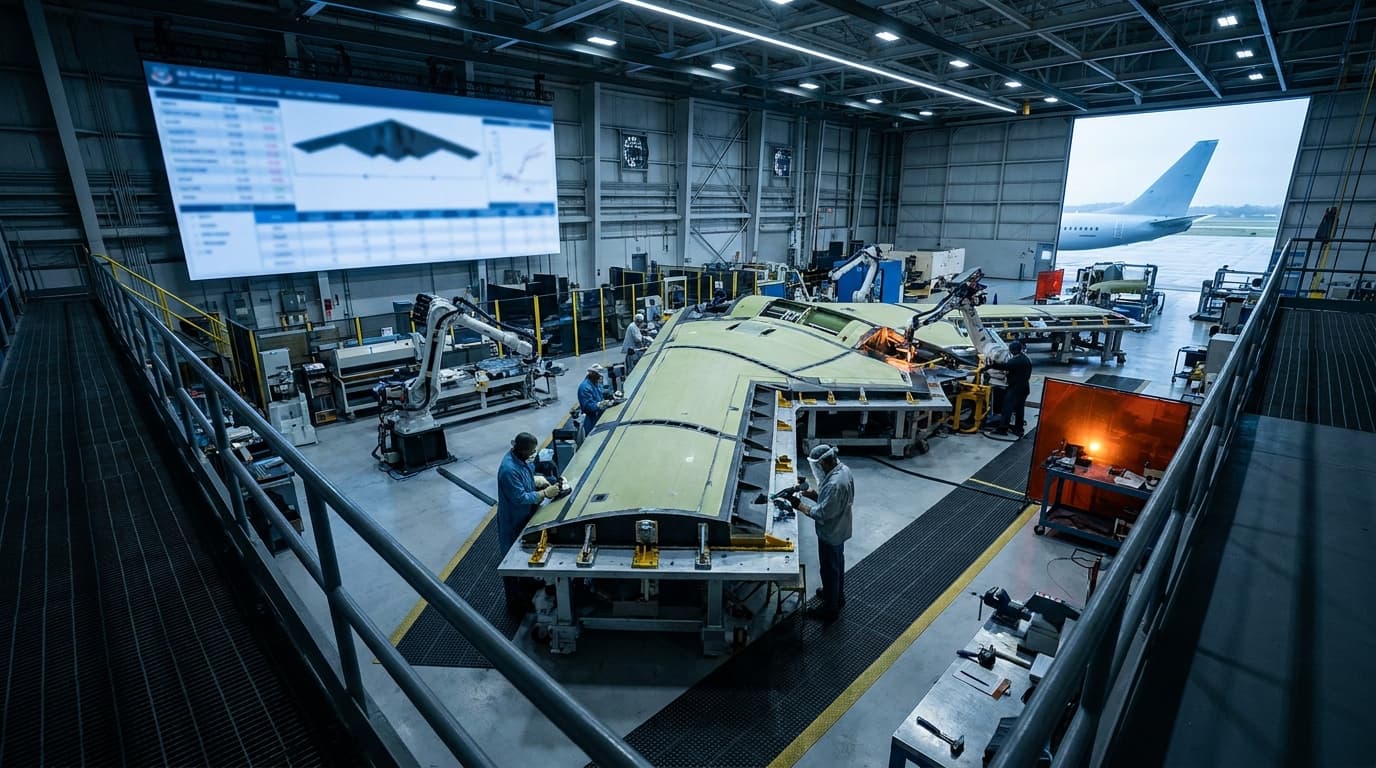
The B-21 Raider line at Air Force Plant 42 in Palmdale has quietly become one of the most aggressive industrial hiring sites in Southern California. After the U.S. Air Force approved low-rate initial production in late 2024, Northrop Grumman now has six airframes in various stages of final assembly and test, and in early 2026 the service and the prime finalized an agreement to expand annual B-21 capacity by roughly 25%, funded by about $4.5 billion in FY25 reconciliation-package supplemental money. The 100-airframe fleet target is unchanged; what is changing is the pace, with first operational Raiders targeted to be fielded starting in 2027.
The bottleneck is not floorspace. Northrop occupies roughly 66% of Plant 42, and the Air Force has publicly confirmed the rate increase can be absorbed within existing facilities. The bottleneck is people — specifically, cleared, hands-on machinists, fabricators, and assemblers in a labor basin where Boeing's commercial side is simultaneously running its own ramp.
Where the program actually is
LRIP notionally covers about 21 aircraft across five lots before any move to full-rate production, with publicly cited output in the ~7–8/year range. The 25% expansion lifts that ceiling without changing the fleet ceiling — a strategic posture that lets the Air Force compress the delivery curve without committing to a larger total buy. Whether that compression actually shows up in the tail numbers depends almost entirely on whether the supplier base and the Palmdale labor basin can absorb the new tempo.
The labor basin is already saturated
The Antelope Valley is not a deep labor market. The same pool that staffs Plant 42 also feeds Stratolaunch, the test ranges, and a steadily thickening Tier-N footprint — including AS Aerospace, which broke ground on a 90,000-sq-ft precision-fastener facility in Palmdale projected to add about 150 jobs. Pull back to the broader Southern California aerospace corridor and the picture gets tighter still: Boeing is hiring up to about 140 workers per week in 2026 to support its commercial ramp, citing both retirements and rate needs. The commercial side is pushing 737 MAX from 42 toward 47/month and stabilizing 787 at 8/month.
The B-21 program is classified, so Northrop's Palmdale headcount is not publicly broken out and a precise head-to-head with Boeing commercial is not possible from open sources. What is visible is directional: a defense prime running a capacity expansion on a clearance-gated line, competing for the same fabrication trades as a commercial prime running an open-recruitment ramp. In a tight basin, the cleared line loses every coin-flip on an uncleared candidate.
The Tier-1 squeeze just got more complicated
The B-21's 2016 Tier-1 supplier roster — Pratt & Whitney, BAE Systems (Nashua, NH), Spirit AeroSystems (Wichita), Orbital ATK, Collins/Rockwell Collins (Cedar Rapids), GKN Aerospace (St. Louis), and Janicki Industries (Sedro-Woolley, WA) — is now operating under a materially different structure. Boeing closed its $4.7 billion acquisition of Spirit AeroSystems in December 2025, and Spirit Defense now runs as a 'non-integrated' subsidiary of Boeing's defense unit. That has practical implications for how B-21 aerostructure work is staffed, prioritized, and managed inside a company whose commercial side is also drawing hard on the same engineering and trades pipeline. The Air Force has said it is not aware of B-21 quality problems linked to Spirit, but the structural change in supplier ownership is one of the most consequential industrial-base shifts the program has absorbed since LRIP.
The clearance bottleneck
The Raider's program security posture narrows the funnel in two ways. First, B-21 work requires personnel who can hold the required clearances — a much smaller candidate pool than the open commercial labor market Boeing recruits into. Second, the work itself is hands-on metal: machining, composites layup, fastening, assembly, and integration. That set of skills overlaps almost exactly with the trades the commercial sector and the maritime industrial base also need most.
Northrop's pipeline play: AFAB
Northrop's primary local response is the Antelope Valley College Aircraft Fabrication and Assembly (AFAB) program — a roughly 16-week intensive that produces job-ready fabricators. The structure is unusually direct: Northrop requires local applicants without prior aerospace experience to complete AFAB before they can be considered, effectively turning the community college into a forward-deployed apprenticeship. The program has reported a historical placement rate near 94%, with one cohort cited as producing 155 Northrop hires in a single month and starting pay above $25/hour. Northrop's own framing of the partnership treats it as a core piece of its Palmdale workforce strategy.
It is also a fixed-throughput pipeline. AFAB cohorts are bounded by classroom and instructor capacity, not by Northrop's hiring need. A 25% line-rate expansion does not automatically translate into a 25% larger cohort.
The other claim on the same trades
The B-21 ramp is colliding with a separate, larger, and equally urgent industrial-base mobilization. [The submarine industrial base — Columbia-class plus Virginia-class — needs roughly 140,000 net new skilled workers over the next decade](https://www.ey.com/en_us/insights/government-public-sector/reimagining-the-us-submarine-industrial-base-workforce), and the broader maritime industrial base figure is closer to 250,000. The scarce SKUs are the same ones Plant 42 needs: CNC machinists, welders, structural fabricators. Geographically the submarine work concentrates in the Northeast and Gulf, but the trades are nationally mobile and the pay floors compete directly.
Federal policy is moving, slowly
The administration has put two relevant levers on the table. EO 14265, 'Modernizing Defense Acquisitions and Spurring Innovation in the Defense Industrial Base', signed in April 2025, sets the broader acquisition-reform posture. EO 14372, 'Prioritizing the Warfighter in Defense Contracting', signed January 7, 2026, sharpens contractor incentives toward warfighter outcomes. Neither order is a workforce program by itself, but both shape how primes can structure ramp risk into their contracts.
Congress moved the workforce piece directly. The FY26 NDAA's Section 1843 directs DoD to stand up an advanced-manufacturing-workforce working group within 180 days, and Section 1844 creates a DoD-led collaborative forum on industrial-base supply chain, manufacturing, and workforce policy. The substantive question is whether those vehicles deliver Palmdale-relevant pipeline expansion — additional AFAB-style partnerships, scholarship dollars, clearance-sponsorship pathways — before the 25% rate increase actually hits the floor.
What to watch
-
Whether the 25% capacity expansion lands on schedule. The choke point is trades, not tooling. If AFAB throughput and Tier-1 hiring at Spirit Defense, Collins, BAE, GKN, and Janicki do not scale in parallel, the rate increase slips regardless of the supplemental funding.
-
Whether Northrop replicates AFAB elsewhere. A single community college pipeline is structurally capped. Cloning the model into additional California and Tier-1-region community colleges is the most direct way to lift the ceiling.
-
Whether the FY26 NDAA workforce vehicles reach Palmdale in time. A working group standing up within 180 days of enactment is not a 2026 hiring lever; it is a 2027–2028 one.
-
How Spirit Defense's 'non-integrated' subsidiary structure affects B-21 aerostructure work. Boeing's commercial ramp and Spirit Defense's B-21 obligations now sit under the same corporate roof, drawing on overlapping engineering and trades pools.
The honest caveat
The B-21 program is classified. Specific Palmdale headcount, cleared-position fill rates, and the exact head-to-head with Boeing commercial within the same labor basin are not publicly broken out. The comparison here is directional, anchored to disclosed hiring tempo, publicly confirmed rate-increase intent, and the published structure of the AFAB pipeline. The conclusion the open record supports is narrower than a precise number but sharper than a hunch: at current AFAB throughput and current commercial hiring tempo, the marginal cleared machinist in the Antelope Valley is the constraint on how fast the 25% B-21 capacity expansion actually shows up in delivered airframes.
Related reading
-
Wolfspeed's Mohawk Valley SiC Fab Is Ramping Just as the Market It Was Built For Cools
-
Substation Gear, Not Gensets, Is Now the Real Cap on AI Power Buildouts
Sources
-
The War Zone — 100 B-21 fleet size target unchanged despite production acceleration
-
The War Zone — B-21 numbers could be boosted with existing production capacity
-
Air & Space Forces Magazine — Northrop can expand B-21 production at Plant 42
-
Air & Space Forces Magazine — Air Force on Spirit AeroSystems B-21 quality
-
[Aerospace Manufacturing — B-21 Raider in production, USAF confirms](https://www.aero-mag.com/northrop-grumman-b-21-raider-production-26012024)
-
Breaking Defense — Boeing completes $4.7B Spirit AeroSystems acquisition
-
Simple Flying — Boeing to increase 737 MAX to 47/month in 2026
-
California Forward — Community college partnership lands aerospace jobs
-
California Forward — Northrop Grumman community college collaboration
-
Granite State Manufacturing — Navy needs 250,000 skilled workers
-
The White House — EO 14265, Modernizing Defense Acquisitions
-
Cleary Gottlieb — EO 14372, Prioritizing the Warfighter in Defense Contracting