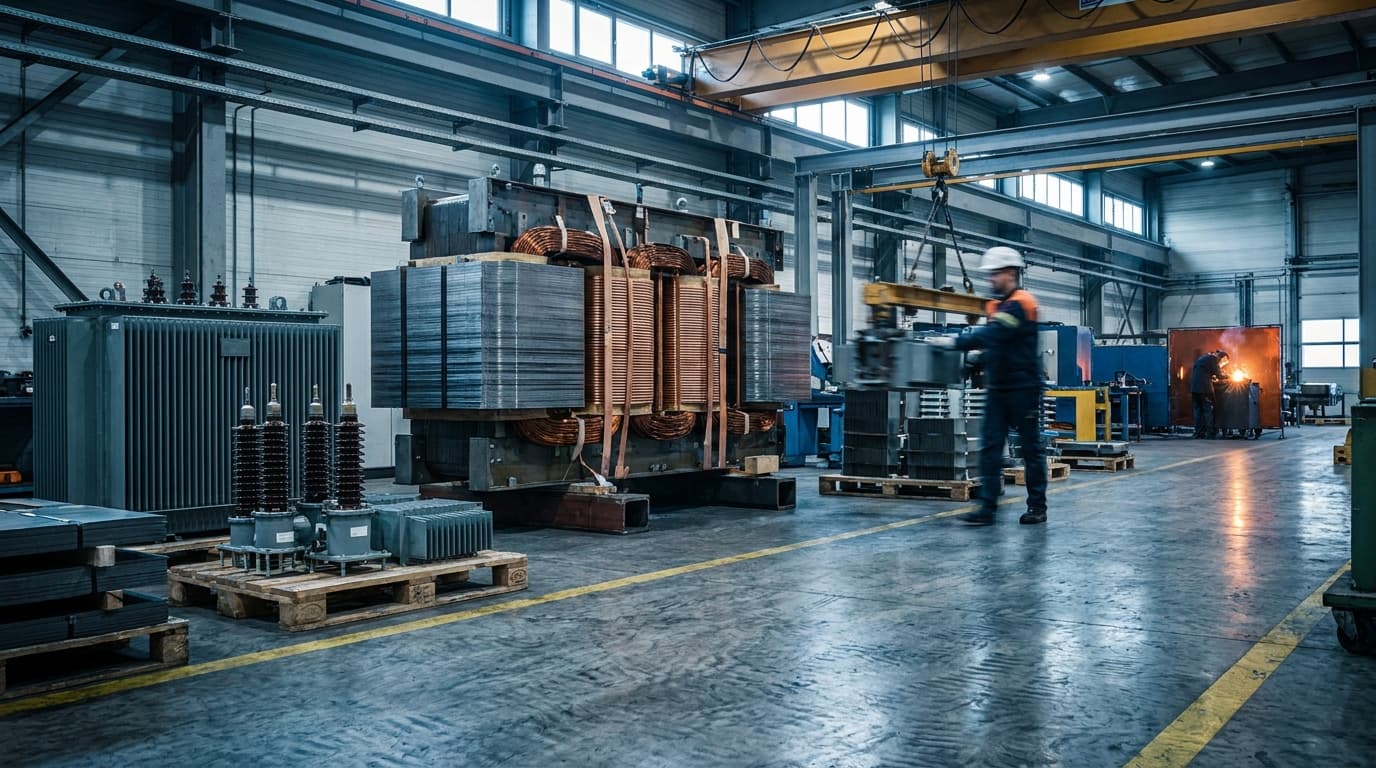
The story that dominated AI infrastructure coverage for the last two years — gas turbines, gensets, and grid interconnection queues — has a new headline constraint, and it sits one tier upstream. The piece of equipment now gating hyperscaler build-outs is the boring, copper-and-steel gear inside the substation: large power transformers, generator step-up (GSU) units, and medium-voltage switchgear. On current lead times, that gear is what decides whether a 2026 announcement becomes a 2026 building or a 2028 one.
Wood Mackenzie's Q2 2025 survey, cited across procurement-side analyses, pegged large power transformer (LPT) lead times at roughly 128 weeks and GSU units at 144 weeks, with some custom orders extending four years out. Custom medium-voltage lineups and certain low-voltage drawout switchgear are quoted at 70 to 100-plus weeks; mainstream MV switchgear has eased to roughly 26–32 weeks but remains well above the 12–16 week pre-COVID baseline. Substation procurement, in other words, is now the longest-lead-time item in a hyperscale build — longer than the chillers, longer than the GPU racks, and in many cases longer than the building shell itself.
The order books say it plainly
Eaton's Q1 2026 results made the demand side legible in dollars. The company's Q1 2026 8-K and accompanying analyst presentation reported Electrical Americas data-center orders up roughly 240% year-over-year, an Electrical segment backlog up 48% YoY, and a trailing-twelve-month book-to-bill of 1.2. Management framed the total data-center backlog at 228 GW — roughly twelve years of capacity at 2025 build rates — language Eaton's leadership and sell-side analysts have been calling a "supercycle" rather than a cyclical upswing.
GE Vernova's Electrification segment told the same story from a different vantage. In Q1 2026 alone, the segment booked $2.4 billion of data-center equipment orders — more than its full-year 2025 data-center bookings — and Prolec GE, its transformer JV, carries a backlog of roughly $5 billion, up 25% since the deal was announced. Siemens Energy, per industry commentary, is signaling four-to-five-year backlogs at the heavy end of its T&D portfolio.
OEMs are spending, but the capacity is back-loaded
The OEM capacity response is real and large — and back-loaded enough that it does not relieve 2026 or 2027. Eaton committed roughly $1.5 billion of incremental capacity, including a new MV switchgear plant in the Omaha area announced in 2026 plus expansions in Mexico and the Dominican Republic. Hitachi Energy has committed more than $1 billion to North American grid manufacturing, anchored by what it says will be the largest U.S. large-power-transformer plant in Virginia by 2028. GE Vernova is leaning on its Prolec GE integration to scale transformer throughput.
The dates matter. A Virginia LPT plant fully ramped in 2028 does nothing for an Abilene or Phoenix site that needs a GSU energized in 2026. That timing gap is the part of the supply-demand picture that is hardest to engineer around.
The squeeze is upstream of the OEM
What makes the bottleneck stickier than a normal capex cycle is that it is partly a feedstock problem. The cores inside a power transformer require grain-oriented electrical steel (GOES), and the United States has effectively one domestic producer (Cleveland-Cliffs's Butler Works). Copper is tight. High-voltage bushings — many sourced internationally — are a recurring choke point that has drawn supply-chain-security attention; see Japan Times reporting on U.S. AI build-out dependencies on foreign electrical components.
That feedstock layer changes hyperscaler procurement behavior. As Data Center Knowledge has reported, large buyers are pre-purchasing transformer cores, posting letters of credit against raw materials, and locking modular power-skid slots years ahead of need. Electrical equipment is well under 10% of data-center capex, but, as procurement teams put it, it is functionally 100% of the bottleneck. The gating constraint is allocation, not budget — which is precisely why money-led tactics like deposits and LCs work.
The buyer playbook
Hyperscalers and large colos have shifted their capital deployment to match. Coverage of 2026 hyperscaler strategy describes a stack of workarounds: long-dated slot reservations with OEMs, deposit-led allocation to jump the queue, modular power-distribution centers that compress some switchgear scope into factory-built skids, and on-site gas or turbine bridging to start revenue-generating compute load before the permanent substation gear arrives. Substation procurement analyses increasingly treat the transformer order as the schedule-defining milestone of the entire project — the date everything else is sequenced backward from.
Second-order effects: the utilities lose the queue
The collateral damage shows up at the regulated utility. Distribution-upgrade projects tied to ordinary residential electrification and industrial reshoring are now competing for the same OEM allocation as hyperscalers — and losing. Data Center Knowledge's synthesis of the substation-gear constraint frames this clearly: utilities that historically commanded priority at Eaton, GE Vernova, Hitachi, and Siemens Energy now wait behind buyers willing to prepay. That creates real rate-case and PUC exposure, and it opens room for smaller MV switchgear OEMs and aftermarket refurbishers — players who can move on shorter lead times even if their unit economics are worse.
The 2026–2028 setup
Bloomberg-sourced reporting in April 2026 estimated that more than half of U.S. data centers planned for 2026 may be delayed or canceled because of electrical-equipment shortages; analyst commentary points to roughly 30–50% of announced 2026 capacity slipping into 2027–2028. Of approximately 12 GW of announced 2026 U.S. data-center capacity across about 140 projects, only around 5 GW is reported as physically under construction; the rest is queued behind interconnection and gear allocation.
The investable read is that the demand side — Eaton's 228 GW backlog, GE Vernova's $2.4 billion quarterly Electrification booking, Prolec GE's $5 billion order book — has run ahead of even an aggressive OEM capex response. Capacity is coming: Hitachi Energy's Virginia plant in 2028, Eaton's Nebraska MV switchgear line, Prolec GE's expansion. But until grain-oriented electrical steel capacity grows and bushing supply diversifies, the binding constraint stays where it is now: in the substation yard, not the diesel yard. Operators planning 2026–2028 AI capacity should treat the LPT and GSU order date — not the GPU delivery date, and not the interconnection study — as the schedule driver, and price feedstock risk into every site they underwrite.
Related reading
-
Caterpillar and Cummins Generator Backlogs Are Now the Real Cap on AI Data Center Buildouts
-
[MP Materials' Mountain Pass Stage II Just Made the Pentagon a Rare-Earth Equity Holder — and Reset the Domestic Magnet Math](/article/mp-materials-pentagon-rare-earth-equity-domestic-magnet-math)
Sources
-
Eaton Posts Record Q1 Revenue as Electrical Backlog Surges 48% — Alphastreet
-
Eaton Earnings Call Highlights Data Center Supercycle — Globe and Mail
-
Eaton Expands Operations in Nebraska with New MV Switchgear Plant
-
Hitachi Energy to Invest $1bn into US Grid Infrastructure Manufacturing — DCD
-
Why AI Data Center Projects Face Years of Delays After Approval — Data Center Knowledge
-
Power Transformers in AI Data Center Expansion — NPC Electric
-
More than Half of Data Centers May Be Delayed — Energy News Beat
-
The AI Power Bottleneck: Data Centers Meet the Steel Monopoly — Adafruit Blog
-
America's AI Build-Out Hinges on Chinese Electrical Parts — Japan Times
-
[AI Data Center Boom Rewires US Power Supply Chain — Data Center Knowledge](https://www.datacenterknowledge.com/build-design/ai-data-center-boom-rewires-us-power-supply-chain)
-
The Real Reason GE and Siemens Can't Clear Their Backlogs — Data Power Supply