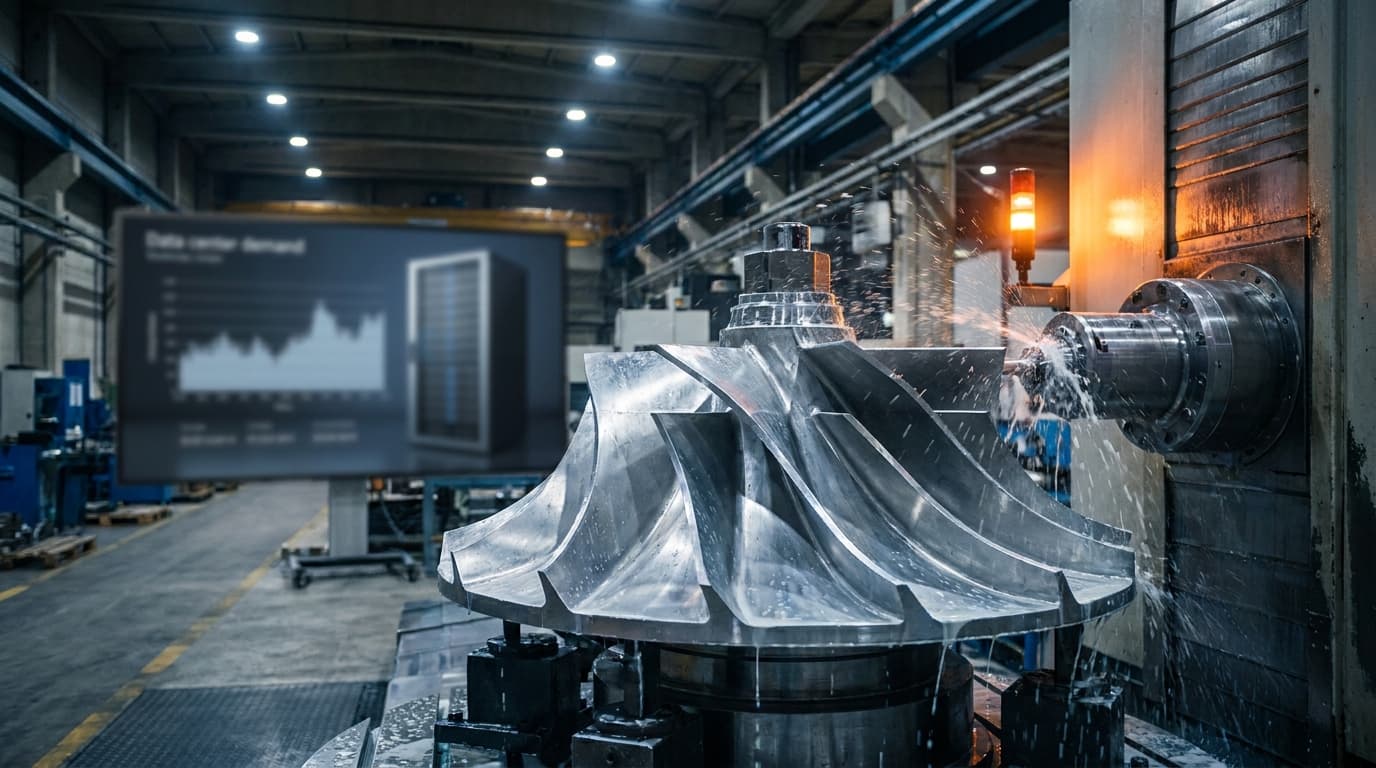
The scarce commodity in American electricity right now is not natural gas, transmission rights-of-way, or skilled linemen. It is a manufacturing slot on a heavy-duty gas turbine line — and the people writing the biggest checks for those slots are no longer utilities.
GE Vernova disclosed in its Q1 2026 8-K that its combined gas turbine position — 44 GW of firm backlog plus 56 GW of slot reservation agreements — reached 100 GW under contract by the end of the first quarter, up from 83 GW at year-end 2025. Those are distinct contract categories, not a published schedule of every available HA-class manufacturing slot. The Q1 release projected at least 110 GW combined by year-end 2026; that was guidance at the time, not a delivery commitment to an individual buyer.
Buyer checklist: reservation, order, delivery and commissioning
October 24 clarification: The discussion below retains its Q1 reporting context. GE Vernova’s July 22 Q2 release subsequently reported 53 GW of equipment backlog and 63 GW of slot reservations, totaling 116 GW. It also reported converting 10 GW of reservations to orders during Q2. These figures illustrate why reservations and orders should not be treated as interchangeable. This is a dated comparison, not a claim to show today’s available slots.
Use these editorial procurement checks when comparing offers. Obtain project-specific answers from the supplier; headline backlog cannot supply them.
| Milestone | Evidence to request | Do not infer |
|---|---|---|
| Slot reservation | Named equipment scope, reserved window, expiry, conversion conditions and written deposit terms | That a reservation is already a firm equipment order, or that all agreements have identical refund or transfer terms |
| Firm equipment order | Executed scope, agreed delivery milestone, acceptance criteria and change provisions | That an aggregate OEM backlog fixes your shipment date |
| Delivery and commissioning | Separate equipment-arrival and operating-readiness schedules, with responsibilities for site work, testing and connections | That factory delivery makes the plant immediately ready to generate power |
Record the source date beside each quoted milestone. Compare like-for-like equipment scope and timing before treating two offers as alternatives.
The numbers behind the Q1 order position
Three data points from the Q1 disclosure define the market. First, the 100 GW figure combines firm backlog and reservations; dividing it by one annual output figure does not establish a customer delivery date. Second, pricing on new gas turbine orders in the first half of 2026 is tracking 10 to 20 percentage points higher on a $/kW basis than orders booked in Q4 2025, according to GE Vernova management commentary reported by Power Engineering. Third, the customer mix has bifurcated: about 80% of the 100 GW under contract is with utilities, independent power producers, and industrials, while roughly 20% — about 20 GW — is explicitly tied to data center load.
That 20% is the headline. GE Vernova's Electrification segment also booked $2.4 billion of data-center equipment orders in Q1 2026 alone — more than the segment recorded for all of 2025. The hyperscalers are not waiting on PJM, ERCOT, or any state PUC; they are buying iron directly.
The trajectory was visible in late 2025. Utility Dive reported at year-end that the 80-plus-GW backlog already stretched into 2029. Six months later, the active deal zone has moved to 2030 and beyond.
How a Slot Reservation Agreement actually works
The instrument doing the work here is the slot reservation agreement, and it deserves a closer look because it is what enables the merit-order flip described below.
A slot reservation and a firm equipment order are separate steps in GE Vernova’s reporting. The Q1 release records 6 GW of reservations converting to orders; the Q2 release records another 10 GW. For a specific transaction, obtain the written deposit, conversion, cancellation and transfer terms. The public aggregate disclosures used here do not establish that every reservation has identical terms.
That structure matters because it severs the link between owning a generation slot and being regulated. A utility historically had to convince a public utility commission to approve a certificate of need, a resource plan, and ultimately CWIP or rate-base treatment before it could commit capital to a long-lead gas turbine. A hyperscaler with an investment-grade balance sheet just wires the deposit. The OEM sees two buyers for the same 2029 frame and allocates to whichever clears at the higher price per kW. There is no regulator in the middle of the hyperscaler's bid.
The OEM oligopoly and where the capacity is going
GE Vernova, Mitsubishi Power, and Siemens Energy together account for roughly two-thirds of global gas turbine capacity under construction, per Utility Dive's cross-OEM analysis. Wait times across the H, J, and HA classes have stretched to five to seven years depending on frame and location. All three OEMs are spending against the backlog.
GE Vernova has committed nearly $600 million to U.S. factories and facilities over two years. The anchor is Greenville, South Carolina, where a $160 million-plus investment targets roughly 550 jobs and ramps HA-class output from 37 units in 2025 to 62 in 2026 and 74 in 2027 — on a path to 70 to 80 heavy-duty units per year. A separate $41 million, 50-job investment in Schenectady, New York expands gas-power capacity in the company's historical home plant. The 7HA and 9HA frames coming off those lines are the platforms the hyperscalers are bidding for.
Siemens Energy's backlog now extends to roughly 2030, and the company is moving heavy-duty output from about 48 units per year to 70 to 80 — putting its SGT-9000HL and SGT5/6-8000H platforms onto a similar ramp. Mitsubishi Power's 2026 and 2027 delivery slots are largely sold; the company has announced plans to double gas turbine production to chase the demand.
The merit-order flip
This is where the industrial-economics story diverges from a normal capital-cycle expansion. When an Amazon or Microsoft non-refundable deposit clears for a 2029 HA frame, the OEM allocation question stops being "whose integrated resource plan needs this unit" and starts being "whose contract prices it highest."
The cost-of-capital arithmetic explains the outcome. Regulated utilities underwrite firm generation at rate-base weighted-average cost of capital — typically a blended figure in the 6 to 8% range after authorized equity returns and approved debt costs. Hyperscalers underwrite generation against PPA economics tied to AI training and inference revenue, with corporate cost of capital and discount rates that comfortably absorb a 10 to 20% per-kW premium on the turbine itself. The OEM is indifferent to the buyer's regulatory category; it sees the price.
Utilities have begun to respond by locking in slots through framework agreements rather than waiting for IRP cycles. Xcel Energy's dual alliances with GE Vernova and NextEra, signed to underwrite a 6 GW data-center outlook, are a concrete example of the playbook: a regulated utility using long-dated OEM agreements to compete with hyperscaler direct procurement on the same production lines.
The Industrial IoT footprint of the build-out
Every HA-class frame is a multi-decade industrial-data stream. The instrumentation on a 7HA or 9HA — blade-path thermocouples, combustion-dynamics pressure sensors, vibration probes, exhaust spreads, generator partial-discharge monitors — feeds into GE Vernova's APM and GridOS asset-performance platforms under service contracts that typically run 15 to 25 years. The connected install base is, in effect, the leading indicator for the OEM's recurring-revenue franchise.
That is why the Greenville and Schenectady capex matters beyond the immediate hardware story. A 74-unit production year in 2027 is not just 74 turbines; it is 74 new long-lived nodes on the OEM's connected-asset network, each one generating diagnostic and performance data that the OEM monetizes through software-as-a-service and long-term service agreements. The capacity ramp is, mechanically, an Industrial IoT installed-base ramp.
What to watch next
Four signals will determine whether the current pricing regime holds or breaks. First, the Q2 2026 GE Vernova update will reveal the SRA-to-firm-order conversion ratio — the rate at which non-refundable deposits translate into binding purchase orders. Second, Siemens Energy and Mitsubishi capacity-expansion milestones will indicate whether the oligopoly's incremental supply lands in 2027-2028 or pushes into 2029. Third, FERC and state PUC orders on whether utility SRA deposits can be rate-based will determine whether regulated buyers can match hyperscaler bids without shareholders absorbing the deposit risk. Fourth, any reported hyperscaler-to-utility slot-resale transactions — secondary trades in manufacturing slots — would confirm that the slot itself has become a tradable asset, with implications for how grid planners model future generation availability.
For operators, investors, and industry professionals tracking American manufacturing, the gas turbine slot market is now one of the cleanest case studies in how AI-driven data-center load is reorganizing capital allocation in heavy industry. The buyer of last resort for U.S. gas-fired iron used to be a regulated utility. In 2026, it is a hyperscaler with a corporate treasury and no rate case to file.
Related reading
-
Power Has Overtaken Capex as the Reshoring Bottleneck, Wood Mackenzie Says
-
Caterpillar and Cummins Generator Backlogs Are Now the Real Cap on AI Data Center Buildouts
Sources
- GE Vernova Inc., Form 8-K, Q1 2026 press release (April 22, 2026)
- GE Vernova Inc., Form 10-K, FY2025
- Power Engineering — Data centers drive record surge in GE Vernova power equipment orders
- Utility Dive — GE Vernova expects to end 2025 with an 80-GW gas turbine backlog that stretches into 2029
- GE Vernova — $160 million investment in Greenville facility
- GE Vernova — $600 million in U.S. factories and facilities over two years
- GE Vernova — $41 million, 50-job investment in Schenectady
- Power Magazine — Mitsubishi Will Double Gas Turbine Production as Demand Grows
- Utility Dive — Gas turbine manufacturers expand capacity, but order backlog could prove stubborn
- Power Magazine — Xcel Energy Inks Dual Alliances with GE Vernova, NextEra
- Siemens Energy — Gas turbines product line
- GE Vernova — H-Class gas turbines