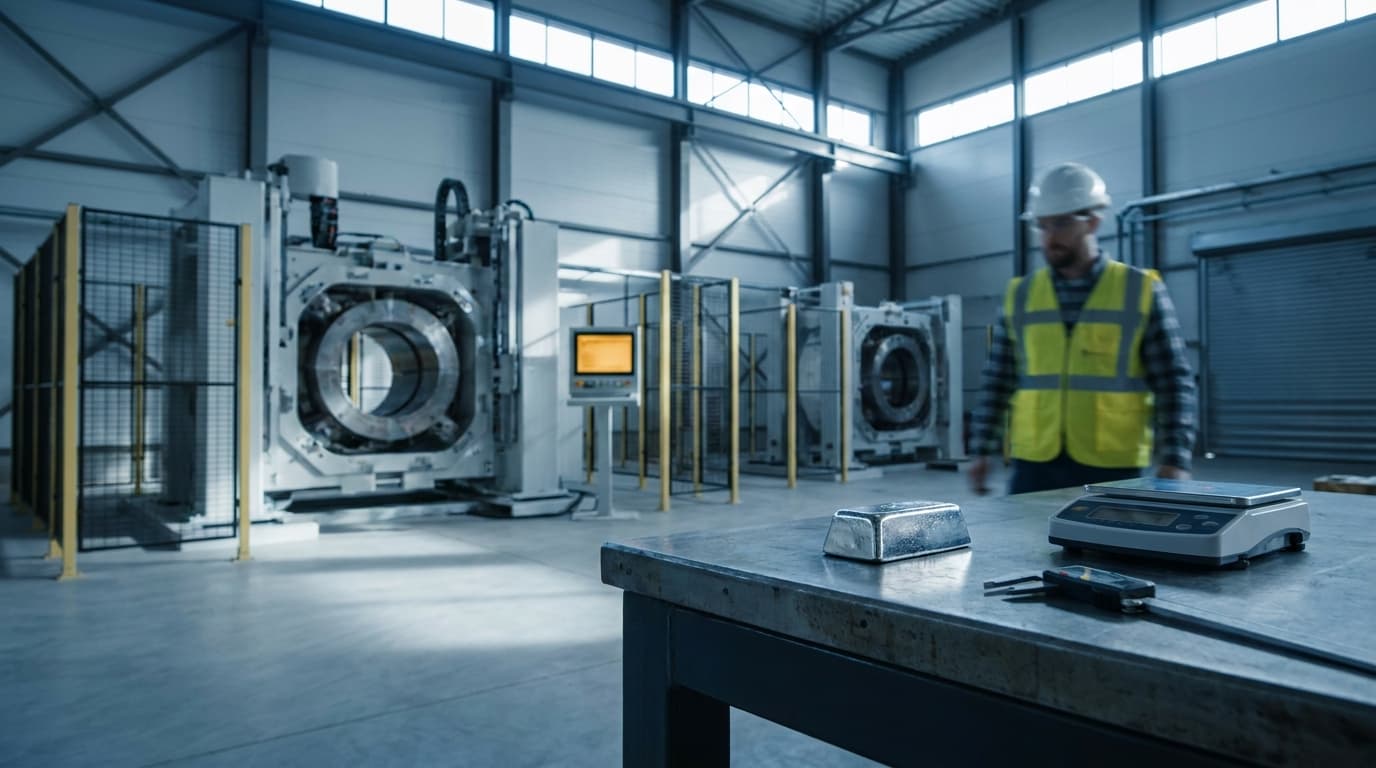
On August 18, 2026, a Houston company said it had made a tonne of iron.
That is roughly the correct scale of the announcement, and roughly the wrong way to read it. Hertha Metals announced that its demonstration plant in Conroe, Texas had produced iron at 99.95% purity — 3N5, the grade permanent magnet makers specify — running continuously on commercial-grade equipment at about one metric tonne per day, from what the company describes as fully domestic inputs. One tonne per day is not an industrial supply. It is a proof point.
The reason it is news is that, per the company's own framing, no American producer had said it before.
"High-purity iron is one of the least visible materials behind the magnets that power everything from electric vehicles to defense systems, and today almost none of it is made in America." — Laureen Meroueh, CEO, Hertha Metals
Meroueh's sentence is the whole story, and it is worth taking literally rather than as founder positioning. The United States has spent the last three years committing billions of dollars to rare earth separation, metal and alloy production, and finished magnet manufacturing. It has committed no publicly identified federal program to the single largest input by mass in the magnet itself.
The mass balance nobody put in a press release
Start with stoichiometry, because it is the one part of this that is not contestable.
The magnetic phase in a sintered neodymium-iron-boron magnet is Nd2Fe14B. Run the molar masses: neodymium at 144.242 × 2 = 288.5; iron at 55.845 × 14 = 781.8; boron at 10.811 × 1 = 10.8. Total 1,081.1 g/mol, of which iron is 781.8 — about 72.3% by weight. Commercial sintered grades run somewhat below that because of grain boundary phases and dopants, which is why the industry, and trade coverage of the Hertha announcement, settles on "roughly 70% iron by mass." Use 70%. Do not use a more precise number than the sources support.
Now apply it to the announced American buildout. Depending on how you count overlaps and company-total versus incremental figures, publicly announced US sintered NdFeB capacity lands somewhere in the range of 26,000 to 32,000 tonnes per year by the end of the decade. At 70% iron by mass, that implies on the order of 18,000 to 22,000 tonnes per year of magnet-grade high-purity iron — a material for which, according to figures repeated across trade coverage and traceable to Hertha's own framing, roughly 90% of global production sits in China.
That 90% figure is not a USGS or federal statistic, and it should be attributed rather than treated as a government number. But even if it is directionally off, the domestic side of the ledger is not in dispute: prior to August 18, no US company had publicly claimed magnet-grade iron from domestic inputs at all. The denominator is what is interesting. The numerator was zero.
The buildout map — and what each announcement declines to say
The magnet plants are real, funded, and sited. What none of them have publicly resolved is where the iron comes from.
-
MP Materials, Northlake, Texas. Announced February 26, 2026: a 120-acre campus less than ten miles from its Independence facility in Fort Worth, $1.25 billion-plus in company investment, roughly $200 million in state and local incentives over a decade-plus (including more than $66 million from the Texas Enterprise Fund and Texas Semiconductor Innovation Fund), 1,500-plus jobs, about 7,000 t/yr added to bring MP to roughly 10,000 t/yr total, commissioning in 2028, a ten-year Pentagon offtake, a GM supply agreement, and an Apple recycling collaboration. Mountain Pass, California supplies the rare earths. The release says nothing about iron sourcing.
-
USA Rare Earth, Cherokee County, South Carolina. Announced June 2, 2026: $1.2 billion at Bailey Industrial Park in Blacksburg — 6,400 t/yr of sintered NdFeB plus 5,000 t/yr of rare earth metals and alloys, roughly 490 jobs, commissioning targeted for April 2028. Combined with its Stillwater, Oklahoma operation, the company targets 10,000 t/yr of magnets. Same silence on the iron input.
-
Noveon Magnetics, San Marcos, Texas. The only currently operational US sintered NdFeB producer. Raised a $215 million Series C in January 2026 led by OneIM ($200 million), expanding beyond 2,000 t/yr.
-
e-VAC Magnetics, Sumter, South Carolina. Shipped its first US-made magnets in late December.
-
Vulcan Elements. Announced a $1.4 billion partnership with the US government and ReElement Technologies in November 2025, toward a 10,000-tonne facility and a "100% vertically integrated domestic magnet supply chain."
That last phrase is the one to test. Vertical integration in this sector has consistently meant integration upstream into rare earths — mine to oxide to metal to alloy to magnet. Iron enters the flowsheet at the alloy melt and has been treated, industry-wide, as a commodity input that shows up when you order it. Until January 1, 2027, that treatment is legally correct.
What the clause actually says
DFARS 252.225-7052, Restriction on the Acquisition of Certain Magnets, Tantalum, and Tungsten (clause revision MAY 2024), currently draws its line at the melt. Through December 31, 2026, the NdFeB restriction covers "melting neodymium with iron and boron to produce the neodymium-iron-boron alloy" and every production phase after it. Buy the iron anywhere; melt it in a compliant country and you are clean.
Effective January 1, 2027, per the clause text on Acquisition.GOV, the restriction "includes the entire supply chain from mining of neodymium, iron, and boron through production of finished magnets."
Four words changed the industrial problem: mining of neodymium, iron, and boron. The covered countries are North Korea, China, Russia, and Iran. Which means that on January 1, 2027, a material that is roughly 90% Chinese-produced and roughly 70% of the magnet by mass moves from outside the clause to inside it — for the full chain, back to the mine.
Here is the reportable gap. Public DFARS-readiness statements from the magnet industry are about rare earths, not iron. Arnold Magnetic Technologies' own post on preparing for the January 1, 2027 change frames the update around rare earth sourcing and commits to "a fully compliant supply chain for Neodymium-Iron-Boron and Samarium-Cobalt magnets by mid-2026." Iron is not mentioned. Noveon's DFARS page asserts compliance with NDAA 2018 §871 and DFARS 252.225-7052 and leans on its magnet-to-magnet recycled-feedstock process — but names no iron source and does not address the 2027 expansion at all.
As of publication, no US magnet producer has publicly named a qualified domestic high-purity iron source. That is the sentence the industry has five months to make false.
The timeline collision
Hertha's answer is Chalyx, its planned commercial plant. The capacity figure has moved: June 2026 coverage put it at 10,000 t/yr; August 2026 coverage describes "more than 9,000 tonnes annually." Treat 9,000-plus as the current number and note that the earlier figure was higher.
The groundbreaking date has moved further. Earlier reporting cited January 2026, then summer 2026. The August 18 announcement says "this fall."
Set that against the compliance date. Break ground in autumn 2026, and construction, commissioning, ramp, and customer qualification all sit entirely on the far side of January 1, 2027 — and qualification, not construction, is the long pole. Even at the optimistic end, Chalyx at 9,000-plus t/yr covers roughly half of the iron implied by announced US magnet capacity, arriving years after the clause starts counting.
The process itself is credible on its face. Hertha's FLEXHERS route — Flexible Fuel Hydrogen Electric Reduction Smelting — is a single-step, coal-free method pairing an electric arc furnace with natural gas or hydrogen as both reductant and energy source, with the company claiming more than 20% lower production cost, roughly 50% lower emissions than conventional routes, and tolerance for lower-grade ore and fines. Longer-term ambition is around 500,000 t/yr within four to five years. Ore feedstock has been reported as domestic Minnesota iron ore, though on a single source. The most detailed technical write-up available is also explicit about what Hertha has not disclosed: capex, project financing, and confirmed offtakes.
Which is why the question to put to the company is not when it breaks ground. It is: first metal date, and qualification-completion date. Those are the dates a program office can build a schedule against.
Qualification is the part that does not compress
Reaching 99.95% is a purity number. Making that iron usable in a sintered magnet is a trace-element problem — carbon, nitrogen, oxygen, sulfur, phosphorus — because interstitials degrade the magnetic phase and the sintering behavior in ways that a bulk purity spec does not capture. A magnet maker does not buy on 3N5 alone; it buys on a full trace certificate, lot-to-lot consistency, and demonstrated behavior through its own press-and-sinter process.
That sequence — sample, pilot lots, process validation, production part approval at the magnet maker, then re-qualification at the prime that buys the magnet — runs on multi-year clocks in aerospace and defense. It also has a hard prerequisite: a plant that exists and produces repeatable lots. A prime cannot begin a PPAP-equivalent qualification against a groundbreaking.
This is the mechanism by which the January 1, 2027 date becomes unmeetable rather than merely tight. Even a fully funded, on-schedule Chalyx cannot produce a qualified defense-grade iron supply within the window, because the qualification clock cannot start before the metal does.
The relief valves — and why they are the actual story
The clause anticipates shortfalls. Four mechanisms will absorb this one:
-
Commercially available off-the-shelf items. COTS is excepted, which pulls a large share of commercial-derivative hardware out of scope entirely.
-
The electronic-device exception. Magnets contained in an "electronic device" are excepted "unless otherwise specified in the contract" — a carve-out whose breadth depends entirely on how contracting officers construe "electronic device," and on whether program offices bother to specify otherwise.
-
The recycled-magnet carve-out. NdFeB magnets made from recycled material qualify if milling and final sintering occur in the United States. This is why Noveon's magnet-to-magnet position is strategically interesting: recycled feedstock sidesteps the virgin-iron question by construction. It does not scale to 26,000 tonnes a year on today's end-of-life magnet stream.
-
The non-availability waiver. An agency may waive the restriction where compliant material "of satisfactory quality and quantity, in the required form, cannot be procured as and when needed at a reasonable price."
Read the waiver language against the facts and the conclusion is close to mechanical. In January 2027, domestic magnet-grade iron will not exist in satisfactory quantity, in the required form, at any price — because the only announced US plant will be under construction. The non-availability determination is not a loophole here; it is the only instrument that lets defense magnet procurement continue.
So the operative question for anyone holding a DoD magnet line is not whether a domestic iron source appears. It is whether the Office of the Under Secretary of Defense for Acquisition and Sustainment is drafting standing waiver guidance for iron, or leaving it to individual contracting officers to improvise 250 identical non-availability determinations in the first quarter of 2027. Those two outcomes look very different from inside a program office.
Follow the money to where it did not go
The federal investment pattern is legible: DPA Title III and Office of Strategic Capital money, plus offtakes and price floors, aimed at separation, metal and alloy conversion, and finished magnets. Billions, across MP, Vulcan, and others.
No public federal award specifically funding domestic high-purity iron for magnet applications surfaced in reviewing the announced portfolio. That is an absence of evidence rather than proof of absence, and it warrants a direct answer from DoD's Industrial Base Policy office before anyone treats it as final. But the shape of it is consistent with how this gap arose in the first place: the policy apparatus indexed on the material named in the headline — rare earths — and the clause, until 2027, drew its line at the melt. Iron was neither scarce-sounding nor in scope. It fell between the programs.
Hertha's own funding history reflects the same neglect. The company disclosed a $17 million round on July 22, 2025, with investors reported to include Khosla Ventures, Breakthrough Energy, Pear VC, and Clean Energy Ventures, and won a DOE EPIC award in 2024. Aggregator profiles disagree sharply on total capital raised — one lists $118 million — and no total should be printed without company confirmation. Either way: a company solving a 20,000-tonne-per-year national input gap has raised a rounding error against a single magnet campus.
What we could not confirm
Three things in this story remain open, and readers should weight them accordingly. Chalyx's capacity is reported at both "more than 9,000" and 10,000 tonnes annually across coverage four months apart, and the company has not reconciled the two publicly. The "first US company to reach magnet-grade spec on fully domestic inputs" framing is Hertha's own claim, not an independently verified one. And the roughly 90% China share of magnet-grade high-purity iron traces to Hertha's framing as repeated through trade coverage, not to a government statistical series. We have requested clarification on all three.
The falsifiable test
This story resolves cleanly, on a fixed date, in one of two ways.
By January 1, 2027, either a named US magnet producer — MP, USA Rare Earth, Noveon, e-VAC, Vulcan, Arnold — publicly identifies a qualified domestic high-purity iron source, or the clause's iron provision is being satisfied through waivers, COTS and electronic-device exceptions, and recycled feedstock.
There is no third outcome, and the second one is far likelier. That is not a scandal; supply chains take longer to build than statutes take to write. But it is worth naming plainly, because "100% vertically integrated domestic magnet supply chain" and "operating under a non-availability determination for 70% of the magnet by mass" are very different industrial positions, and right now the press releases only describe one of them.
We will report which one is true in January.
Related reading
Sources
-
DFARS 252.225-7052 — Restriction on the Acquisition of Certain Magnets, Tantalum, and Tungsten (Acquisition.GOV, clause rev. MAY 2024)
-
[Hertha Metals produces magnet-grade iron for US rare earth magnets](https://www.mining.com/hertha-metals-produces-magnet-grade-iron-for-us-rare-earth-magnets/) (MINING.COM)
-
Hertha reaches magnet-grade iron purity (Metal Tech News, August 19, 2026)
-
Hertha Metals High-Purity Iron NdFeB Supply Chain 2027 (Rare Earth Exchanges)
-
High-Purity Iron Plant Targets US Rare Earth Magnet Supply Gap (The Metalnomist, June 13, 2026)
-
Hertha Metals' Texas high-purity iron plant: supply, process and capex notes for engineers (Geomechanics.io)
-
Hertha Metals — Latest News (company newsroom)
-
USA Rare Earth Selects Cherokee County, South Carolina (June 2, 2026)
-
Arnold Magnetic Technologies Prepares for DFARS Compliance Updates Starting Jan 1, 2027