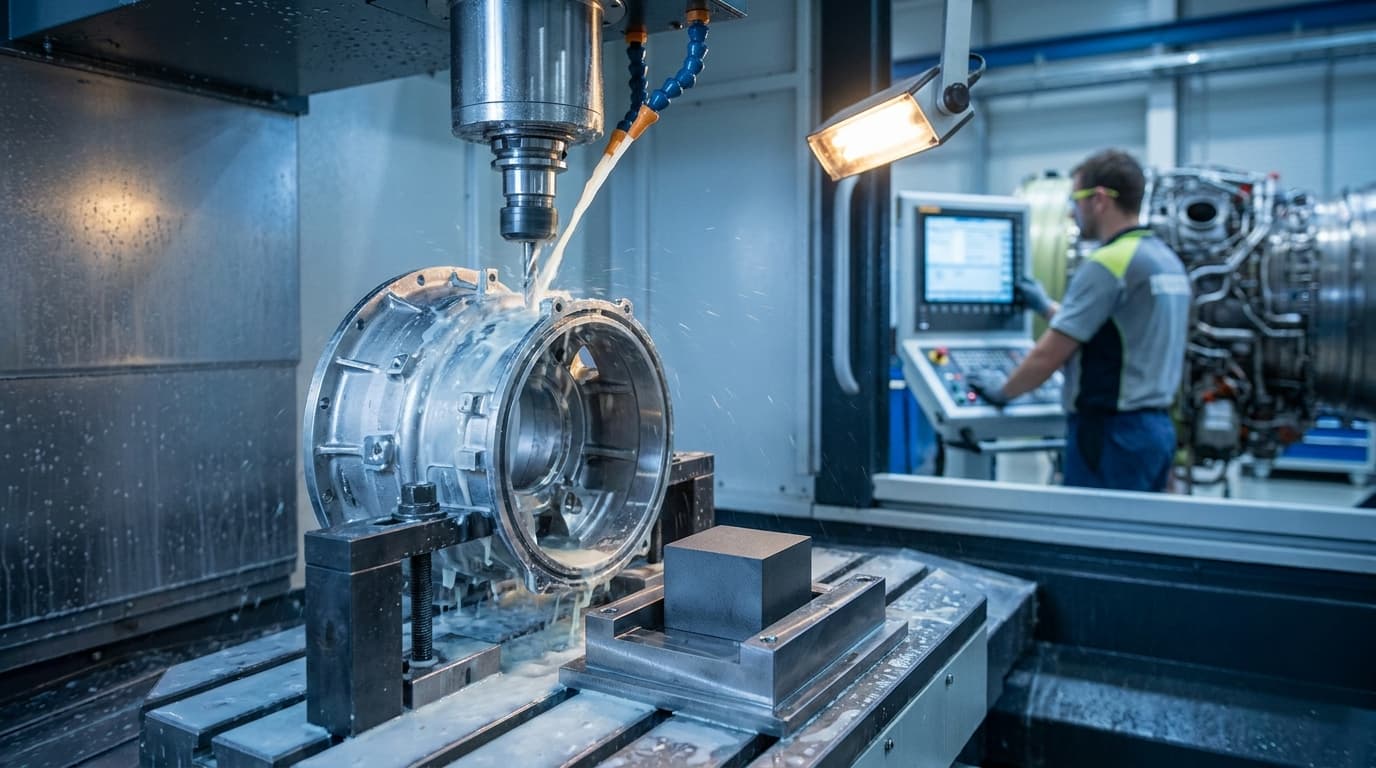
There is a turbomachine inside the Honeywell Integrated Power Package on every F-35 that will not work without samarium-cobalt magnets. There are fin actuators on missiles that sit close enough to hot sections that no other permanent magnet chemistry holds its field. Adamas Intelligence puts roughly 23 kilograms — about 50 pounds — of SmCo alloy in each F-35, spread across high-temperature actuators, the IPP turbomachine and lube pump, and F-35B lift-system components. It is a rounding error by weight and by cost. It is also, on current schedules, about to become legally unsourceable from two directions at once.
Two dates do the work here. On November 10, 2026, China's suspension of its October 2025 extraterritorial rare earth package lapses by its own terms. On January 1, 2027, the U.S. Defense Federal Acquisition Regulation Supplement restriction on samarium-cobalt magnets stops applying at the melt step and starts applying at the ore. Roughly seven weeks separate them. Neither requires a forecast to see coming; both are printed in published regulatory text.
What the "two to three years" number actually is
The figure circulating through defense trade coverage — that the United States has two to three years of samarium supply — deserves to be stated precisely, because the imprecise version is doing damage. National Defense Magazine reported on July 1, 2026 that the number traces to Permag, the only U.S. producer of samarium-cobalt magnets, and to its CEO Joseph Stupfel. It describes supply Permag secured for itself. It is one private company's inventory position, disclosed by its chief executive.
It is not a National Defense Stockpile figure. It is not a measured industrial-base runway. There is no public number for that. The most useful thing to say about the samarium picture is that the clearest visibility anyone has into domestic runway comes from a single firm's purchasing decision — and that firm bought ahead because it saw what was coming, not because anyone told it to.
Why SmCo has no substitute
Samarium-cobalt survives heat that neodymium-iron-boron does not. Trade coverage puts SmCo's Curie temperature in the 700–800°C range with operational stability cited to roughly 550°C (Rare Earth Exchanges; cross-check against Electron Energy Corporation grade datasheets before designing to a number). NdFeB does not reach those positions, and no amount of price signal changes that. Engine-adjacent accessory drives, high-temperature actuators, gyros, radar assemblies, guidance sets, satellite mechanisms — these are physics constraints, not procurement preferences.

Which means demand for samarium is perfectly price-inelastic in exactly the applications that matter most, and there is no design-around that does not cost a thermal margin somewhere.
The invisibility problem
SmCo is under 2% of global permanent magnet usage. That single statistic explains most of why the U.S. is here. A part that weighs a few kilograms per platform and costs a fraction of a percent of unit price never earned a line in prime-level supply chain modeling. No commercial-scale Western separation circuit was ever built for samarium, because there was never a commercial-scale Western market to justify one.
The corollary matters for anyone reading the domestic magnet headlines: the NdFeB buildout does not carry samarium along with it. Neodymium separation capacity does not produce DFARS-compliant samarium metal as a byproduct that anyone in the United States is currently separating at scale.
The China side of the vise
On April 4, 2025, China's Ministry of Commerce issued Announcement No. 18, placing seven elements — samarium, gadolinium, terbium, dysprosium, lutetium, scandium and yttrium — plus magnets containing them under national-security export licensing. Licenses are per-shipment and require an end-user certificate, technical description, importer details and full value-chain documentation.
Two things about Announcement 18 are routinely misread. First, it was never suspended. Second, it does not operate alone: Article 1 of 2024's Announcement No. 46 separately prohibits dual-use exports to U.S. military end users or for military purposes, and MOFCOM has stated that applications for overseas military end users will not be approved. Both points are confirmed in Pillsbury's analysis of the suspension.
What was suspended is the bigger October 9, 2025 package. Announcements 61 and 62 asserted extraterritorial jurisdiction over foreign-made items containing 0.1% or more by value of PRC-origin rare earths, alongside a foreign-direct-product-style rule reaching items made with PRC rare earth technology (CSET's English translation of Announcement 61; Jones Day on the mechanics). Announcement 70, issued November 7, 2025, suspended Announcements 55–58, 61 and 62 — including the 0.1% rule and five added elements — from November 7, 2025 until November 10, 2026. The legal framework was not repealed. It was paused with an expiry date, and that date is now about ten weeks away.
On timelines: the framework allows up to 45 working days, with no statutory approval deadline, and observed processing has run from 45 days to several months (Taylor Wessing). The sharper description of what that does to a buyer is administrative rather than adversarial: license processing itself functions as the rationing mechanism, without a denial ever being issued. Operators who have lived through it should be asked to characterize the silence on the record. It should not be estimated for them.
The U.S. side of the vise
The DFARS final rule published May 30, 2024 amended DFARS 225.7018 and clause 252.225-7052 to bar DoD and its contractors from delivering samarium-cobalt or neodymium-iron-boron magnets mined, refined, melted or produced in China, Russia, Iran or North Korea (Cornell LII mirror; Crowell & Moring's read of the final rule).
The phase change is the whole story. Through December 31, 2026, the SmCo restriction begins at melting samarium with cobalt to form the alloy, and covers every step after — powder formation, pressing, sintering or bonding, magnetization. Effective January 1, 2027, it begins at the mining or production of the cobalt and samarium ore or feedstock, and it explicitly captures recycled material.
That is the compliant-conversion workaround closing. Today a Western mill can take oxide of uncertain provenance and produce a compliant magnet because the clock starts at the melt. In 2027 it cannot. The rule's own background material cites China at roughly 60% of rare earth mining and about 90% of processing in 2023 — which is the scale of what the upstream half of the clause now reaches.
The 2022 F-35 precedent
This enforcement risk is not theoretical. F-35 deliveries were suspended on August 31, 2022 after a Honeywell turbomachine was found to contain a Chinese-made samarium-cobalt alloy. Deliveries resumed only after DoD signed a national-security waiver in October 2022.
That is the template for what a January 1, 2027 full-chain violation looks like: not a fine, a delivery stop. It also raises the question nobody has answered publicly. The 2022 waiver covered a magnet whose non-compliance was discovered deep in a subassembly. After the rule reaches ore and recycled feedstock, the population of parts that could fail an audit expands considerably. Is the waiver still the release valve, and does anyone at DoD intend to keep granting them at volume?
Domestic separation, dated honestly
Energy Fuels has done real work at White Mesa, Utah. It announced technical capability to commercially produce samarium, gadolinium, dysprosium, terbium, lutetium and yttrium oxides in April 2025; began heavy REE oxide production in July 2025; produced its first kilogram of dysprosium oxide at 99.9% purity on August 21, 2025, roughly 29 kg through September; qualified heavy REO for permanent magnet use on December 19, 2025; and had terbium by April 2026. Qualification, not production, is the gating step, and Energy Fuels has cleared it.

The problem is the calendar on the buildout. Metal Tech News reported on August 5, 2026 that the $104 million White Mesa expansion targets terbium and dysprosium circuits commissioned by end-2027, with samarium, europium and gadolinium circuits following by end-2028.
| Milestone | Date |
|---|---|
| Permag/EEC targets DFARS 252.225-7052 compliance for NdFeB and SmCo | Mid-2026 (target) |
| China Announcement 70 suspension expires; Announcements 55–58, 61, 62 eligible to snap back | November 10, 2026 |
| DFARS SmCo restriction extends to ore/feedstock, including recycled material | January 1, 2027 |
| Energy Fuels White Mesa: terbium and dysprosium circuits commissioned | End-2027 |
| Energy Fuels White Mesa: samarium, europium, gadolinium circuits | End-2028 |
| Ucore Louisiana SMC samarium/gadolinium path | Commercial planning |
Ucore Rare Metals is designing a dedicated samarium/gadolinium path at its Louisiana Strategic Metals Complex in Alexandria: a roughly 600 tpa TREO "Machine A" plus three RapidSX lines at up to about 3,000 tpa TREO each, capable of praseodymium, neodymium, samarium, gadolinium, terbium and/or dysprosium from select partial MREC groups. Those are design-intent figures, not operating capacity. The company has secured $18.4 million in DoD funding. The customer is signaling too: on March 1, 2026 the Department of Defense issued a request for proposals to increase domestic production of critical minerals including samarium and gadolinium.
Separation is the bottleneck. Sintering is not.
This is the distinction that should govern every procurement conversation between now and 2027. Magnet-making capacity is being added right now. Permag has announced a multi-million-dollar capital plan to more than double Electron Energy Corporation's SmCo capacity in Lancaster County, Pennsylvania — alloying, pressing and fabrication equipment — with DFARS compliance targeted for mid-2026, and has said it intends to invest beyond that first phase (Manufacturing.net). Arnold Magnetic Technologies is publicly organizing around the January 1, 2027 date as well.
DFARS-compliant samarium metal upstream of those presses arrives, on published schedules, in 2028 at the earliest. A doubled sintering line without compliant feedstock is idle capital with a depreciation schedule. When a prime tells you its magnet supply is secured, the follow-up question is which of the two things it has actually qualified — the magnet producer, or the metal.
Western non-China SmCo supply is thin enough that a single outage at any Western separator, metallizer or magnet producer propagates immediately into defense and aerospace procurement. There is no second source deep enough to absorb it.
Price and contract mechanics
Samarium has no liquid public benchmark, so every number here belongs to its source. Trade and aggregator pricing put samarium oxide around $114–117/kg in January 2026, against a substantially lower pre-control base. Distributor-side coverage from Duramag cites SmCo lead times of 8–12 weeks or longer and price increases of 15–20% through 2025, along with a purity problem: Western mills barred from new Chinese feedstock still depend on oxides historically refined only in China. That is a vendor source. Use it for texture, not as market data.
The contract exposure is more concrete than the price. Fixed-price subcontracts written before April 2025 contain no economic price adjustment clause for an element that had no price history worth indexing. And a request for equitable adjustment on a sole-source part flowing through a single domestic magnet producer is hard to substantiate — there is no competing quote to benchmark against, which is the same fact that created the exposure.
What to report next
-
What is the qualification timeline and cost for a second-source SmCo grade, and will DoD accept accelerated qualification against the January 1, 2027 date?
-
Are primes filing price-adjustment requests, or absorbing pass-through from subcontractors?
-
Which programs have already redesigned around SmCo, and what thermal margin did they surrender to do it?
-
Did DoD's March 1, 2026 samarium and gadolinium RFP produce awards, and to whom?
-
Does any prime have a documented January 1, 2027 waiver strategy, or is the plan simply compliance?
The part that needs no forecast
November 10, 2026 is a date in a Chinese regulatory announcement. January 1, 2027 is a date in the Code of Federal Regulations. Neither is a prediction, a scenario or a risk-weighted outlook. The domestic separation capacity that would make either one survivable is scheduled for end-2028.
The gap is the story. Everything else is commentary.
Related reading
-
Everyone Is Building Magnet Plants. Nobody Is Making the Iron
-
Chip Revenue Grew 35% in a Single Quarter. Nobody Poured More Concrete.
-
What Tier-3 Foundries Should Expect From the GE Castings Deal
Sources
-
Stockpiles of Critical Mineral Needed for High-End Magnets Begin to Dwindle — National Defense Magazine, July 1, 2026
-
DFARS 252.225-7052 — Acquisition.gov, and the Cornell LII mirror
-
DoD Expands Restrictions on Supply Chain for Certain Magnets, Tantalum, and Tungsten — Crowell & Moring
-
China Suspends Export Controls on Certain Critical Minerals and Related Items — Pillsbury Winthrop
-
MOFCOM Notice 2025 No. 61, English translation — Georgetown CSET
-
China Imposes Extraterritorial Export Control Measures Over Rare Earth Items — Jones Day
-
China Imposes Export Controls on Medium and Heavy Rare Earth Materials — Holland & Knight
-
China's Rare Earth Export Controls: Implications for European Defence Companies — Taylor Wessing
-
China leverages paperwork to ration rare earths — East Asia Forum
-
The Consequences of China's New Rare Earths Export Restrictions — CSIS
-
How much rare earths does an F-35 really contain? — Adamas Intelligence
-
DoD inks waiver for deliveries of F-35s, halted over Chinese material — Defense News
-
Permag Doubles Capacity for Samarium Cobalt Magnet Manufacturing — Magnetics Magazine, and Manufacturing.net
-
Samarium Cobalt Magnets — Electron Energy Corporation
-
Arnold Magnetic Technologies Prepares for DFARS Compliance Updates Starting Jan 1, 2027
-
Energy Fuels Now Producing Heavy Rare Earth Element Oxides and [Heavy Rare Earth Oxide Qualified for Permanent Magnets](https://investors.energyfuels.com/2025-12-19-Energy-Fuels-US-Produced-Heavy-Rare-Earth-Oxide-Successfully-Qualified-for-Use-in-Permanent-Magnets)
-
White Mesa heavy rare earth build underway — Metal Tech News, August 5, 2026
-
Ucore Accelerates Commercial Planning for Samarium and Gadolinium Oxides and Ucore Secures $18.4M DoD Funding
-
SmCo Magnet Supply & Cost Outlook – 2026 Update — Duramag (vendor source)
-
Samarium's Strategic Comeback — Rare Earth Exchanges (trade source)