At CES 2026 in January, and through a follow-on March launch of HMAX Energy, Hitachi did something more interesting than another industrial-AI press cycle: it explicitly staked its frame on mission-critical — or in Hitachi's own language, social — infrastructure. Energy grids. Rail. Heavy industry. Water-and-utility-grade assets. That is a deliberate carve-out from the AI pitches that Stellantis, Accenture and NVIDIA made for discrete automotive manufacturing in May, and from the process-plant story that won Laminar a 2026 Edison Gold. The vendor narrative matters, because the engineering implications of substation- and rail-grade AI are not the same as plant-floor AI — and buyers should not assume one stack covers the other.
What HMAX actually is
HMAX is a three-pillar product structure — HMAX Mobility, HMAX Energy, and HMAX Industry — that Hitachi formalized at CES 2026 alongside collaborations with NVIDIA, Google Cloud and Nozomi Networks, all framed around bringing AI to social infrastructure rather than to factories generically. The January 6 launch release made the segmentation explicit.
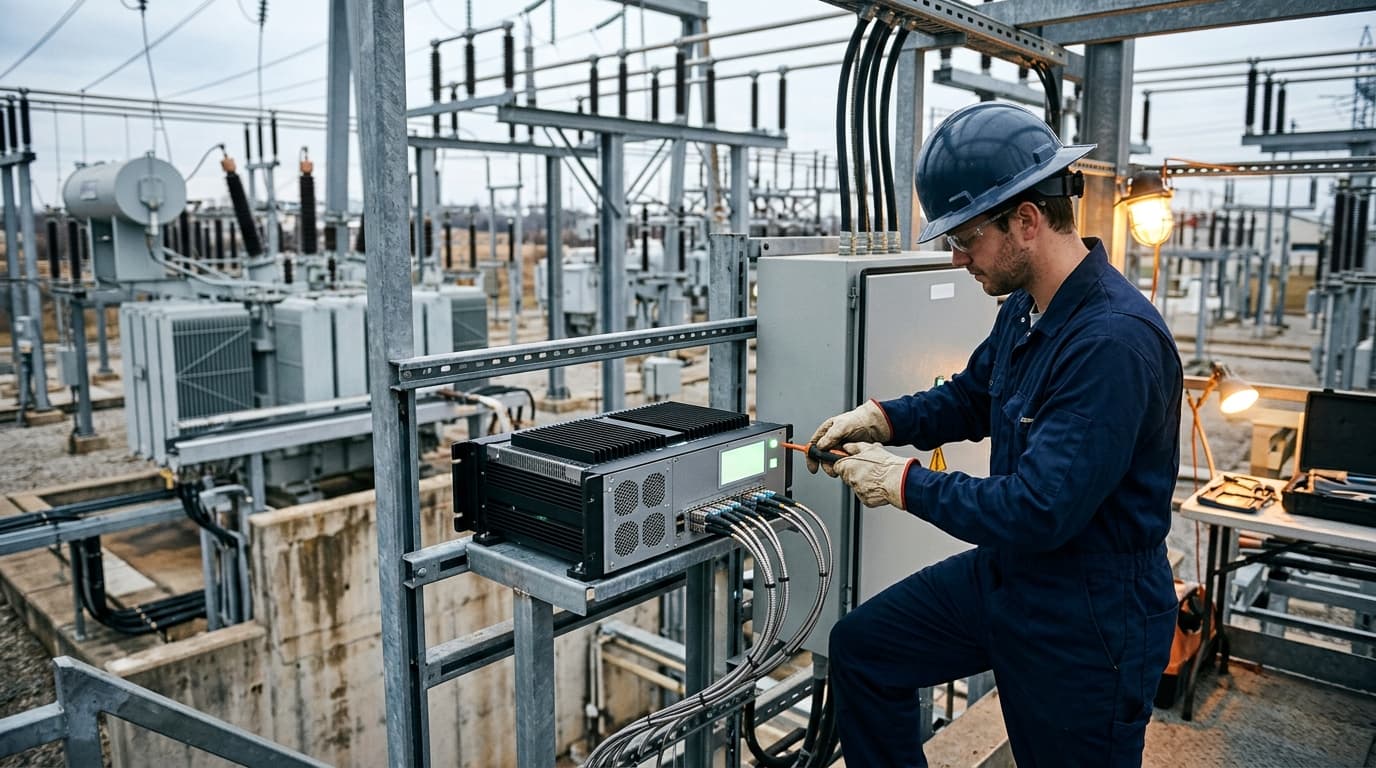
The Energy pillar is the most concrete instantiation of the strategy. HMAX Energy, launched March 24, 2026, covers switchgear, transformers, full substations, HVDC links, and power-quality solutions. The compute story is industrial-grade edge: Hitachi is using NVIDIA IGX Thor at the asset edge so that data is processed locally and only relevant signals are forwarded to control centers — a deployment topology dictated as much by deterministic latency and bandwidth realities as by data-sovereignty constraints. Hitachi cites reference cases reducing revenue loss from equipment breakdowns by up to 60% through faster emergency response and failure prevention, and its HMAX Energy product page details the scope across utilities, renewables, industries and data centers.
The other half of the mission-critical stack is asset management and OT security. Hitachi Energy in January reinvented its Ellipse Enterprise Asset Management product with Microsoft AI, explicitly aimed at critical-infrastructure resilience — i.e., OT asset records, not plant MES. The Nozomi Networks partnership wraps OT/IoT monitoring around the same surface. Notably, OT cyber sits inside the AI stack here, not bolted on after the fact.
Why mission-critical changes the AI stack
The marketing line is cleanest when it lines up with engineering. Mission-critical infrastructure imposes different non-functional requirements than a paint line or a brewery:
- Availability SLAs. Siemens' own pitch for AI-driven rail predictive analytics claims 99%+ service availability for fleet operators, including its work on the Brightline West LA–Las Vegas project. That is the operational bar against which Hitachi's mission-critical positioning is implicitly benchmarked.
- Asset lifecycles. Substations, HVDC equipment and rail-signaling LRUs run on 20–40 year horizons. AI that ships on a 12-month consumer-grade cadence does not map cleanly to that.
- Edge-resident inference with deterministic latency. The IGX Thor footprint in HMAX Energy reflects this — protective-relay-adjacent decisions cannot wait on a cloud round-trip.
- OT-grade change control. Pushing a model update to a substation is not the same as deploying a container to a CPG plant; the regulatory and certification surface is materially larger.
- Adversarial-OT security. The Nozomi integration concedes the obvious: AI-enabled OT expands the attack surface, and treating that as a separate procurement is not viable for critical infrastructure operators.
Contrast 1 — Stellantis/Accenture/NVIDIA: digital-twin auto manufacturing
On May 18, 2026, Stellantis, Accenture and NVIDIA announced a strategic partnership for AI-driven digital-twin manufacturing built on NVIDIA Omniverse, with initial pilots in North American plants in 2026. This is a serious, well-resourced bet — but it is squarely discrete automotive manufacturing. Throughput, quality, line balancing, and product-launch acceleration are the natural KPIs. There is no public-safety SLA on the line, no NERC-CIP-equivalent regulatory floor, no 30-year transformer the model has to coexist with. It is a different game played with different rules, and conflating it with Hitachi's frame would let buyers and analysts mis-scope both stacks.
Contrast 2 — Laminar: chemical-process AI on existing pipes
Somerville-based Laminar took Gold at the 2026 Edison Awards in Manufacturing & Logistics for self-driving factory technology, with deployments at AB InBev, Coca-Cola and Unilever. The technical hook is in-pipe spectroscopy sensors retrofitted onto existing piping, feeding a process-control model. In May, Laminar promoted Sanjay Rajan to CRO, explicitly to scale its Chemical-Process AI platform into food & beverage, chemicals, pharma and CPG.
Process plants are continuous, capital-intensive, and unforgiving — but they are commercial process plants, not public infrastructure. The economics are throughput, yield, and giveaway; the regulators are FDA, USDA, and state environmental agencies, not FERC or rail-signaling certifiers. The Laminar story is a strong one, and the Edison Gold is real validation. It is also not the same problem Hitachi has framed itself around.
Where Hitachi competes head-on: Siemens and ABB
The honest competitive surface for HMAX Energy is not Stellantis and not Laminar. It is Siemens — which used its own CES 2026 keynote to frame industrial AI as embedded end-to-end across design, engineering and operations — and whose SICAM portfolio is the direct substation-automation competitor to Hitachi Energy. ABB sits adjacent on the electrification side, particularly in the data-center grid build-out. Hitachi's choice to lean explicitly on the "social infrastructure" label looks like a vendor-frame move designed to differentiate inside that specific peer group.
Independent analyst validation has followed the positioning. Hitachi Digital Services was named a Leader in all three categories of the 2026 ISG Provider Lens Intelligent Robotics and Physical AI Services report — Consulting & Transformation, Integration & Engineering, and Managed Services / RaaS — which matters less for the badge than for what it implies about Hitachi's integrator depth on the physical-AI side.
Does mission-critical lift the floor — or does the market bifurcate?
The open question is whether the OT-grade bar pulls the whole industrial-AI market up, or whether buyers settle into a clean split between plant-floor AI and grid/rail-grade AI. The bifurcation case is the stronger one for now. Discrete and process-AI vendors are optimizing throughput, quality and yield, where good-enough latency and best-effort availability are acceptable trade-offs. Grid and rail AI have to clear OT-grade availability targets, asset-lifecycle compatibility, certification regimes, and adversarial-OT security — bars that Stellantis's Omniverse pilots and Laminar's spectroscopy retrofits simply are not asked to clear today.
The cross-pollination will be real at the edges. Discrete and process vendors will adopt edge inference and OT security as their customers' insurers and auditors catch up. But the substation/rail/HVDC stack is structurally different enough that a single "industrial AI" label is doing more harm than good in 2026.
Implications for buyers
Operators evaluating the HMAX Energy pitch — utilities, ISO/RTO members, large industrial loads, hyperscaler grid teams — should test the boring things, not the demo. Edge inference latency and the actual IGX Thor footprint inside the substation enclosure. OT change-control workflows and whether they survive an internal audit. Integration with existing EAM and SCADA stacks, including Ellipse if it is already in-house. Model-update cadence and rollback paths under a NERC CIP regime. Model accuracy will be the easiest box to check; everything around it is harder.
Discrete and process buyers should run the inverse test: when a vendor cites a mission-critical reference, ask whether the underlying SLA matches your operation, or whether you are buying availability you do not need at a price you should not pay. The Stellantis–Accenture–NVIDIA and Laminar pitches are credible inside their lanes. They are not substitutes for what Hitachi is selling — and HMAX Energy is not a substitute for them either.
Hitachi's CES 2026 framing is a product story and a vendor-positioning move in the same breath. Watch whether Siemens and ABB respond with a similarly explicit mission-critical AI frame in the back half of 2026, or whether they hold the broader industrial-AI label and force Hitachi to defend the narrower lane it just claimed.
Related reading
Sources
-
Hitachi ignites CES 2026 unveiling key collaborations with NVIDIA, Google Cloud and Nozomi Networks
-
Hitachi reinvents Ellipse EAM with Microsoft's AI-enabled technology (January 2026)
-
Hitachi's Industrial AI for Mission-Critical Infrastructure — AI Magazine
-
Laminar Wins Gold at 2026 Edison Awards for Advancing Self-Driving Factory Technology
-
Laminar Promotes Sanjay Rajan to CRO as Industrial AI Demand Expands in Process Manufacturing
-
Siemens unveils technologies to accelerate the industrial AI revolution at CES 2026
-
High-speed rail and AI: Transforming US infrastructure — Siemens