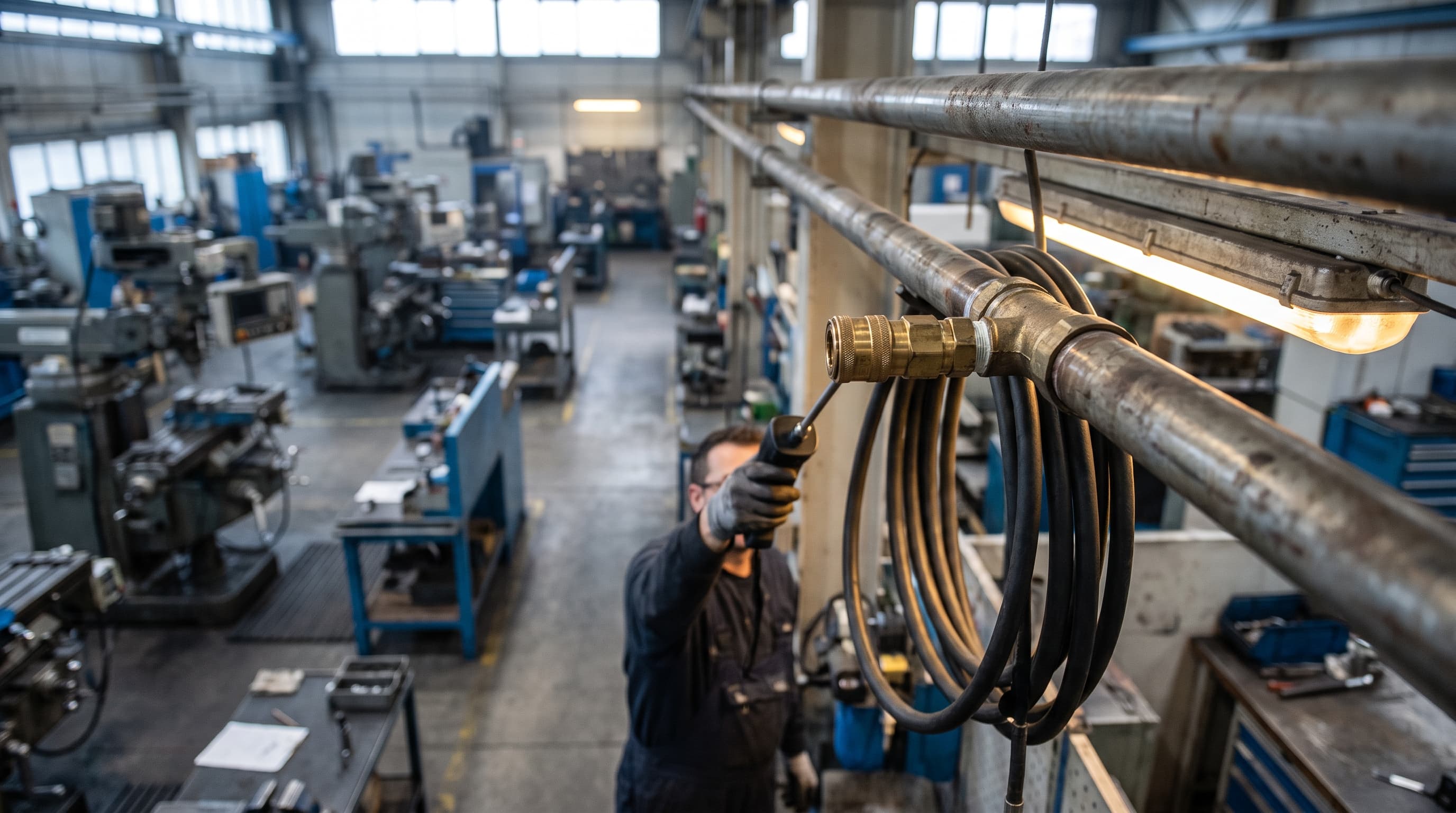
Compressed air leak detection starts with a flow baseline taken while production is off. Next, find leaks with an ultrasonic detector or acoustic imager, then tag and log each one. Price each leak as cfm × kW per cfm × hours × $/kWh and fix the best payback first. Finally, check the savings by retesting and reading compressor power.
-
Baseline: measure leak flow during non-production hours with a load/unload test, a receiver pressure-decay test or a flow meter.
-
Detect: survey with soapy water, a handheld ultrasonic unit or an acoustic imager.
-
Tag and log: number every leak, photograph it, and record its location, size and the part it needs.
-
Price and rank: turn each leak into an annual dollar cost and fix them in order of dollars saved per repair dollar.
-
Verify: rerun the baseline and confirm the compressor draws less power.
Why the hiss belongs in the energy budget
If the compressor keeps cycling on a Sunday with every line down, that air is escaping through couplings, hoses, drains and worn fittings. The power used to compress it costs the same per kilowatt-hour as the power that runs a press. Leaks make noise, not scrap, so they are easy to leave out of the energy budget.
The load is not small. A DOE survey found that about 10% of the electricity in a typical industrial facility goes to making compressed air, and 30% or more at some facilities, according to New Hampshire's Department of Environmental Services. DOE's Compressed Air Tip Sheet #3 says leaks are "often wasting as much as 20%-30% of the compressor's output." The Compressed Air Challenge says a well-maintained system should lose less than 10%, and DOE sets a cost-effective target of 5 to 10% of total system flow.
The worst cases are far higher. Ron Marshall of the Compressed Air Challenge writes that experienced auditors have found plants losing more than 80% of their air to leaks. He also notes that DOE studies found only about 50% of compressed air is used effectively.
The price of power sets what each cubic foot of air is worth. The US average industrial retail price was 9.17 cents/kWh in June 2026, up from 8.90 cents in June 2025, according to EIA's Electric Power Monthly. Prices vary widely by state: 4.62 cents in New Mexico, about 6.7 to 6.9 cents in Louisiana and Tennessee, 20.74 cents in California and 43.37 cents in Hawaii. By our math, the same leak costs a California plant about 4.5 times what it costs a plant in New Mexico.
Step 1: Set a flow baseline
A baseline tells you how much air the system loses when nothing should be using it. Without one, you cannot show what a leak survey saved. Run the test during non-production hours, on a weekend or between shifts, with end uses shut off. Three methods cover most plants.
Load/unload timing test
For compressors with start/stop or load/unload controls, shut off the end uses and time the compressor through its cycles. The Compressed Air Challenge formula, from Marshall's "Finding and Fixing Leaks", is:
Leakage % = (T × 100) / (T + t), where T is minutes on load and t is minutes off load.
For example, a compressor that runs loaded for 3 minutes and unloaded for 12 minutes shows (3 × 100) / 15 = 20% leakage. That falls within DOE's 20 to 30% warning range. Time several cycles and use the average.
Receiver pressure-decay test
For systems with a receiver, bring the system up to operating pressure, stop the compressor and time how long pressure takes to fall to a lower set point. The formula is:
Leakage (cfm free air) = (V × (P1 - P2) / (T × 14.7)) × 1.25
V is the system volume in cubic feet, counting receivers plus piping (divide gallons by 7.48 to get cubic feet). P1 and P2 are the starting and ending pressures in psig, and T is the time in minutes. The 1.25 factor corrects for leaks slowing down as pressure falls. For example, a 100-cubic-foot system that falls from 100 to 80 psig in 2 minutes gives (100 × 20 / 29.4) × 1.25, or about 85 cfm.
Permanent flow meter
A thermal-mass flow meter on the main header turns a one-time test into a trend line. Marshall's first practice for a leak program is to baseline and monitor flow. A reading taken every weekend shows whether leaks are creeping back between surveys.
Convert air to kilowatts
Record how many kilowatts the compressor room draws for every 100 cfm it delivers. Marshall's cost example uses 18.4 kW per 100 cfm, a common benchmark if you have no metered data. If you can log compressor power during the baseline test, use your own figure. That number turns every cfm on the leak list into dollars. DOE's free MEASUR software has more than 40 calculators. Some cover compressed air and can be used to baseline a system and value savings measures.
Step 2: Choose a detector
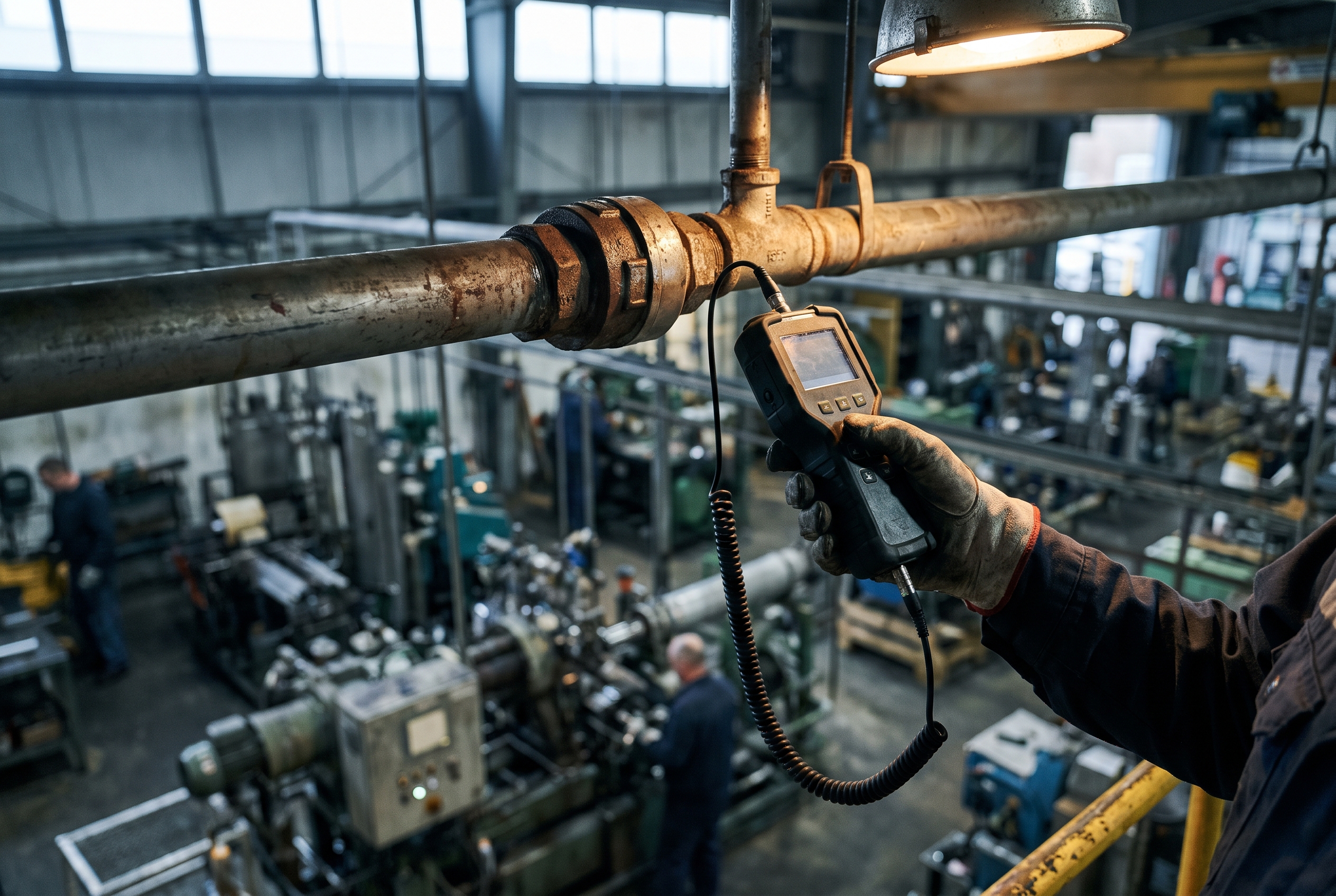
The Compressed Air Challenge calls ultrasonic acoustic detectors the preferred method. They are fast, they work while equipment is running, and operators become competent after about 15 minutes of training. Soapy water still works on fittings you can reach.
| Method | Cost | Notes |
|---|---|---|
| Soapy water | Minimal | Works on accessible fittings; useful to confirm a suspected leak |
| Handheld ultrasonic detector | About $500 to $10,000 (Marshall 2020) | Fast; works with equipment running; about 15 minutes of training (CAC) |
| Acoustic imager | List prices of $8,999.99 (Fluke ii500), $21,299.99 (ii905) and $26,599.99 (ii915) (Fluke) | Top of the price range; compare against a contractor's survey quote |
Before buying, try each candidate on your noisiest line and your highest overhead pipe runs, since those are where a survey slows down. Then work out the cost of ownership. CAC recommends testing leak levels quarterly, so a plant that owns a detector will use it at least four times a year. A plant planning a single sweep can weigh a survey contractor's quote against the tool price plus staff hours.
Know where to point it. DOE lists the usual leak points as couplings, hoses, tubes, fittings, pipe joints, quick disconnects, filter-regulator-lubricators (FRLs), condensate traps, valves, flanges, packings, thread sealants and point-of-use devices.
Step 3: Tag and log every leak
Finding a leak is half the job; the log is what gets it fixed. DOE and CAC both list identification, including tagging, as one element of a leak program. The others are tracking, repair, verification and employee involvement. Marshall recommends putting a tag at each leak and keeping a photo database.
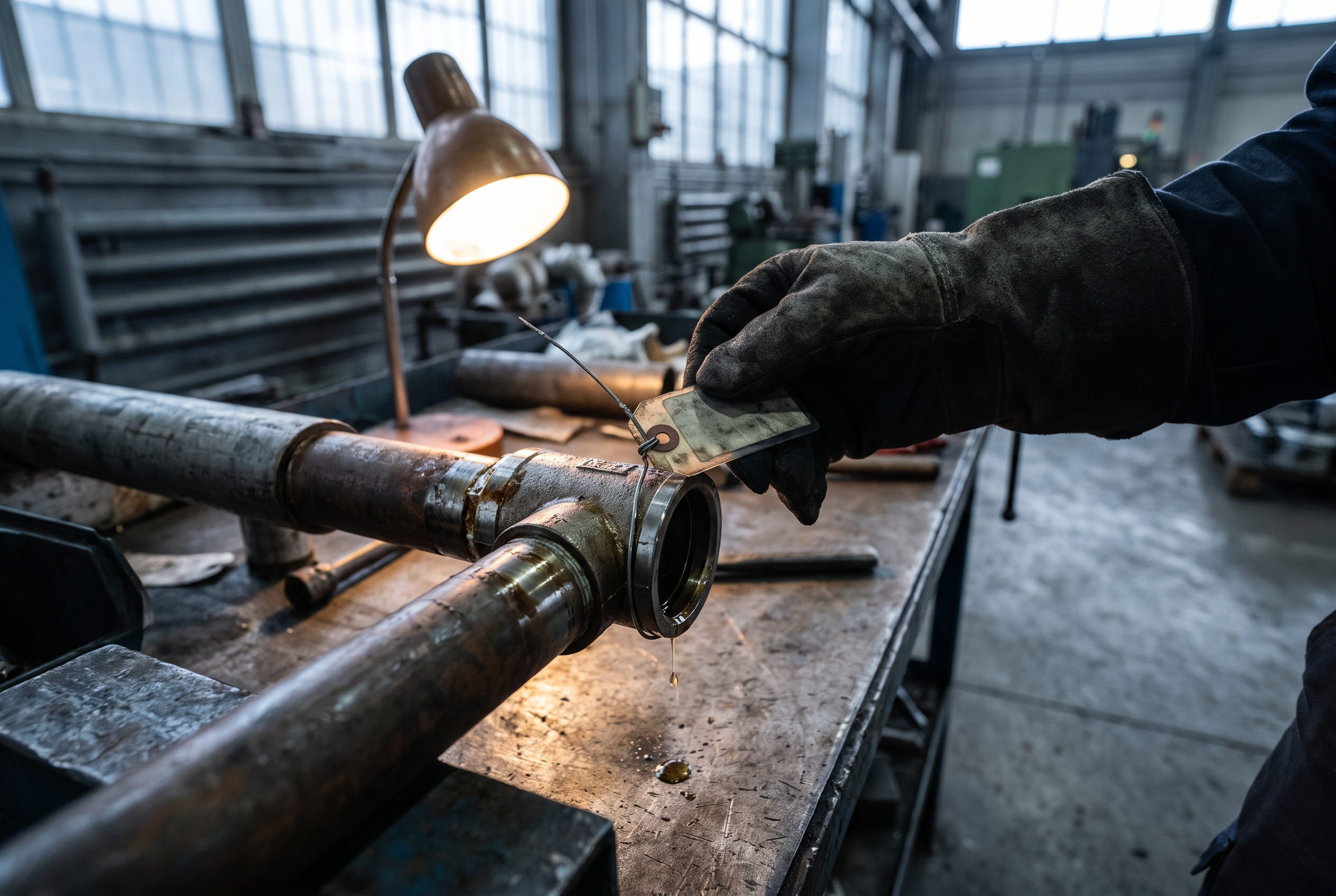
For each leak, record:
-
A numbered tag hung at the leak, matching its log entry
-
A photo and a precise location (line, machine, column number)
-
Estimated flow in cfm
-
The part needed to fix it
-
Whether the repair needs a shutdown or can be done with the system live
-
An owner and a due date
If the plant runs a CMMS, a work order there is the natural place for each entry. If it does not, a spreadsheet works. Trade coverage of MEASUR describes a bag-method leak estimator, a leak cost calculator and a way to track survey results, which gives plants without a CMMS a free alternative.
Step 4: Put a dollar figure on each repair
The pricing formula is:
Annual cost = cfm × kW per cfm × operating hours × $/kWh
The often-quoted claim that one 1/16-inch leak costs more than $1,000 a year comes from Marshall's 2020 article. He assumed 24/7 operation, $0.10/kWh and 18.4 kW per 100 cfm. Fluke gives a similar figure of $1,046 a year for a 6.5 cfm leak, attributed to DOE. The figure changes with current prices and shift patterns. The table below shows our calculations, all at 18.4 kW per 100 cfm:
| Leak | Flow | Hours per year | Power price | Annual cost |
|---|---|---|---|---|
| 1/16 in. at 100 psig | 6.5 cfm | 8,760 (24/7) | 9.17 cents (US avg.) | about $960 |
| 1/16 in. at 90 psig | 5.72 cfm | 8,760 (24/7) | 9.17 cents | about $845 |
| 1/16 in. at 100 psig | 6.5 cfm | 8,760 (24/7) | 10 cents | about $1,050 |
| 1/16 in. at 100 psig | 6.5 cfm | 2,080 (one shift) | 9.17 cents | about $230 |
| 1/16 in. at 90 psig | 5.72 cfm | 2,080 (one shift) | 9.17 cents | about $200 |
| 1/16 in. at 100 psig | 6.5 cfm | 8,760 (24/7) | 20.74 cents (California) | about $2,170 |
| 1/16 in. at 100 psig | 6.5 cfm | 8,760 (24/7) | 4.62 cents (New Mexico) | about $480 |
| 1/8 in. at 100 psig | 26.1 cfm | 8,760 (24/7) | 9.17 cents | about $3,860 |
The 6.5 cfm figure at 100 psig is the common reference value. DOE's orifice table gives 5.72 cfm for a 1/16-inch hole at 90 psig. Hole size moves the number more than anything else in the table. Leak flow scales with the square of the hole diameter, so a 1/8-inch hole passes 26.1 cfm at 100 psig. That is about four times the flow of a 1/16-inch leak (Plant Engineering).
Use the right hours. A one-shift plant that keeps the header pressurized overnight and all weekend pays for leaks during all of those hours. Use the hours the system is pressurized, not the production hours.
Once every leak has a dollar figure, divide its annual cost by its repair cost (parts plus labor) and work down the list. For example, take two leaks that each cost $960 a year. One is at a quick disconnect and takes $50 to fix, a score of about 19. The other needs a $400 regulator job, a score of 2.4. At 24/7 operation both pay back in less than a year, but the cheap one goes first. Save repairs that need a shutdown for the next planned outage rather than forcing one.
Step 5: Verify the savings on the meter
After repairs, rerun the same baseline test under the same conditions. Compare compressor kW and runtime against the first reading. Marshall's fourth practice is verification with monitoring, and DOE lists verification as a program element.
Verification is what separates a leak program from a leak survey, because fixing leaks cuts flow but may not cut kilowatts. A compressor running at 70% of capacity can still draw about 90% of full power, according to Atlas Copco's Bob Baker in Plant Engineering. The savings reach the bill only if the controls let the compressor cut power as demand drops. That takes load/unload control with enough storage, a variable speed drive, or a sequencer that shuts machines off.
Check the control mode before promising a savings number to finance. If the retest shows flow down but kW flat, the leak repairs worked. The problem is on the supply side, in the controls.
Make it stick
-
Test quarterly. CAC recommends checking leak levels every quarter. Rerun the Step 1 test each time so the results can be compared.
-
Involve operators. DOE and CAC both list employee involvement as a program element. Ultrasonic detection takes about 15 minutes to learn, so operators can tag leaks on their own lines.
-
Lower header pressure. For systems around 100 psig, every 2 psi of extra discharge pressure takes about 1% more energy at full load. Unregulated leaks pass about 1% more flow per psi (Marshall 2020; Plant Engineering). In Atlas Copco's example, raising pressure from 100 to 125 psig added 22 cfm of leakage.
-
Isolate idle zones. Valves that shut off air to areas that are not running stop the leakage in those zones off-shift. PLENCO cut its off-shift losses 62% this way (see below).
What results look like
Compressed Air Best Practices reported results from DOE Better Plants partners in September 2022:
-
Schneider Electric fixed more than 250 leaks across six plants and saved $60,000 a year.
-
RING Container found more than 1,900 cfm of leaks using about 1.5 million kWh a year, and saved $138,000 a year.
-
PLENCO installed isolation valves that cut off-shift losses by 62%. That saved 406,000 kWh and $35,000 a year, with a 1.5-year payback.
Plants want the skills. Compressed air has been the most requested of Better Plants' in-plant system trainings since they began in 2011.
The capex angle: fix leaks before you buy a compressor
If a plant loses 20 to 30% of its compressor output to leaks, a new compressor sized to today's measured demand is partly sized to feed those leaks. Run the leak program first, rerun the baseline, and size the replacement to what the plant uses. The same applies when low pressure at the far end of the header makes a second machine look necessary. Check leaks and header pressure before assuming the answer is more capacity.
For plants that want an outside audit before a major purchase, ISO 11011:2013 sets requirements for conducting and reporting a whole-system compressed air energy assessment. It covers supply, transmission and demand, and includes estimated energy savings. Asking each bidder whether their assessment follows the standard makes proposals easier to compare.
The operator's takeaway: a leak program is an energy project with a measured baseline and a ranked repair list. It needs a verification step that reads the kilowatt meter, not only the flow meter. Of the three steps, verification is the one most likely to show whether the savings reached the bill.
Related reading
Sources
-
U.S. DOE, Energy Tips: Compressed Air Tip Sheet #3, Minimize Compressed Air Leaks
-
Bob Baker, Atlas Copco, "Compressed air leaks leads to lost money," Plant Engineering, Mar. 7, 2017
-
Fluke, "How an air leak detector will help you optimize your compressed air systems"
-
ISO 11011:2013, Compressed air: Energy efficiency, Assessment (ANSI Webstore)