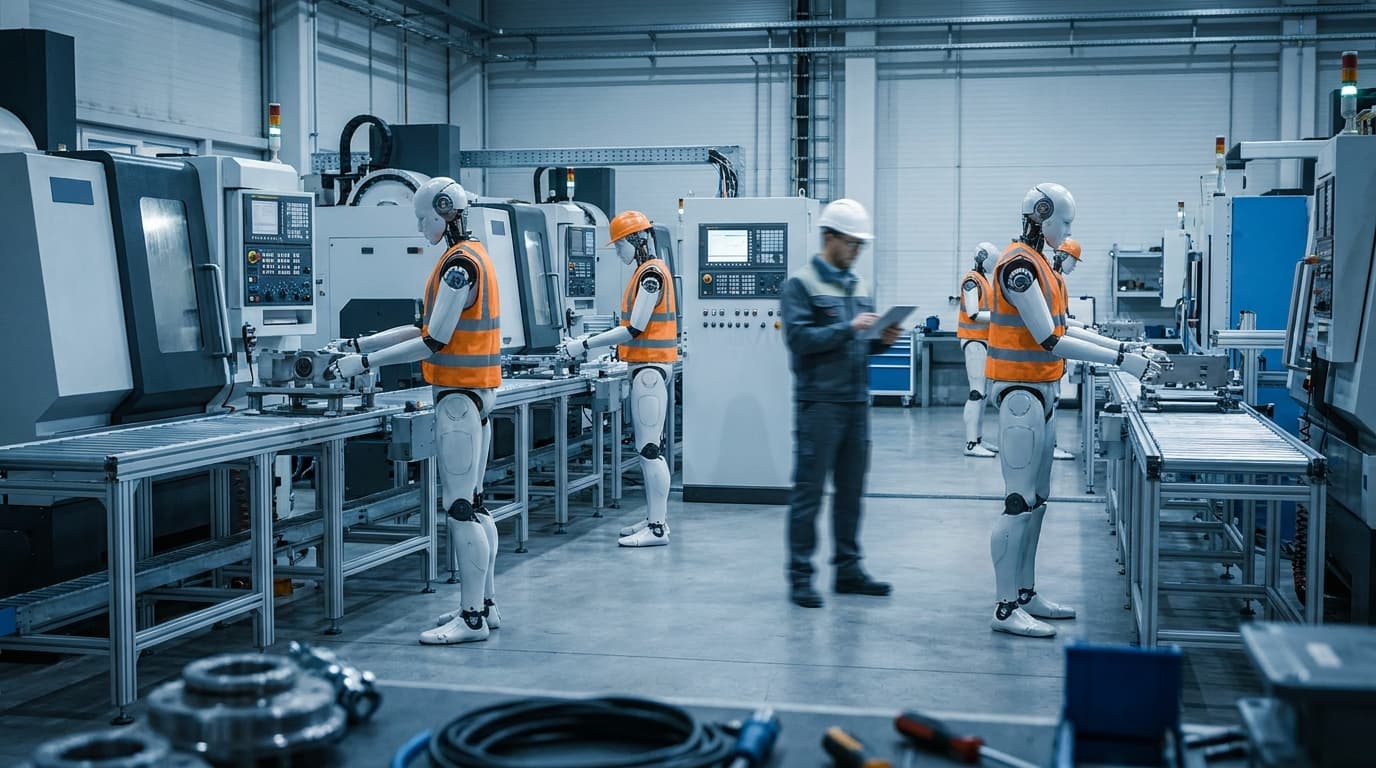
For most of the last three years, the humanoid robot was a keynote prop — a bipedal machine folding laundry or carrying a tote across a staged demo floor, narrated in the future tense. In 2026 that narration changed. Humanoids crossed from rendered roadmaps into binding commercial contracts, and the clearest marker of that shift came in mid-May, when UK-based startup Humanoid disclosed a phased, binding deployment-and-supply agreement with auto-parts giant Schaeffler. The plan: field a four-digit number of wheeled humanoid units across Schaeffler's global plants by 2032 (Humanoid).
That is no longer a demo. It is a procurement line item — among the largest disclosed humanoid rollouts to date (DC Velocity). And it forces the question every operations and capital-allocation executive now has to answer: at roughly $90,000 to $100,000 per Western pilot unit today, does the math work — and does it work before the asset depreciates? The deeper wager underneath Schaeffler's signature is a cost curve. Bank of America projects the bill of materials for a humanoid falling toward $13,000–$17,000 by 2030–2035 (Bank of America Institute). Schaeffler is, in effect, betting that the cliff edge is close.
The deals, side by side
Three 2026 commitments anchor the shift, and they differ meaningfully in what they actually obligate versus what they merely demonstrate.
Humanoid / Schaeffler is the most structurally significant because it is binding and phased. The initial phase runs December 2026 through June 2027 across two German sites: Herzogenaurach, where units handle box-moving inside live production, and Schweinfurt, which gets a three-month capability demonstration plus integration, followed by a three-month continuous-operation validation near full scale (Humanoid). Critically, the deal is not a straight equipment purchase. It uses a Robot-as-a-Service (RaaS) model — robots plus fleet software, maintenance, 24/7 support, and updates — and it bolts on a separate five-year actuator supply agreement that makes Schaeffler the preferred supplier for more than half of Humanoid's joint-actuator demand for wheeled platforms through 2031, a projected seven-digit number of actuators. The customer, in other words, is also a key component vendor.
Figure / BMW Spartanburg is the most data-rich. Figure's Figure 02 completed an approximately 11-month pilot (10 months at full deployment) at BMW Group Plant Spartanburg, working 10-hour shifts Monday through Friday. The tally: more than 1,250 run-hours, over 90,000 sheet-metal parts loaded at roughly 99% part-loading accuracy, contributing to more than 30,000 BMW X3 vehicles. That operational data fed directly into the design of the next-generation Figure 03 (Figure; ASSEMBLY).
BMW Leipzig / Hexagon AEON extends the trend to Europe. BMW began deploying Hexagon Robotics' AEON humanoid at Plant Leipzig, with an operational debut in December 2025 and scaling toward deeper pilot integration in summer 2026 — including high-voltage EV battery work. AEON is a 1.65-meter, 60-kilogram machine moving at up to 2.5 m/s, carrying 22 sensors, capable of self-swapping its own batteries and learning tasks through imitation from roughly 20 demonstrations (BMW Group; Hexagon Robotics).
The pattern across all three: the work is unglamorous and repetitive — box handling, sheet-metal loading, strain-heavy battery tasks — and the metrics being tracked are run-hours, uptime, and part accuracy, not dexterity stunts. That is what a maturing technology looks like.
The cost cliff, explained
The economics turn on a single contested number: what a humanoid costs. Bank of America's framing is the most useful because it separates the layers. A Western, pilot-stage humanoid runs about $90,000–$100,000 per unit today. A China-sourced bill of materials — the raw component cost — was roughly $35,000 at the end of 2025. And BofA projects that BOM falling to about $13,000–$17,000 per unit by 2030–2035, a decline of more than 50%, driven by spec standardization, manufacturing scale, and China's component supply chain (Bank of America Institute; Fortune).
The trap for operators is conflating those numbers. A $35,000 BOM is not a $35,000 robot on your floor. BOM excludes systems integration, software, the RaaS service wrap, maintenance, and support — exactly the layers that make a fleet actually run inside a live plant. The headline unit price that gets quoted in coverage and the all-in cost of fielding a reliable fleet are different animals. Schaeffler's choice of a service model rather than outright purchase is partly an acknowledgment of that gap: the per-unit hardware figure is the smallest part of the total commitment.
Other analysts bracket BofA's numbers. Goldman Sachs cites a current humanoid unit cost of roughly $30,000–$150,000, down from $50,000–$250,000 a year earlier — about 40% in year-over-year cost cuts (Robotics & Automation News). The direction is not in dispute. The timing and the floor are.
The economics that decide it
For an operator, the deal lives or dies on a race between two clocks: how fast a humanoid pays back its cost through saved labor, and how fast the hardware obsolesces.
On payback, the supporting data is encouraging. Industrial-robot payback periods fell from about 5.3 years in 2019 to roughly 1.3 years in 2024, per McKinsey, and humanoid manufacturing paybacks are commonly cited in the 18-to-36-month range — fastest in high-wage economies, where the labor-arbitrage spread is widest (Robotics & Automation News). That is precisely why a high-wage German auto-parts maker is an early signer rather than a laggard: the savings per displaced labor-hour are largest exactly where Schaeffler operates.
But payback assumes utilization. The ROI is a function of effective output — uptime, accuracy, and the share of a shift the robot is actually productive rather than idle, charging, or waiting on an engineer. Figure's 99% part-loading accuracy and 1,250-plus run-hours matter precisely because they are the inputs that make a payback model real instead of aspirational. A humanoid that works 10-hour shifts at near-perfect accuracy is an asset; one that needs constant supervision is an expensive demonstration.
The obsolescence clock is the harder problem. Figure 02 generated its BMW data and then handed the lessons to Figure 03 — meaning the pilot units were superseded by their own successor. If next-generation hardware lands every 12 to 24 months while paybacks run 18 to 36 months, an operator who buys outright risks owning depreciated assets before they have finished paying for themselves. That tension is the single strongest argument for the model Schaeffler chose.
RaaS versus capex ownership
Robot-as-a-Service reshapes the risk. Under the Schaeffler structure, there is no upfront per-unit capital outlay; the customer pays an ongoing fee for robots plus the software, maintenance, support, and updates that keep them running (Humanoid). For the operator, that converts a depreciating capital asset into an operating expense and pushes obsolescence risk back onto the vendor — if the hardware refreshes, that is the vendor's problem to amortize, not a stranded line on the customer's balance sheet.
It is also a signal worth reading in the other direction. A vendor willing to carry units on a service basis is making a statement about per-unit reliability and lifetime cost — RaaS only pencils for the supplier if the robots stay up and the support burden stays bounded. The model aligns incentives around uptime, which is the same variable the operator's payback depends on. The actuator supply leg deepens the alignment further: Schaeffler is buying robots as a service while selling the joints that go into them, hedging its bet on both sides of the transaction.
The reshoring paradox
Here is the uncomfortable part. The cheapest route to that $13,000–$17,000 BOM runs straight through Chinese supply chains — the same chains that automation and reshoring were, in part, meant to circumvent. BofA is explicit that China's component ecosystem is a primary driver of the projected cost decline (Bank of America Institute).
And Chinese vendors are not waiting for the 2030 curve; they are already pricing below it. Unitree's G1 lists at roughly $13,500–$16,000 — at or under BofA's projected 2030 Western BOM target — its ultra-light R1 at about $5,900 (¥39,999), while its enterprise-grade H1 runs roughly $90,000–$150,000 (The Robot Report; Automate.org). Unitree shipped more than 5,500 humanoid units in 2025 — roughly a third of global output — grew revenue 335% year over year, and filed for a roughly $610 million Shanghai IPO in March 2026.
The strategic bind is plain. A US or EU operator deploying humanoids to reduce dependence on foreign labor and supply chains may, by chasing the lowest unit cost, deepen its dependence on Chinese components and Chinese-built robots. The cheapest humanoids will likely come from the very supply chain that reshoring rhetoric targets. Schaeffler's actuator deal — building joint-supply capacity inside Europe — reads, in that light, as an attempt to keep at least part of the value chain onshore even as the broader cost curve bends toward China.
Operator takeaways
For executives weighing whether 2026's pilots translate into durable line economics, a few things separate signal from noise:
-
The first use cases that pencil are narrow and strain-heavy. Sheet-metal loading and box handling (Figure at Spartanburg, Humanoid at Herzogenaurach) and high-voltage EV battery work (AEON at Leipzig) — repetitive, ergonomically punishing tasks in high-wage plants — are where the labor-arbitrage math is most favorable today.
-
Watch effective output, not headline price. Uptime, part-loading accuracy, and run-hours are the variables that make a payback model real. Figure's ~99% accuracy over 1,250-plus hours is the kind of evidence that matters; a sticker price is not.
-
Treat per-unit cost as the smallest line. Integration, software, and service dominate the true cost of a fielded fleet. The $35,000 BOM is not the number you will pay.
-
Secure the supply chain you are betting against. If the cost curve runs through China, component-supply security — the logic behind Schaeffler's actuator agreement — becomes a strategic question, not a procurement footnote.
-
Favor structures that absorb obsolescence. With hardware generations turning over faster than paybacks complete, RaaS shifts depreciation risk to the vendor and keeps the operator from owning yesterday's robot.
The longer-run forecasts are deliberately vast — BofA projects roughly 3 billion humanoids globally by 2060, and McKinsey estimates humanoids could fill about 4% of manufacturing labor demand by 2030 (Fortune; Robotics & Automation News). Those numbers will rise and fall with every quarterly revision. What is concrete is narrower and more telling: in 2026, a tier-one auto-parts supplier signed a binding contract for thousands of machines that do not yet exist at the price the model assumes, on the bet that the cost cliff arrives before the depreciation does. Whether 2026's pilots convert into durable line economics is the open question. Schaeffler has already placed its chip.
Related reading
-
79% of U.S. Manufacturers Are Reshoring. Only 34% Can Actually Absorb the Work.
-
The $1.77 Trillion Reshoring Boom Isn't Showing Up in the Concrete
-
The 48D Cliff: Why Chipmakers Are Racing to Pour Concrete Before Dec. 31, 2026
Sources
-
[Humanoid — Humanoid Secures Landmark Deal with Schaeffler to Deploy Thousands of Humanoid Robots](https://thehumanoid.ai/humanoid-secures-landmark-deal-with-schaeffler-to-deploy-thousands-of-humanoid-robots/)
-
[DC Velocity — Schaeffler to use 'thousands' of humanoid robots in auto parts factories](https://www.dcvelocity.com/material-handling/robotics/schaeffler-to-use-thousands-of-humanoid-robots-in-auto-parts-factories)
-
Figure — F.02 Contributed to the Production of 30,000 Cars at BMW
-
[ASSEMBLY — Humanoid robots complete trial project at BMW assembly plant](https://www.assemblymag.com/articles/99678-humanoid-robots-complete-trial-project-at-bmw-assembly-plant)
-
BMW Group — First humanoid robot introduced in Plant Leipzig
-
[Bank of America Institute — Physical AI, part 2: Humanoid robots (12 March 2026)](https://institute.bankofamerica.com/content/dam/transformation/physical-ai-part-2.pdf)
-
Fortune — More people will own a humanoid robot than a car by 2060, BofA predicts
-
The Robot Report — Unitree Robotics unveils G1 humanoid for $16K
-
Automate.org — China's Unitree returns with an ultra-light, low-cost humanoid robot
-
[Robotics & Automation News — Humanoid robots show clearer ROI but commercial success depends on effective output](https://roboticsandautomationnews.com/2026/05/19/humanoid-robots-show-clearer-roi-but-commercial-success-depends-on-effective-output/101714/)