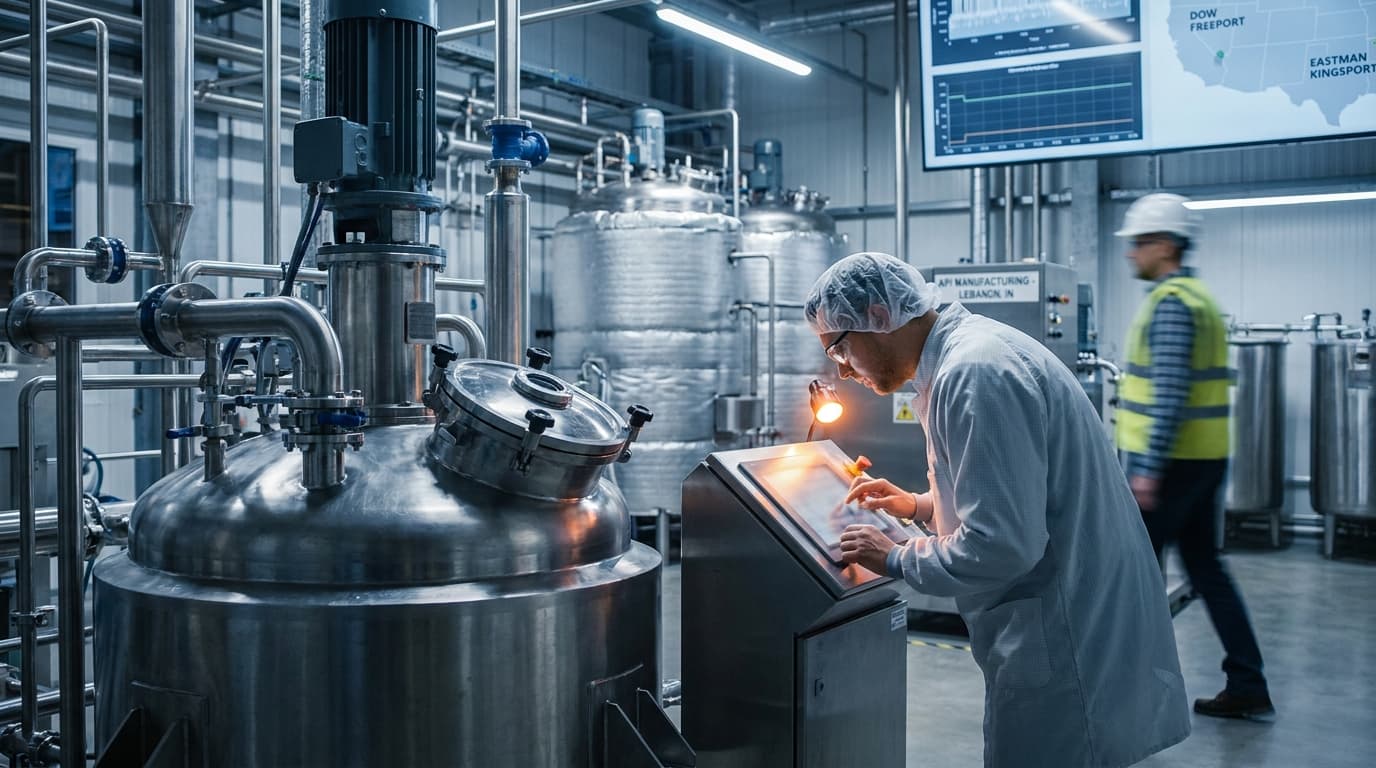
Eli Lilly is trying to do something American pharma has not attempted in a generation: stand up four new U.S. drug-substance plants while simultaneously doubling the largest active-pharmaceutical-ingredient (API) site in the country. The capital is committed. The constraint sitting underneath it is the U.S. process-engineering bench — the same bench that keeps Dow's Freeport, Texas complex and Eastman's Kingsport, Tennessee operations running.
The numbers leave little room for handwaving. On Feb. 26, 2025, Lilly pledged at least $27 billion for three new API sites — roughly $6 billion in Huntsville, Alabama, $6.5 billion in Houston, and $5 billion in the Richmond, Virginia area — plus a fourth parenteral plant. CNBC reported the pledge takes Lilly's post-2020 U.S. manufacturing capex past $50 billion. Lilly itself says the four sites will create more than 3,000 permanent engineering and scientific jobs on top of 10,000 construction roles.
Then, on May 6, 2026, the company added another $4.5 billion to its Lebanon, Indiana API megasite, bringing total invested capital there to roughly $18 billion. Fierce Pharma documented the add-on; Lilly's own disclosures tie the buildout to tirzepatide and the broader incretin pipeline. Lebanon is on track to be the largest API production complex in U.S. history when it opens in 2027.
The simultaneity problem
The schedule is what makes the labor math hard. The $2 billion Concord, North Carolina injectables plant started commercial production at the end of 2024 and is still ramping toward roughly 600 jobs. Lebanon needs operators and engineers in seats before its 2027 startup. Huntsville, Houston, and Richmond will be staffing in parallel.
Lilly is not the only buyer. Pfizer's $750 million Kalamazoo expansion, announced in late 2022, is bringing on roughly 300 new jobs that explicitly include process engineers, scientists, and operators, with first new operations expected from 2025. Novo Nordisk's $4.1 billion Clayton, North Carolina expansion will phase in another 1,000 jobs between 2027 and 2029, on top of the 2,500 employees already on site.
That is four separate companies hiring against the same narrow specialty in the same 18- to 36-month window.
The role nobody has enough of
The contested profile is not a generic chemical engineer. It is a process engineer with cGMP experience, ideally with continuous-flow, peptide, or complex small-molecule background. The American Institute of Chemical Engineers has publicly described the pharma process-engineering role as one with a thin pipeline. Recruiter and trade-press analyses are blunter: Actalent identifies process engineers as a primary bottleneck for U.S. reshoring, and CSG Talent names process engineers, validation engineers, project managers, and site directors as the three- to five-year gaps. Pharmaceutical Executive has framed the qualified-talent shortfall as the binding constraint on reshoring, not capex.
Continuous-flow expertise is its own scarcity. A 2024 review in ACS Organic Process Research & Development documents pharma firms standing up dedicated flow-process divisions and competing for the same chemist–engineer interdisciplinary bench that specialty chemicals has trained for decades.
The pipeline math
The Bureau of Labor Statistics is the cold-water source. Its 2024–2034 Occupational Outlook projects chemical-engineer employment to grow about 3 percent over the decade, with roughly 1,100 openings per year — most from retirements and transfers, not net new demand. Pharma reshoring is competing with U.S. specialty chemicals expansions, semiconductor fab buildouts, and a graying incumbent workforce for a flow that small.
Lilly's stated 3,000-plus engineering and scientific hires across the four new sites alone equal nearly three years of the entire national chemical-engineer opening flow. That is before Pfizer Kalamazoo, Novo Clayton, or Lebanon's late-stage staffing.
What specialty chemicals is doing about it
Dow and Eastman are not standing still. Dow's Freeport, Texas complex is publicly recruiting 2025–2026 graduate process and R&D engineers via its campus graduate program. Eastman is actively posting process development engineer roles in Kingsport. Both companies are leaning into the same talent pool that pharma is now trying to drain.
Industry chatter has described retention bonuses and accelerated promotion tracks as part of the response, but neither company has publicly disclosed formal retention or counter-offer programs targeted at pharma poaching. Operators evaluating the talent contest should treat the visible posture — aggressive graduate recruitment and consistent process-engineering reqs in Freeport and Kingsport — as the verified signal, and treat richer counter-offer packaging as plausible but not confirmed.
Workforce development is the only real refill
There is no three-year solution that does not run through community colleges, AIChE pipelines, and apprenticeship programs. The geography of the new pharma plants — Alabama, Texas, Virginia, Indiana, North Carolina — overlaps almost perfectly with the Gulf Coast and Southeast specialty-chemicals corridor, which means the same regional technical schools and engineering programs feed both sectors. State and federal incentives that fund pharma capex without funding the corresponding pipeline expansion will produce plants that open under-staffed.
Outlook
Of the four new Lilly sites, Houston and Richmond will compete most directly with Gulf Coast and mid-Atlantic chemicals employers; Huntsville sits closer to aerospace and defense suppliers but still inside a tight regional engineering market. Concord is already showing the pattern — roughly 400 of an expected 600 jobs filled as the plant ramps. Operators and investors should watch for two signals through 2027: published time-to-fill metrics on cGMP process-engineering roles, and any visible compensation drift in specialty-chemicals job postings in Freeport, Kingsport, and the Houston Ship Channel. If U.S. process-engineer wages step-change upward in 2026–2027, the API reshoring thesis works but margins on downstream specialty chemicals will compress. If they do not, expect at least one of the four new Lilly sites to slip its staffing curve.
Related reading
Sources
-
Eli Lilly plans at least $27 billion in new U.S. manufacturing investments — CNBC
-
Lilly to invest $4.5B more into massive Indiana manufacturing complex — Fierce Pharma
-
Pfizer expands its major manufacturing network in Kalamazoo, Michigan — Pfizer CentreOne
-
Pfizer announces 300 new jobs amid a $750 million expansion near Kalamazoo — Bridge Michigan
-
Novo Nordisk plans $4.1B Johnston Co. expansion — NC Biotechnology Center
-
Chemical Engineers — U.S. Bureau of Labor Statistics Occupational Outlook Handbook
-
Reshoring Pharmaceutical Manufacturing and a Booming Pharma Market — Actalent
-
What a 100% Pharma Tariff Means for CDMOs and U.S. Manufacturing — CSG Talent
-
Three Ways to Close the Urgent Talent Gap — Pharmaceutical Executive
-
Process Engineers in the Pharmaceutical Industry — AIChE / ChEnected
-
2025–2026 Campus Graduate, Research and Development, Freeport, TX — Dow careers
-
Process Development Engineer, Kingsport, TN — Eastman careers