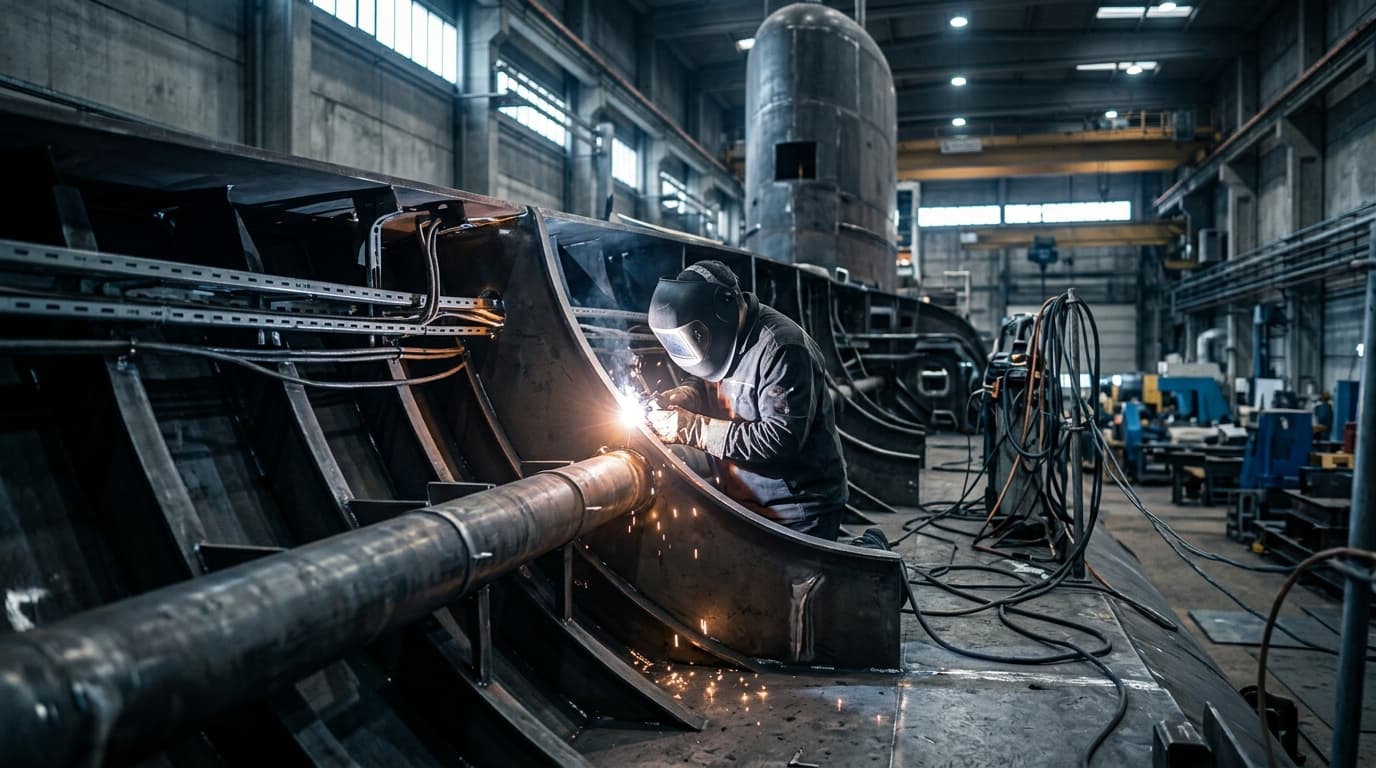
The U.S. Navy's submarine program has quietly become the largest sustained skilled-trades hiring effort in American manufacturing in a generation — and it is now competing, applicant by applicant, with the EV battery plants and semiconductor fabs that absorbed most of the headlines over the last three years. The binding constraint on Columbia-class and Virginia-class submarine output is no longer steel, castings, or shipyard real estate. It is welders, pipefitters, electricians, machinists, and nuclear-qualified trades, drawn from the same regional labor pools that auto OEMs and CHIPS-Act-funded fabs are also bidding for. For adjacent manufacturers, the implication is straightforward: wage pressure, supplier displacement under defense priority ratings, and a structural — not cyclical — tightening in skilled-trades supply.
The scale of the ask
Public targets cited by the Navy and by the BlueForge Alliance, the Navy-designated nonprofit integrator for the Submarine Industrial Base (SIB), call for roughly 100,000-plus new skilled tradespeople across the submarine industrial base over approximately a decade. The demand is anchored in three programs running in parallel: Columbia-class ballistic-missile submarines (SSBNs), Virginia-class attack submarines (SSNs), and the Virginia-class sales to Australia under AUKUS Pillar 1.
Columbia is the Navy's number-one acquisition priority. First-of-class USS District of Columbia (SSBN-826) is under construction at General Dynamics Electric Boat as lead yard, with HII's Newport News Shipbuilding building major modules. The Congressional Research Service tracks the program in detail, including its persistent schedule and workforce risk.
Virginia-class production has been targeted at two boats per year, with the Navy and the primes working toward 2.33 per year to support the AUKUS sale path to Australia. CRS reporting and independent assessments from the Government Accountability Office have flagged that actual delivery cadence has been running below plan, with workforce attrition and productivity cited repeatedly as root causes.
Who is doing the hiring
Three institutional actors sit at the center of the buildout. HII's Newport News Shipbuilding and General Dynamics Electric Boat are the two prime construction yards; each has publicly announced multi-thousand-person annual hiring plans in recent years, with HII reporting some of the largest single-year shipyard hiring totals in its history through its corporate newsroom. Electric Boat runs Columbia lead-yard work out of Groton, Connecticut and module fabrication at Quonset Point, Rhode Island.
BlueForge Alliance, working under NAVSEA and the Program Executive Office Strategic Submarines, sits above both primes as the workforce and supplier integrator. Its public-facing recruiting brand, BuildSubmarines.com, runs national advertising and channels candidates into Electric Boat, Newport News, and the supplier base — which, by Navy and BlueForge figures, spans roughly 16,000 companies across all 50 states.
Why wages aren't clearing the market
The labor problem is harder than a posted-wage problem. Several of the trades the submarine yards need most — nuclear-qualified welding and pipefitting in particular — require training pipelines that run 12 to 24 months or longer before a worker is productive on regulated work. Short-term wage hikes can attract bodies; they cannot produce qualified welders on the time horizon Columbia and Virginia need them.
That timing problem is colliding with parallel federal subsidy stacks that are also pulling on the same trades. CHIPS-Act-funded fab construction in Arizona, Ohio, and New York, and Inflation Reduction Act–driven EV battery plant builds across the Southeast and Midwest, are recruiting welders, electricians, and machinists out of overlapping metro labor markets. Bureau of Labor Statistics occupational wage data remains the cleanest baseline for tracking how those wage curves are moving across defense, semiconductor, and EV end markets.
The DPAS lever and supplier displacement
The lever that connects submarine demand to commercial operators is the Defense Priorities and Allocations System. As the Department of Commerce's Bureau of Industry and Security describes, DPAS allows rated orders to legally pre-empt unrated commercial orders at shared suppliers. Columbia carries a DX rating — the highest national-defense priority. Virginia and many of the sub-tier components running into both classes carry DO ratings.
For an adjacent manufacturer that buys from the same forge, foundry, valve maker, or specialty electrical supplier as a tier-2 or tier-3 submarine supplier, this is not abstract. A DX-rated subcontract for a Columbia casting or forging can move ahead of a commercial order at the same facility, and the supplier is required by regulation to comply. The Submarine Industrial Base Council and Defense Production Act Title III investments — hundreds of millions to low-billions of dollars across recent budget cycles — are pushing additional capacity into castings, forgings, and additive manufacturing, but that capacity is being absorbed by the submarine programs themselves before it relieves the commercial queue.
Reality check: cadence is slipping
The independent oversight picture is sober. GAO and CRS have both reported that Virginia-class delivery cadence has slipped below the planned two-per-year, and that Columbia faces meaningful schedule risk. Workforce attrition, hours-per-ship productivity, and supplier on-time delivery are the recurring themes, not material shortages. USNI News and Defense News have tracked the resulting hiring announcements, supplier investments, and Navy budget submissions in close to real time.
What adjacent manufacturers should do now
Three concrete moves are worth running this year. First, audit supplier exposure: identify which of your tier-1 and tier-2 vendors hold DX- or DO-rated submarine subcontracts, and model the queue risk on commercial orders that share their lines. Second, model wage pressure in the MSAs where you operate alongside the build hubs — Groton/New London, Quonset Point, Newport News, and the broader Mid-Atlantic, New England, and Gulf Coast supplier clusters — and against the EV and fab construction footprints competing for the same trades. Third, plan capacity and hiring on an 18-to-36-month horizon of tightened skilled-trades supply rather than a single-year wage adjustment.
Outlook
AUKUS Pillar 1 keeps the demand curve bent upward through the 2030s. Columbia construction extends across the same window. This is a structural reallocation of skilled-trades labor toward the submarine industrial base, layered on top of CHIPS- and IRA-driven industrial buildouts that are themselves not yet at steady-state staffing. For operators outside defense, the practical posture is to treat submarine workforce demand as a permanent input to wage modeling and supplier risk — not a temporary surge that will subside on its own.
Related reading
-
Micron's Manassas 1α DRAM Start Gives the U.S. a Third Memory Geography
-
Wood Mackenzie Just Named the Reshoring Bottleneck No Capex Plan Has Solved: Electricity
Sources
-
BlueForge Alliance — Submarine Industrial Base workforce and supplier integrator
-
BuildSubmarines.com — national recruiting platform for the submarine industrial base
-
Congressional Research Service — Navy Columbia (SSBN-826) Class Ballistic Missile Submarine Program
-
Congressional Research Service — Navy Virginia (SSN-774) Class Attack Submarine Procurement
-
GAO — Navy Shipbuilding: Increased Use of Leading Design Practices Could Help Improve Outcomes
-
HII (Huntington Ingalls Industries) Newsroom
-
General Dynamics Electric Boat
-
U.S. Navy / NAVSEA — Program Executive Office Strategic Submarines
-
Bureau of Labor Statistics — Occupational Employment and Wages
-
U.S. Department of Commerce — BIS Defense Priorities and Allocations System (DPAS)