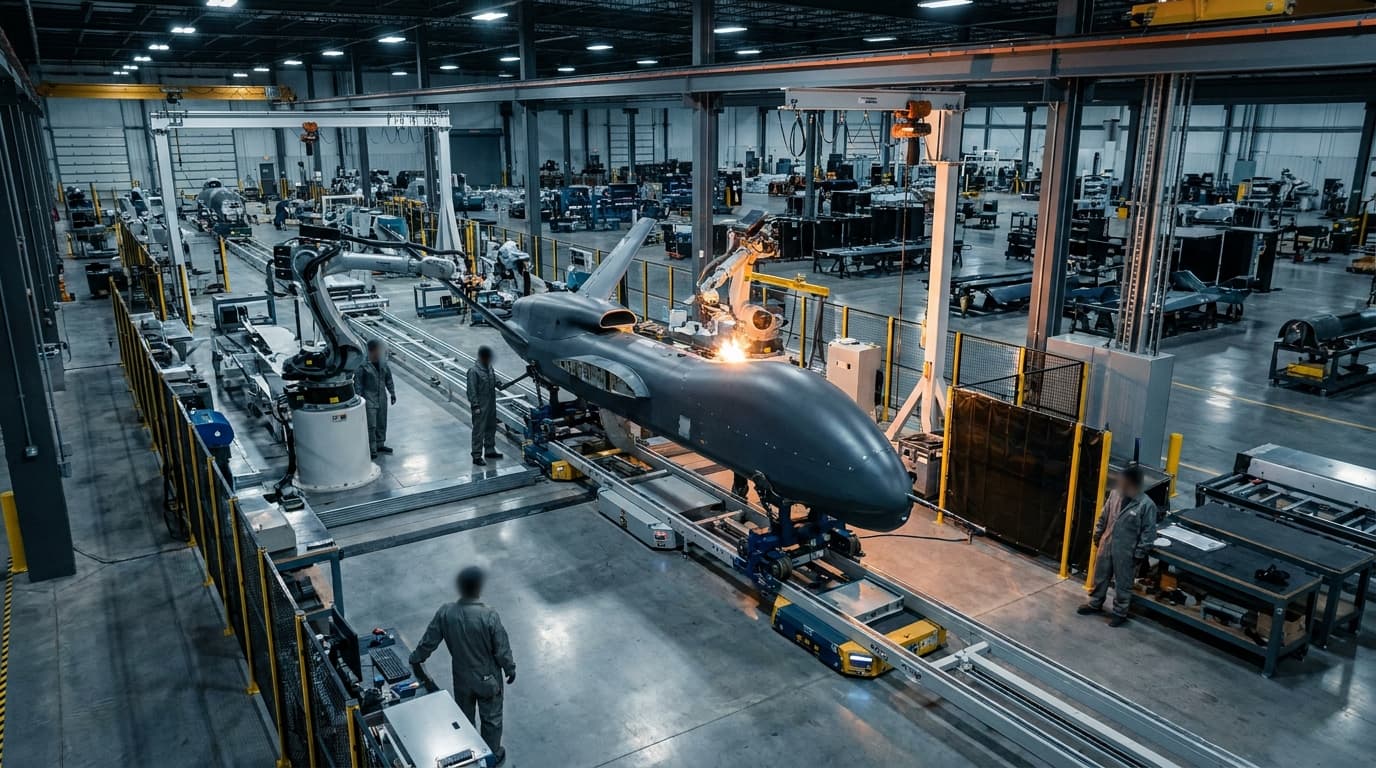
Anduril rolled the first Fury (YFQ-44A) airframe off the line at Arsenal-1 in Pickaway County, Ohio, in March 2026 — roughly three months ahead of the originally announced July 2026 target. For a company whose entire pitch to the Pentagon is that a software-defined prime can hit production cadences a legacy integrator cannot, the schedule was the credibility test. It hit it.
The site sits on roughly 500 acres near Rickenbacker International Airport, about 20 miles south of Columbus, and is master-planned at 5 million square feet across at least seven buildings. Building 1 — about 866,000 square feet and now operational — houses the Fury line. Building 2, at roughly 1 million square feet, is under construction. Anduril's stated capital commitment exceeds $900 million, against a state-level pitch of 4,000 jobs by 2035 and a projected $2 billion in annual economic output at maturity. By Ohio's own accounting, it is the largest single-payroll project in state history.
The line itself: 22 stations, 50 to 150 a year
The Fury cell is built around 22 workstations, sized for an initial output of about 50 aircraft per year and a nameplate of roughly 150 per year on three eight-hour shifts. That is the headline number, and it is the one that matters for the comparison Anduril is forcing the customer to make. Legacy primes building comparable autonomous platforms are working against 18- to 24-month lead times; Arsenal-1 is engineered for a station-based, software-defined flow more recognizable from a contract manufacturer's floor than from a tier-one defense assembly bay. Anduril executives have framed the line philosophy in those exact terms.
Industry analysts have picked up the same flex-capacity framing: the building is intentionally not a single-product line. The architecture is meant to absorb additional programs without retooling a dedicated bay each time, which is the structural concession to a buyer that no longer wants to underwrite a single-airframe factory.
The product slate beyond Fury
Anduril has committed the Roadrunner interceptor, the Barracuda cruise-missile family, and a fourth, classified program to the site by the end of 2026. That product mix is what makes the workforce and supplier picture nontrivial: Fury is a turbojet-powered combat aircraft, Roadrunner is a vertical-launch interceptor, and Barracuda is an air-breathing cruise weapon. The tooling, test-cell, energetics-handling, and propulsion-qualification requirements differ materially across those three, and Building 2's eventual fit-out will signal which of them is being pulled in for high-rate production first.
Workforce: 250 by year-end, and the Intel overlap
Anduril is targeting roughly 250 onsite hires by the end of 2026, building toward 4,000 by 2035. The constraint is not headcount in aggregate — central Ohio has it — it is electrical, mechanical, and test-technician labor specifically, and that pool is also being pulled on by Intel's Licking County campus in New Albany, which is targeting roughly 3,000 full-time staff with about 70% in technician roles requiring a two-year degree or less.
The publicly designated regional pipeline for both employers is Columbus State Community College's Electro-Mechanical Engineering Technology AAS and its one-year semiconductor-tech credential. That makes Columbus State the chokepoint — and the wage-setter — for advanced-manufacturing technicians inside roughly a 90-mile radius. Operators planning suppliers, contract assemblers, or test labs in the corridor should price in tightening on EE/test-tech wages well before either employer reaches its respective steady-state headcount.
The construction labor market is the parallel pressure point. Intel alone has projected on the order of 7,000 tradespeople through its build-out, and Arsenal-1's vertical construction is pulling on the same pool while Building 2 goes up.
Supplier corridor: what gets sourced locally, what flies in
Regional economic-development materials position Arsenal-1's supplier base across the Columbus–Dayton corridor, with Rickenbacker handling air-cargo flow for components that are not economically sourced in-state. The realistic local-content map for the medium term: tier-2 electronics assembly, harnessing, machined and sheet-metal subassemblies, composites layup at the smaller end, and integration services. Propulsion subassemblies, energetics, and specialized seekers will continue to flow in from established defense corridors. The interesting watch-item is whether Anduril qualifies a non-trivial share of its tier-2 electronics inside Ohio rather than defaulting to incumbent defense-electronics geographies, because that decision is what would convert an anchor tenant into an actual cluster.
The demand side: Replicator's miss and the DAWG pivot
Arsenal-1 is being built into a procurement environment that has just been rewritten. The Congressional Research Service's read on Replicator is that DOD's August 2025 milestone — fielding 'thousands' of attritable autonomous systems — landed instead at 'hundreds.' That delivery gap is the explicit context for the FY27 budget request, which folds Replicator 2 into a new Defense Autonomous Warfare Group at $54.6 billion — DOD's largest-ever drone and counter-drone request.
Crucially for Arsenal-1's pricing posture, the early-2026 Replicator 'gauntlet' tasks 12 vendors with delivering 30,000 one-way-attack drones at a $5,000 unit cost. Fury sits in a different class and price band, but the gauntlet is the price/throughput benchmark the buying community is now anchored to. DOD's own messaging on Replicator's unit economics reinforces that the buying criterion has shifted from program prestige to dollars-per-effect at delivered volume — which is, not coincidentally, the criterion Anduril's line is designed to meet.
The cluster thesis
Three megaprojects in a 30-mile triangle — Anduril at Rickenbacker, Intel in New Albany, and the Rickenbacker logistics complex itself — do not automatically constitute an industrial cluster. What turns adjacency into a cluster is shared labor pipelines, shared tier-2 suppliers, and shared specialized infrastructure. Central Ohio now has the first; Columbus State's technician credentials are explicitly common to both Anduril- and Intel-class employers. The second is the open question — Arsenal-1's tier-2 qualification decisions over the next 18 months will determine whether suppliers see enough cross-program demand to capitalize Ohio facilities rather than service the work from existing footprints elsewhere. The third — Rickenbacker's air cargo and surface logistics — is already in place and is, more than anything else, why this site beat the other states that bid for it.
Risks and watch-items
-
Construction-labor crowding. Building 2's schedule shares trades with the Intel build-out; slippage on either compounds.
-
Classified-program throughput visibility. The fourth program at Arsenal-1 is undisclosed; investors and suppliers will have to triangulate from hiring patterns and Building 2 fit-out, not public milestones.
-
Tier-2 supplier capitalization. Without anchor commitments from Anduril, local electronics and composites tier-2s may not greenfield Ohio capacity.
-
Federal program continuity beyond DAWG. A $54.6 billion FY27 ask is not a multi-year contract. Arsenal-1's 50-to-150 ramp assumes the autonomous-systems budget line survives at scale through the next administration's first request cycle.
-
Wage pressure. A 90-mile-radius bidding war for EE and test technicians between Anduril and Intel is now a base case, not a tail risk.
The headline is that Arsenal-1 went from concrete to a delivered first article on a CCA-class airframe in the space of about a year, three months ahead of the company's own announced date. That is the data point. Whether central Ohio compounds it into a defense manufacturing cluster — rather than one very large factory next to one very large fab — depends on supplier and workforce decisions that will be made over the next several quarters, mostly out of public view.
Related reading
Sources
-
JobsOhio — Ohio Partners with Anduril to 'Rebuild the Arsenal'
-
Defense News — Anduril to build 'Arsenal-1' autonomous weapons plant in central Ohio
-
Manufacturing Dive — Anduril chooses Ohio for $1B manufacturing facility
-
Breaking Defense — As Fury production starts, Anduril pledges a different production approach
-
Air & Space Forces Magazine — Look Inside Anduril's New Factory as CCA Production Begins
-
NBC4 WCMH — Anduril's Ohio plant opens three months ahead of schedule
-
Dayton Daily News — Construction is ongoing as Anduril begins hiring at Arsenal-1
-
Janes — Arsenal-1 aims to provide flexible capacity for defence production
-
DefenseScoop — DOD's largest-ever investment in drones and anti-drone weapons
-
Air & Space Forces Magazine — Replicator 'on Track' to Field Thousands of Cheap Drones
-
Columbus State Community College — Intel and Chip Manufacturing Careers
-
Circleville Herald — Arsenal-1 campus heads into production in March