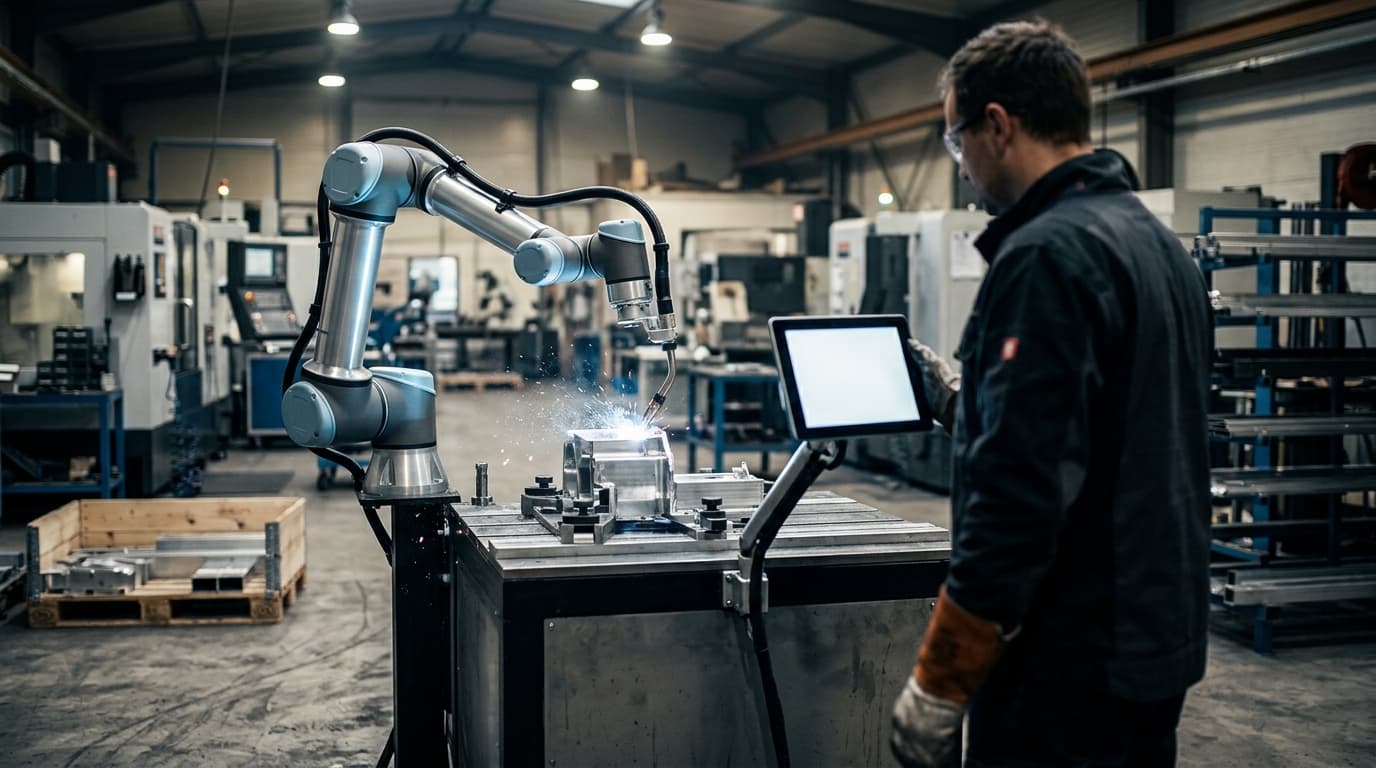
Mind Robotics closed a $400 million round led by Kleiner Perkins on May 13, 2026, valuing the Rivian spinout at $3.4 billion and pushing total capital raised past $1 billion. The unusual part is not the size. It is the use of proceeds. According to the company's own announcement, the capital is going to deployment infrastructure — fleet, field service, integrator partnerships — not foundation-model research. That single framing tells you where the industrial robotics race has moved. The capability layer is no longer the constraint. Distribution economics is.
What the Mind Robotics round actually says
Founded by Rivian CEO RJ Scaringe in 2025, Mind Robotics began as a spinout that kept Rivian as a training-data and deployment partner. The new round adds Meritech Capital, Redpoint Ventures, SV Angel, and Garuda Ventures to an existing syndicate that already included Accel, Andreessen Horowitz, Eclipse, Bain Capital Ventures, Greenoaks, and the venture arms of Volkswagen and Salesforce. The investor mix — strategics on the deployment side, growth investors on the capital-efficiency side — matches the explicit positioning that this is a commercial scaling round.
For a company that two years ago did not exist, the implication is blunt: the people writing the checks believe the model layer is good enough to ship, and the next dollar of return comes from getting more robots onto more floors faster than competitors can. Hardware OEMs spending venture money on field-service density is a sign the industry has crossed a maturity threshold.
The same-week signal from AGIBOT
Mind Robotics' announcement landed in the same window AGIBOT formally designated 2026 as 'Deployment Year One' at its Partner Conference and rolled its Sharebot platform out as a global robotics-rental channel. AGIBOT has already signed a Robots-as-a-Service deal with Singtel to lease humanoids over 5G to Singapore enterprises, plus a separate agreement with Italy's SIR Spa.
The operational proof point is more interesting than the partnership headlines. AGIBOT's G2 humanoids are running on a live consumer-electronics line at 310 units per hour, 19–20 second cycle time, and 99%+ uptime, with a plan to scale to 100 robots on that line by Q3 2026. Those are structured-environment numbers — a fixed station, repetitive task, well-lit visual conditions — but they are real, repeatable, and now being marketed as a reference architecture for paying customers.
Path Robotics goes mobile — where fixed cells fail
A month earlier, Path Robotics launched Rove, a quadruped-mobile autonomous welding system, at Sea-Air-Space 2026. The pitch on the company's own page reads as a direct shot at the legacy capex-cell model: 4x productivity, 30%+ lower cost, and — the line that matters — $0 capex. Mobile welding is targeted squarely at heavy industry, shipyards, and large fabrications where parts are too big to bring to a fixed cell. It is also the segment where job-shop economics break down most painfully: a $250,000 robotic welding cell idles when the next contract is for an oversized weldment that does not fit.
Three converging plays in a single quarter — a deployment-capital round, a public RaaS-platform launch, and a mobile-welding subscription product — point at the same thesis: the next margin pool is in how robots get to the work, not whether they can do it.
The per-hour math, modeled
Today's public cobot lease floor is roughly $5 per hour. Standard Bots' RO1 publishes from ~$5/hr, with monthly plans typically in the $1,000–$3,000 range; Universal Robots ships leasing as a first-class purchase channel. That $5/hr is the headline. The question — and the reason a deployment-only round is being written at a $3.4 billion valuation — is what that number does at fleet scale.
Three levers compress it. Utilization: a job shop running one cobot 40 hours a week pays the same fixed cost as one running 120; lease pricing follows. Maintenance amortization: a field-service tech with route density across ten shops costs a fraction of a dedicated technician per site. Field-service density itself: integrator partnerships, the explicit use of proceeds in the Mind Robotics announcement, are how that route density gets built. Stack those compression levers against the public $5/hr floor and the implied steady-state for an industrial-cobot subscription clears the $4/hr line. That figure is a model, not a quote — only delivery robots currently advertise rates that low — but it is the number a deployment-funded OEM has to underprice to win the SMB tier. ABI Research already projects RaaS installations will generate $34 billion in 2026 revenue, which is the scale at which those unit economics start to converge.
Why the SMB job-shop tier is now the battleground
For a decade, fabricators below $10 million in revenue could not buy robotic welding. A turnkey cell ran $200,000 to $300,000, payback assumed eight-hour two-shift utilization that small shops rarely hit, and the integrator engagement looked like an ERP implementation. Subscription pricing inverts every line of that pro forma: capex becomes opex, the integrator engagement compresses to a deployment visit, and downside risk shifts from the operator's balance sheet to the OEM's fleet.
That tier is where the demand is. The U.S. had roughly 433,000 open manufacturing jobs as of December 2025, with Deloitte and the Manufacturing Institute projecting as many as 2.1 million unfilled by 2030 and 79% of executives naming skilled labor as their top challenge. The job-shop tier is where that hiring gap bites first because it has the thinnest HR machinery to compete for talent.
The labor-cost ceiling RaaS has to beat
The welding workforce sets the price discipline. Industry estimates cited by trade schools and AWS data put roughly 30% of U.S. welders at or near retirement by 2026, with the Midwest — Ohio, Michigan, Indiana, Wisconsin — among the hardest-hit regions. Pay reflects the squeeze. AWS-sourced data summarized by The Fabricator puts general welder pay in the $18.50–$32 per hour range, with experienced Midwest and Gulf Coast welders clearing $50 per hour. Loaded for benefits, supervision, and turnover, that is the labor cost a $4/hr robotic alternative is being priced against — and the calculation does not require the robot to do everything a journeyman welder does. It only has to take the repetitive seams off the bench so the human can be deployed on the work the robot cannot reach.
Integrators: the winners and the squeezed
The integrator channel is where deployment economics get realized — or stalled. JR Automation, a Hitachi Group company founded in 1980, and Genesis Systems, the robotic-welding and fiber-laser specialist owned by IPG Photonics, are the kind of A3-member integrators positioned to absorb subscription-model volume. They have the field-service footprint, the controls engineering depth, and the customer relationships in the very vertical — metal fabrication — that the Mind Robotics, AGIBOT, and Path deployment plays target.
The structural risk is channel conflict. If an OEM-owned RaaS platform scales fast enough, OEMs go direct, and the integrator's margin on the install gets compressed into a service-contract residual. That is the pattern enterprise software went through. It is plausible the same compression hits robotic-welding integrators in the next 24 months — and equally plausible that the integrators with installed-base scale become acquisition targets for the deployment-funded OEMs that need their field-service density.
What to watch next
Four signals will resolve the modeled math into a quoted reality. First, Sharebot pricing disclosure — once AGIBOT publishes a humanoid RaaS rate card, the per-hour number stops being a projection. Second, Mind Robotics' first announced integrator partnerships, which will reveal whether the strategy is to absorb integrators or partner with them. Third, conversion rates from Path Robotics' Rove early-adopter program into multi-cell repeat orders, the cleanest signal of whether mobile welding works outside a launch-event demo. Fourth, A3 and Automate 2026 booth signals — which OEMs are leading with subscription pricing on their floor cards and which are still leading with capex specs.
Risks and caveats
The sub-$4/hr figure is a forward extrapolation from a public $5/hr floor, not a quoted industrial rate. Humanoid deployment outside structured electronics lines remains unproven at the throughput numbers AGIBOT is publishing for its consumer-electronics reference site. Integrator channel conflict is a real failure mode for the OEM-direct strategy. And labor-cost displacement math always understates the cost of integration, change management, and the first 90 days of a job-shop deployment where the robot has to earn its keep on the smaller-batch work that makes job shops job shops. None of which negates the core read: the people writing $400 million checks have decided the next return comes from getting robots onto more floors faster, and the floor they are racing for is the one that used to be priced out.
Related reading
Sources
-
Rivian spinoff Mind Robotics raises another $400M — TechCrunch
-
Mind Robotics Announces $400M in New Funding to Expand Industrial Robotics Deployment — BusinessWire
-
Mind Robotics Secures $400 Million Funding, Valued at $3.4 Billion — GuruFocus
-
Mind Robotics Announces $400M in New Funding — The AI Insider
-
Year One of Deployment: How AgiBot is Building a Global Robot Empire — Aparobot
-
Cobot price explained: 2026 guide to collaborative robot costs — Standard Bots
-
Outlook, trends, and pay for the welding workforce — The Fabricator
-
Forging the Future: America's Growing Welder Shortage — Best Trade Schools
-
U.S. Manufacturing Labor Shortages and Hiring Pressures in 2026 — MIE Solutions