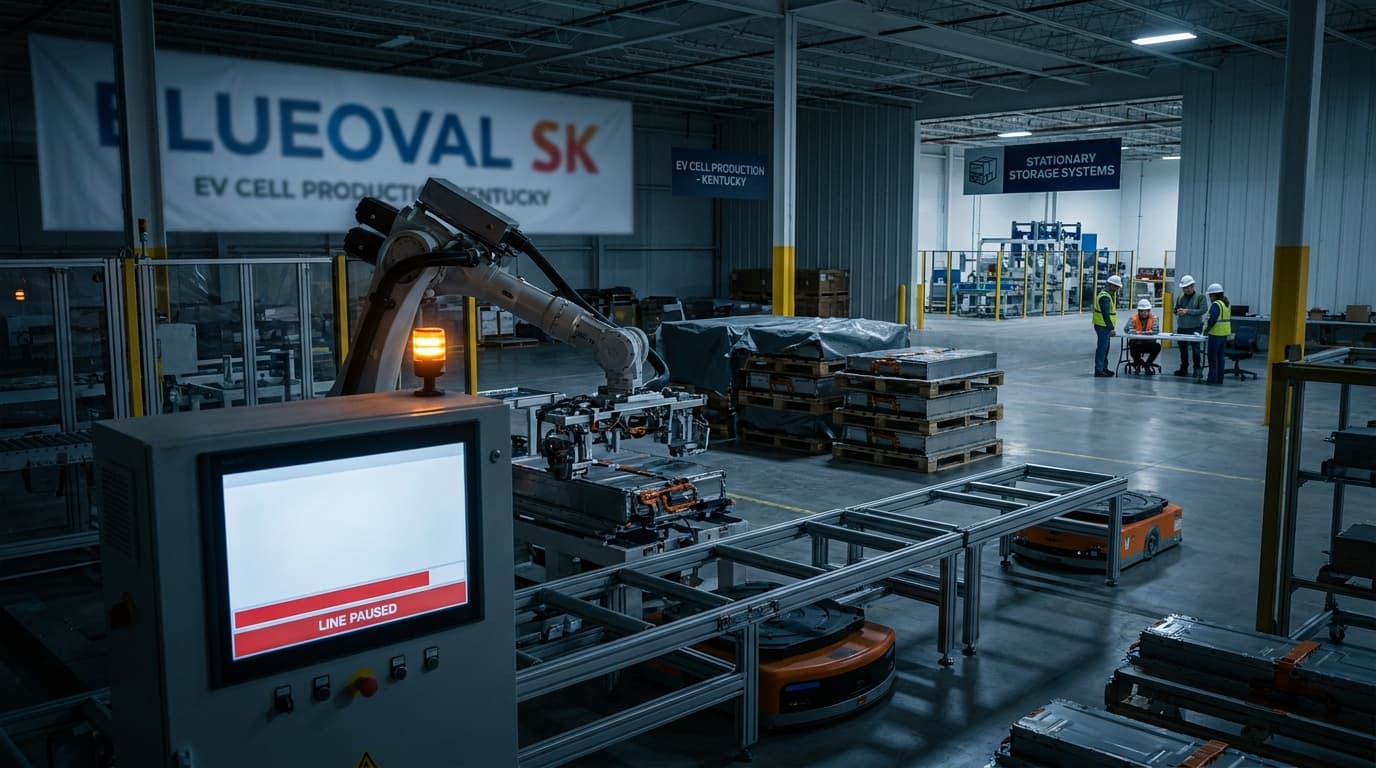
The U.S. battery cell industry has crossed a threshold that the groundbreaking-ceremony era of 2022–2024 was not designed for: more cell capacity is being commissioned than the domestic EV market can absorb. The result is showing up not in press releases about new plants, but in plant-closure notices, paused production lines, and retooling announcements that quietly convert EV cell capacity into stationary storage capacity.
The clearest evidence sits in three states. In Kentucky, the Ford/SK On BlueOval SK Battery Park is scheduled to close on February 14, 2026, with all 1,512 workers laid off, as Ford and SK On dissolve the $11.4 billion joint venture in the first quarter of 2026. In Ohio, Ultium Cells paused cell production at Lordstown in January 2026 and laid off 1,334 hourly workers, with the planned recall of roughly 850 of them slipping from June to August 2026. In Kansas, Panasonic's De Soto plant — originally promising full production by March 2027 — is ramping toward roughly 50% of capacity with no replacement date for the full-production target.
For operators, equipment suppliers, and investors, the story is no longer how many gigawatt-hours the U.S. is building. It is how many of those gigawatt-hours will actually ship a cell in 2026 — and how the 45X advanced-manufacturing credit, which pays per unit of output rather than per unit of investment, reshapes the economics of every line that runs below its design rate.
Nameplate vs. utilized
The U.S. went from a cell-import market to a cell-manufacturing market in roughly four years. Treasury and industry data cited around mid-2025 put cumulative U.S. battery manufacturing investment at about $48.3 billion, supporting roughly 62,700 jobs, the bulk of it concentrated in Korean-OEM joint-venture cell plants. Public capacity trackers, including academic monitoring of North American battery production capacity and Argonne National Laboratory's announced-capacity dataset, document a pipeline of more than 700 GWh of cell capacity under construction or commissioning against roughly 200 GWh already online in 2024.
BloombergNEF has flagged scenarios in which U.S. cell-factory utilization drops below 70% in 2026 as that nameplate runs ahead of EV cell demand, a demand picture that the IEA's Global EV Outlook 2026 also frames as materially below the curves OEMs sketched in 2022 and 2023. The arithmetic is unforgiving: a depreciation schedule sized for an 85–90% utilized line behaves very differently when the line runs at 50% or sits dark.
Anatomy of the closures
BlueOval SK is the largest single data point. Ford and SK On are dissolving the joint venture in Q1 2026, with the Glendale, Kentucky cell campus going fully cold on February 14, 2026 and the entire 1,512-person workforce laid off. Trade press has tracked the layoff schedule as the JV winds down. The wind-down comes alongside Ford's December 2025 termination of a 75 GWh / 9.6 trillion won (roughly $6.5 billion) European cell supply contract with LG Energy Solution — the supply book is being rewritten, not just the manufacturing footprint. Financial coverage of the Kentucky shutdown has emphasized the gap between the $5.8 billion capex sunk into the site and the output it will deliver before going dark.
At Ultium, the trigger was demand-side. The elimination of the federal $7,500 EV tax credit — the 30D credit explained in recent policy summaries — pulled forward the inflection that GM and LG Energy Solution had been managing around. Lordstown's pause and 1,334 layoffs landed in January 2026; the timing of the partial recall is now an August 2026 date that has already slipped once.
Pivot, don't pour concrete
Where the first response to demand softness in 2022–2023 was to push out groundbreakings, the 2026 response is to retool. The clearest example is Ultium's Spring Hill, Tennessee plant, which initially paused EV cell production in January 2026 before being retooled for LFP energy-storage cells with a roughly $70 million investment, with stationary-storage production targeted for Q2 2026 and all 700 previously laid-off workers recalled.
LG Energy Solution has gone further, opening its first large-scale U.S. LFP plant for stationary storage and signaling reallocation of roughly 20% of gigafactory lines from EV to ESS chemistries. SK On is publicly pivoting toward stationary energy storage at remaining U.S. capacity following the Ford split, including Commerce, Georgia. Samsung SDI has signaled ESS production starts in 2026 at Kokomo, Indiana. Industry-wide reporting frames this as the dominant playbook for salvaging stranded EV cell investment.
The risk in this pivot is symmetrical to the one that triggered it. Reporting on the ESS market has noted that, almost overnight, the U.S. has flipped to an oversupply position for stationary storage cells as multiple EV lines convert to LFP at the same time. The same capacity-vs-demand mismatch that caught EV cell plants can recur in ESS if the conversions are not paced to the actual storage offtake pipeline.
Panasonic's slow ramp
Panasonic's De Soto, Kansas plant offers the cleanest example of demand reshaping a startup schedule rather than a shutdown one. The plant was originally targeted for full production by March 2027. Local reporting in mid-2025 documented the deceleration driven by softer EV sales, and subsequent coverage of the opening confirmed the pushed full-production timeline. In early 2026, two of the planned eight lines were operating, two more were starting, and the second-wing first lines are slated for 2027 — leaving the plant running near 50% with no public commitment to a new full-ramp date.
For equipment suppliers, the De Soto pattern is the more instructive one. Lines are still being installed; they are simply being installed slower, with the option value of pacing intact rather than written off.
45X math on under-loaded lines
The economic backstop the industry has been counting on is the Section 45X Advanced Manufacturing Production Credit. The credit is defined in the IRS's advanced-manufacturing production-credit guidance and its supplementary guidance, and summarized authoritatively in the Congressional Research Service's overview. Trade-press coverage of the finalized rule and detailed regulatory coverage confirm the structure manufacturers are operating under.
For battery makers, the headline numbers are $35 per kWh for each eligible cell produced and sold and $10 per kWh for each module — a per-output credit, not a per-investment credit. That structural choice has consequences that the gigafactory class of 2022–2024 is now living through.
-
Idle lines earn nothing. A plant at 50% utilization captures roughly half the 45X value of a plant at full utilization, while still depreciating the full installed asset base.
-
Pivoting to LFP cells preserves the credit. 45X is chemistry-agnostic on the cell side, so a line converted from NMC EV cells to LFP ESS cells continues to earn $35/kWh on each cell produced and sold.
-
Sourcing has become a second-order utilization tax. The One Big Beautiful Bill Act, signed July 4, 2025, preserved 45X largely intact but layered in foreign-entity-of-concern and prohibited-foreign-entity content thresholds. Legal analysis from Miller & Chevalier and a second read from White & Case document the carve-outs and ratchets. Morgan Lewis's FEOC walk-through details the schedule: 60% non-prohibited-foreign-entity content in battery components in 2026, ratcheting five percentage points per year to 85% by 2030.
The combined effect on a cell plant running at 50% with a Chinese-anode supply chain is to compress both halves of the unit economic story — fewer eligible kWh produced, and a tightening domestic-content requirement on the kWh that do qualify.
Greenfield reshuffling
The most visible greenfield casualties are the projects tied to the joint ventures and contracts that have already unwound: BlueOval SK's Tennessee follow-on capacity and any remaining cell tonnage that was implicitly underwritten by the Ford-LG European supply agreement that Ford terminated in December 2025. The conversion playbook — Spring Hill's LFP retool, LG Energy Solution's first U.S. large-scale LFP plant, SK On's pivot to ESS, Samsung SDI's 2026 ESS start at Kokomo — is now effectively the substitute for net-new EV cell groundbreakings.
On the federal side, the Department of Energy's Ultium Cells page remains the cleanest public artifact of the bet that is being repriced.
What manufacturers and equipment suppliers should watch
-
Cell-line tool orders. Coater, calender, and formation-cycler order books from Korea and Japan are the leading indicator for whether 2027–2028 commissioning is being deferred or merely re-chemistried.
-
Dry-room buildouts. Dry-room capex is the long-lead item that distinguishes a deferred line from a canceled one. Continued construction on second wings — as at De Soto — signals option value being preserved.
-
LFP localization speed vs. FEOC schedule. The 60→85% non-prohibited-foreign-entity ratchet through 2030 will either pull LFP cathode active material localization forward or expose converted ESS lines to credit haircuts. The pace at which domestic cathode and anode capacity comes online is the binding constraint.
-
ESS offtake discipline. If every paused EV line converts to ESS without firm storage offtake, the oversupply that broke EV cell utilization in 2026 will recur in stationary storage cells by 2027.
The utilization story
The first-generation U.S. gigafactory buildout is finished as a groundbreaking story. The capacity is largely installed or committed; the capex is largely sunk; the 45X framework is largely fixed. What remains variable is utilization — which lines run, at what chemistry, for which offtake — and the labor, equipment, and credit dollars that follow. Kentucky going dark in February, Ohio's pause stretching into August, and Kansas idling at half load are not anomalies. They are the new baseline against which every remaining battery investment decision will be measured.
Related reading
-
Foxconn's Wisconsin Pivot to AI Server Assembly Quietly Hits Full Tilt
-
Intel's Ohio Slip to 2030 Forces Commerce to Convert Its Biggest CHIPS Bet into Equity
Sources
-
Ford Authority — BlueOval SK Battery Park to close in February
-
Yahoo Finance — Ford's $5.8B Kentucky battery plant goes quiet
-
Battery Technology — LG Energy Solution's first U.S. LFP plant
-
CREB / University of Maryland — North American battery capacity update
-
Argonne National Laboratory — Battery component manufacturing dataset