For two years the reshoring debate has been framed as a demand problem: would the announcements actually translate into plants, jobs, and output? On May 20, 2026, Wood Mackenzie effectively closed that question and reopened a harder one. In an analysis declaring the United States has entered a new era of soaring electricity demand driven by data centers, electrification, and manufacturing reshoring, WoodMac confirmed what site selectors and utility planners have been saying privately for a year: the binding constraint is no longer demand. It is the grid that is supposed to serve it.
For operators, investors, and economic development officials trying to phase 2027–2029 capex, that reframing changes the question from where to build to when the power will physically arrive.
The number that reframes everything
WoodMac's headline figure is the one to internalize: there are roughly 220 GW of data-center power demand in the U.S. pipeline, of which 183 GW is already backed by firm commercial commitments. That committed slice alone equals about 22% of total 2025 U.S. peak demand. WoodMac projects U.S. data-center capacity will rise from roughly 24 GW today to around 110 GW between 2026 and 2030, accounting for roughly 68% of total load growth over that window.
The companion WoodMac release on the electrical equipment market sizes the U.S. data-center electrical equipment opportunity as growing from roughly $20 billion to about $65 billion by 2030. The flip side is the one manufacturers feel: the same transformers, switchgear, and high-voltage breakers needed for a hyperscale campus are needed for a semiconductor fab, an EV battery plant, or an aerospace machining facility — and they are now being bid against each other.
WoodMac's longer-form Horizons piece makes the structural point plainly: the current U.S. electricity market design was not built to deliver power on data-center or manufacturing timelines. That is the thesis a 2027 fab schedule now has to survive.
The equipment bottleneck
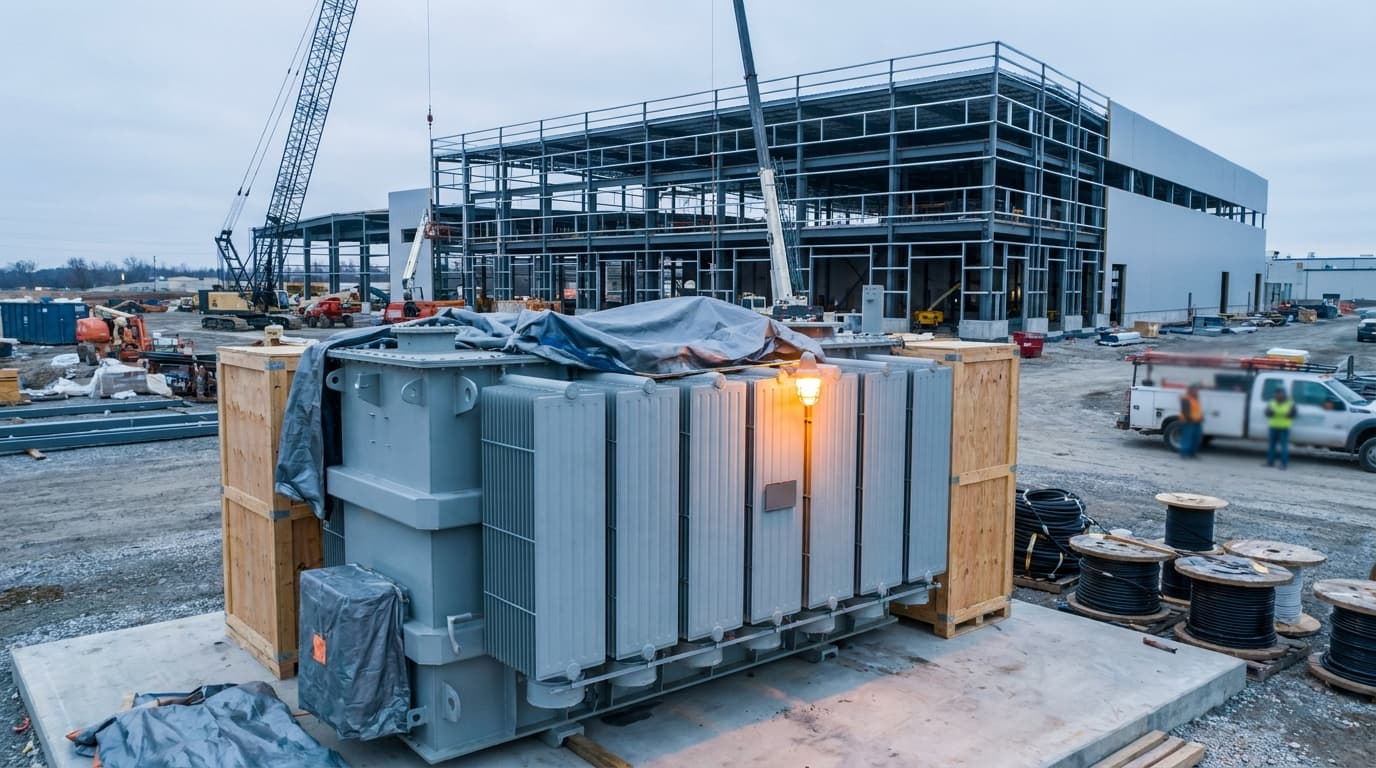
Wood Mackenzie pegs current lead times for critical grid equipment at 18–36 months. pv magazine USA reported on May 11, 2026 that lead times for high-capacity transformers have extended to roughly four years. That is the number that quietly governs every behind-the-fence energization plan in 2026.
POWER Magazine's accounting of the supply side is similarly stark. In its 2026 industry review, GE Vernova reported a Q1 2026 transformer backlog up 86% year over year, with data-center transformer orders alone in the quarter exceeding all of 2025. Prolec GE is investing more than $300 million across expanded Monterrey-area capacity and U.S. sites, but the same reporting notes hyperscalers are now placing orders three to four years out — crowding distribution utilities and industrial buyers further back in the queue.
Utility Dive's trade coverage reaches the uncomfortable conclusion: even with domestic electrical-equipment reshoring underway, transformer and breaker backlogs are not clearing fast enough to absorb announced manufacturing capex. A plant whose energization depends on standard-spec equipment ordered in 2026 is, in practice, a 2028–2030 first-power plant.
Announced vs. energized: the macro data still does not show the boom
The reshoring counterpoint is awkward but worth confronting. IoT Analytics' May 2026 Industrial Macro Pulse, published one year after the 'Liberation Day' tariff regime, finds that the announced reshoring boom has not yet shown up in the macro data. The real U.S. industrial growth story in the print, IoT Analytics argues, is data centers and the power infrastructure built to feed them.
That gap between announcement and energization is not a contradiction of the WoodMac thesis — it reinforces it. Capacity that has been announced but is waiting on transformers, transmission upgrades, or interconnect studies does not show up in industrial production or shipments data. It shows up as a backlog at GE Vernova and as a queued application at an RTO.
Queue mechanics that matter to plant managers
If equipment is the physical constraint, interconnection process is the procedural one. PJM, which covers a large share of the reshoring and data-center footprint, ran its 2026 cycle as a single annual intake window with a Cycle 1 application deadline of April 27, 2026. Zero Emission Grid's process write-up walks through the practical effect: any project that missed that window is now waiting for the next intake.
The Large Load story is sharper. As ZEG documents, the PJM Board declined to create a dedicated Large Load Interconnection queue, pushing the question back onto states and host utilities. PJM's Expedited Interconnection Track is not in place until August 2026. RMI's structural diagnosis of the region's speed-to-power problem describes the same dynamic from the other side: the procedural lag, not the resource adequacy line, is what is moving fab and plant energization dates to the right.
MISO is signaling the same compression. Its January 2026 Interconnection Process Working Group readout, summarized here, acknowledges both generation and load queues are at levels that strain historical throughput, with large, fast-moving industrial and data-center loads compressing schedules. For an OEM evaluating Indiana, Michigan, or Louisiana sites inside MISO, that translates into longer impact-study windows and more conservative in-service dates.
Exposure check: TSMC Arizona, Anduril Arsenal-1, and the gas-turbine backstop
Two flagship announcements illustrate how the grid constraint is already showing up in real schedules.
Manufacturing Dive reported that TSMC's second Arizona fab has slipped to 2027 or 2028, with federal and state incentives now explicitly tied to power-interconnect, reclaimed-water, and on-site storage commitments. The political economy of CHIPS-era support has quietly evolved: the gating diligence is no longer the site, it is the kilowatt-hour delivery schedule.
In central Ohio, AEP Ohio is improvising around the same problem at Anduril's Arsenal-1. Local NBC4 reporting describes AEP's 'Endor Switch Project' — a temporary-power solution scheduled for construction between December 2025 and March 2026 — to bridge the area while permanent transmission is built. Anduril's own announcement targets a roughly 5 million-square-foot, ~4,000-job facility with first weapons production aimed at July 2026. The fact that one of the most strategically significant reshored manufacturing builds in the country requires a named temporary-power workaround is the clearest single data point in support of WoodMac's thesis.
Behind-the-meter and utility-scale gas backstops are not a clean escape hatch either. A separate WoodMac analysis, reported by Utility Dive, projects U.S. gas turbine prices rising roughly 195% by 2027 amid the supply-demand crunch. Any manufacturing project that pencils in self-generation as the contingency plan needs to mark that capex to a fast-moving market.
What site selectors should do now
The practical adjustments fall out of the same logic:
-
Lead with power-availability diligence. The transmission and interconnection letter is now the gating document for a 2027–2029 in-service date. Treat it the way you used to treat the site control letter.
-
Lock equipment slots before site selection, not after. With high-capacity transformer lead times at four years and hyperscalers ordering three to four years out, the queue for medium- and large-power transformers may be the real critical path, not permitting.
-
Model 24–36 month power windows directly into capex sequencing. WoodMac's 18–36 month equipment range is not a tail risk; it is the central case. Phasing tooling and labor ramps to a single energization date inside that range underestimates the variance.
-
Read the queue rules the way the RTOs wrote them. In PJM, the April 27, 2026 single-window intake and the August 2026 Expedited Track set the calendar. In MISO, the IPWG's compressed-schedule warnings should be priced into any large-load assumption.
-
Stress-test the behind-the-meter alternative. A 195% projected rise in gas turbine prices by 2027 changes the math on self-generation as a hedge against grid timing.
The 2027–2029 question
WoodMac's 'new era' framing is not a forecast — it is a statement that the regime has already changed. The reshoring policy stack of the last several years worked in announcements. Whether it works in megawatts is now a 2027–2029 question, and the answer will be written less in trade press releases than in interconnection queue positions, transformer order books, and the temporary switching projects utilities are quietly building to keep flagship plants on schedule.
Related reading
-
Wood Mackenzie Just Named the Reshoring Bottleneck No Capex Plan Has Solved: Electricity
-
Power Has Overtaken Capex as the Reshoring Bottleneck, Wood Mackenzie Says
Sources
-
Data center demand drives U.S. electrical equipment market to $65B — Wood Mackenzie
-
Transformers in 2026: Shortage, Scramble, or Self-Inflicted Crisis? — POWER Magazine
-
Transformer, breaker backlogs persist, despite reshoring progress — Utility Dive
-
Gas turbine supply crunch set to raise prices 195% by 2027: WoodMac — Utility Dive
-
PJM Large Load Interconnection Process: BYONG & 2026 Developments — Zero Emission Grid
-
MISO IPWG Jan 2026: Queue mechanics, large load considerations — Zero Emission Grid
-
TSMC delays second Arizona chip plant to 2027 or 2028 — Manufacturing Dive
-
AEP plans temporary power solution near Anduril — NBC4 WCMH-TV
-
Anduril Building Arsenal-1 Hyperscale Manufacturing Facility in Ohio — Anduril