On May 20, 2026, Wood Mackenzie publicly declared that the United States has entered a new era of soaring electricity demand, driven by three converging forces: data centers, electrification of industrial loads, and manufacturing reshoring. For operators and capital committees, the statement is less a headline than a reclassification. The reshoring story has been told in tons of steel, square feet of clean room, and federal incentive dollars. Wood Mackenzie's framing collapses all of that into one variable that no factory-side capex plan has solved: who gets the next firm megawatt, and when.
The competition is no longer abstract. Hyperscalers are signing ten-year power-purchase agreements at premium rates and, in many corridors, accepting take-or-pay structures to lock in capacity. Industrial site-selection models, by contrast, were built in an era when firm electricity was a commodity priced into the utility bill and not a binding constraint on whether a fab, EV plant, or electrified process line could break ground. That assumption has died quietly over the last 24 months.
The equipment bottleneck behind every interconnection queue
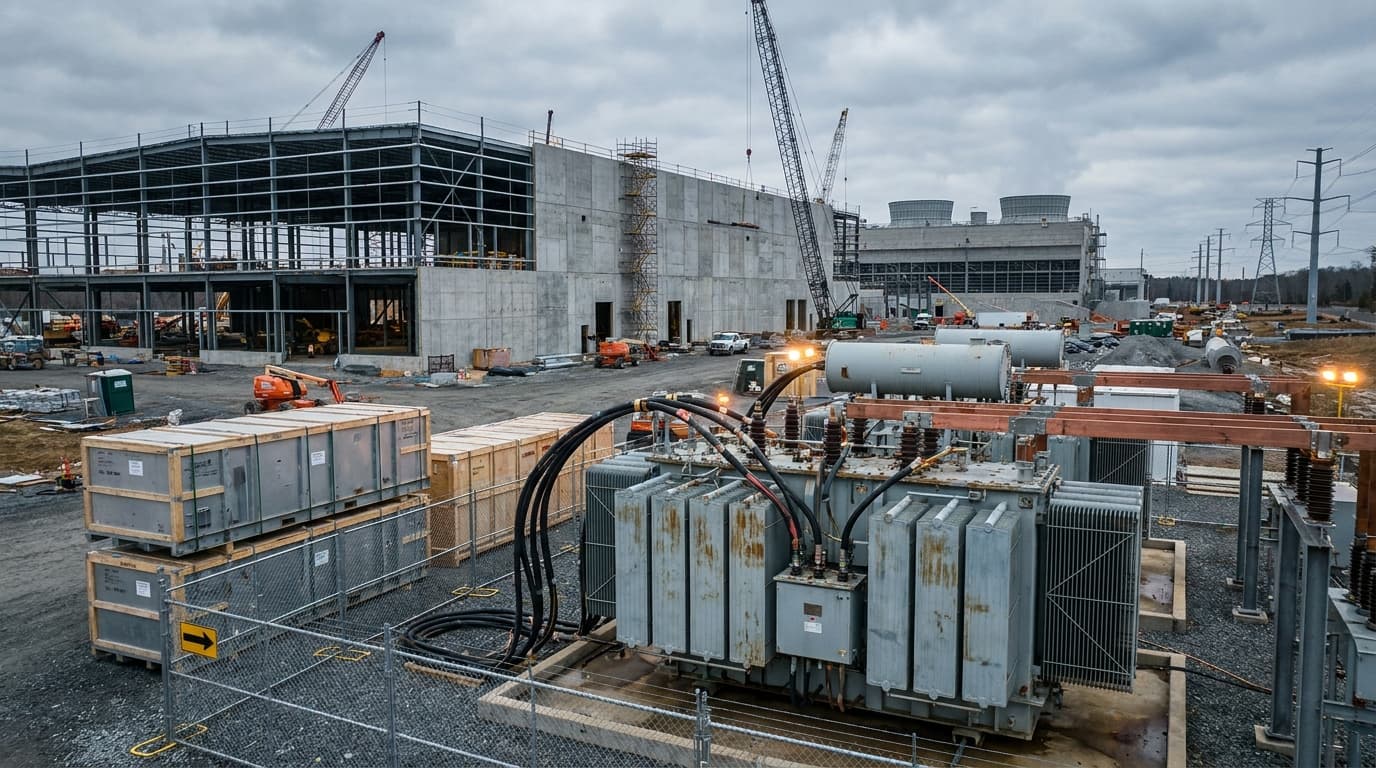
The clearest physical evidence sits inside substations. PJM-region substation transformer lead times have stretched from roughly 140 weeks in 2023 to 150 weeks in 2025 and now past 160 weeks in 2026, with full PJM project-to-operation timelines cited at roughly eight years. Eight years is longer than the typical greenfield fab cycle from groundbreaking to first wafer. It is also longer than most political horizons that anchor reshoring incentives.
The supplier side confirms what the queue suggests. Prolec GE's order book has reached approximately $5 billion, with data-center sales rising from about 10% of total in 2024 to roughly 20% in 2025. GE Vernova's Electrification segment booked $2.4 billion in data-center equipment orders in Q1 2026 alone, exceeding the full year of 2025. Utility capex plans across U.S. investor-owned utilities now total roughly $1.4 trillion over five years through 2030, up more than 21% from $1.1 trillion a year earlier — yet grid interconnection processing still averages about 53 months nationally. The supply-side response is real, but it is competing for the same transformer slots, the same skilled labor pools, and the same rights-of-way that industrial substations need.
Corridor stress test: where reshored capex meets grid reality
Phoenix
Arizona Public Service plans to serve approximately 4,000 MW of data-center load over the next decade and is relocating three major transmission line sets to power TSMC's north Phoenix fab. APS and Salt River Project have also subscribed to the Transwestern Desert Southwest pipeline expansion, but incremental gas does not arrive until late 2029. For a project at TSMC's scale this works because the transmission relocation is being executed in lockstep with the fab. For the next tier of suppliers and downstream packaging investments arriving behind it, the gas-to-electrons timing gap is the binding constraint.
Central Ohio
As of February 12, 2026, AEP Ohio reported 5,642 MW of post-tariff signed data-center contracts on top of 12,219 MW signed before the large-load tariff — a 17.8 GW backlog. The Ohio Manufacturers' Association has argued before regulators that even after AEP halved its forecast from 30 GW to 13 GW, the signed pipeline still inflates real demand and risks socializing hyperscaler-driven grid investment onto industrial ratepayers. The OMA dispute is not a sideshow. It is the first sustained example of organized manufacturing pushback against the assumption that data-center load growth is benign for the industrial base in the same service territory.
Carolinas I-85
Duke Energy reports approximately 6 GW of Carolinas data-center pipeline plus a fresh 2.7 GW of Charlotte-area deals, lifting the total to roughly 7.6 GW. Load growth in the Carolinas is forecast at about 2% in 2026 jumping to 4–5% in 2027 through 2030, against a $103 billion capex plan. The timing asymmetry matters: industrial commitments along I-85 are being made in 2026, but the bulk of new generation arrives in the 2027–2030 window. Projects that need firm power before then are competing inside a smaller, contested pool.
Tennessee Valley
On May 4, 2026, the Tennessee Valley Authority issued a Request for Proposals for 50 to 1,000 MW of firm, dispatchable capacity — gas, nuclear, hydro, or coal — with delivery windows running from December 2026 through December 2031, per TVA's FY2027 Congressional Justification. A federal monopoly utility soliciting third-party firm capacity is a signal industrial customers should read directly: even TVA does not consider its own generation pipeline sufficient to meet near-term firm demand in its corridor.
The 'firm-power letter' is becoming a siting prerequisite
The procedural consequence is showing up in site-selection committees. Industry analyses now treat power requirements as a gating criterion in economic development decisions, and the data-center side has already crossed that line — power availability now drives data-center site selection ahead of traditional factors like tax incentives or proximity to fiber. The same pressure is moving upstream into industrial siting. Written commitments from utilities — load letters, conditional service agreements, and increasingly take-or-pay structures patterned on hyperscaler contracts — are becoming a prerequisite to breaking ground rather than a closing item.
The counterpoint
AEP Ohio's forecast revision from 30 GW down to 13 GW under regulatory pressure is a reminder that the demand numbers driving this entire story are negotiable. Manufacturer groups argue that inflated forecasts let utilities justify capex that ratepayers ultimately fund, and that the hyperscaler-versus-industrial allocation problem is partly an artifact of how speculative data-center load is counted. Operators evaluating corridor risk should look at signed-contract figures, not announced figures, and should weight regulatory pushback as a real variable in the timing of new capacity.
What to watch
The near-term tells are concrete. PJM's 2026 interconnection cycle will show whether transformer-driven delays have stabilized or extended further. TVA's RFP responses, due after May 4, will indicate whether independent power producers can move firm capacity faster than the utility's own pipeline. FERC interconnection reform implementation will determine whether the 53-month national average compresses. And the most consequential political question is whether any state — Ohio, Arizona, or a Carolinas regulator — moves first on a manufacturing-priority interconnection lane that treats reshored industrial load as a distinct queue from speculative data-center load.
Wood Mackenzie's May 20 statement did not announce a new bottleneck. It named one that the capex plans, federal incentives, and groundbreaking ceremonies of the last three years have collectively failed to solve. For the next wave of American factories, the question of whether they get built on schedule will be decided in substations and interconnection queues, not in board rooms.
Related reading
Sources
-
Wood Mackenzie: U.S. enters new era of soaring electricity demand (May 20, 2026)
-
Data Center Knowledge: transformer lead times and PJM project timelines
-
Utility Dive: Manufacturers vs. AEP Ohio on data-center demand forecasts
-
Ironton Tribune: AEP Ohio 5,642 MW post-tariff signed contracts
-
Arizona Technology Council: APS transmission relocation for TSMC
-
Hoodline: Duke Energy 2.7 GW Charlotte-area data-center deals
-
TVA FY2027 Congressional Justification (May 4, 2026 firm-capacity RFP)
-
SEDC: Power requirements in economic development site selection
-
Data Center Knowledge: Power availability now drives site selection
-
PowerLines: U.S. utility capex plans, $1.4T five-year aggregate