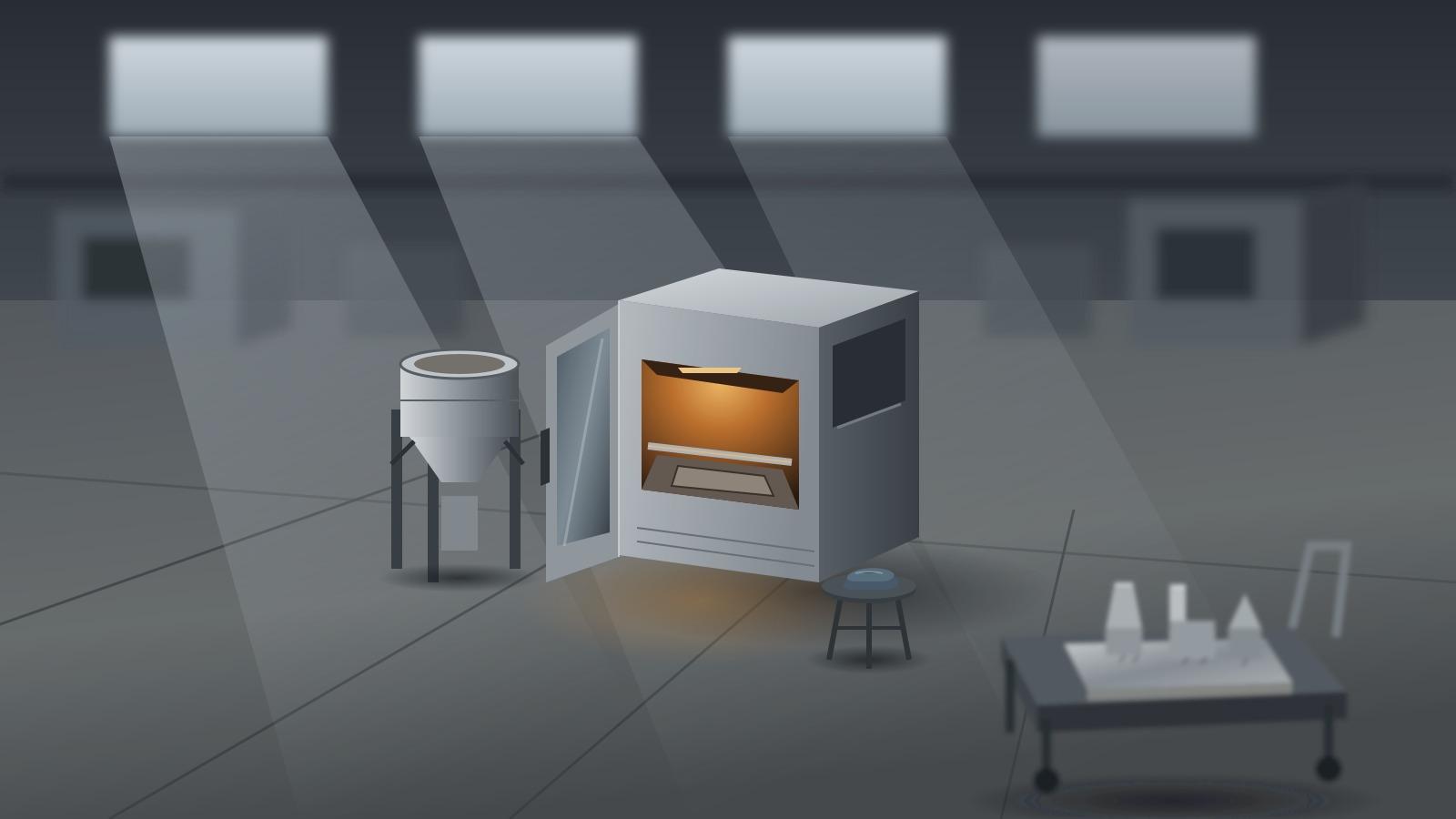
Formnext 2026 opens at Messe Frankfurt on Tuesday, November 17, and runs through Friday, November 20. Organizer Mesago has moved the show into Halls 11.0, 12.0 and 12.1 with nearly the same total floor space and expects "around 800" exhibitors, according to its September 10 release. The UK is partner country. There's a new Formnext Defence Summit, and ASTM International runs an AM Innovation and Standards Summit the day before the show opens. Of the Formnext 2026 new printers, production buyers will most want to see Nikon SLM Solutions' MACHX, a mid-size laser powder bed fusion (L-PBF) series to be unveiled Tuesday at 10:00.
This guide is meant to help buyers decide which stands to visit. It isn't a highlight reel. It's built from exhibitor announcements, organizer and research-institute press releases, and two trade previews. We haven't seen or run any of these machines, and several launches had no published specifications at the time of writing. The value of a show visit is in what you get vendors to commit to in conversation, so most of what follows is about which questions to ask.
Three question sets for every booth
Booth demos are good at showing build speed. They're poor at showing what a part costs once it has been qualified, inspected and shipped. Bring these to every stand:
-
Cost per part. Machine price and lead time, inert gas consumption, powder utilization and refresh rate, and operator hours per build including setup, unpacking and cleaning.
-
Qualification. Which parameter sets and material data exist today, who validated them, and what carries over from machines you already run. A new platform that forces requalification of an existing part family carries a cost that won't appear on the quote.
-
Post-processing. Depowdering, stress relief and heat treatment, support removal, surface finishing and inspection. On many production parts these steps cost as much labor as the print.
Nikon SLM Solutions MACHX (Hall 12.0, Booth D119, Tuesday 10:00)
Nikon SLM's Formnext page describes MACHX as "A new L-PBF system built for the mid-size segment, where the requirements of most parts actually sit," and lists energy, automotive, defense and aerospace as target industries. TCT Magazine reported on November 2 that "Though many details remain under wraps, Nikon SLM Solutions has confirmed that it is targeting mid-range-sized applications" and "has engineered the machines to be more easily scalable." According to TCT, MACHX will be a series of several machines that sits alongside the SLM 280, SLM 500 and NXG lines. It doesn't replace them.
No build volume, laser count, throughput or price had been published in any source we reviewed. That makes the unveiling the first chance to get basic answers. For existing Nikon SLM customers, the important questions are about continuity:
-
How does the MACHX build envelope compare with the SLM 280 and SLM 500, and which part families is it meant to take over?
-
How many lasers does it have, and how are overlap zones handled and qualified?
-
Do SLM 280 and SLM 500 parameter sets and material qualifications transfer, or does each part start again?
-
What are the price, lead time and installation footprint, and what uptime will Nikon SLM put in the contract?
Simulation moves into build preparation
One part of the MACHX workflow is already public. In an October 29 release carried by Machine Design, Nikon SLM and PanOptimization said PanX simulation software now has a dedicated Nikon SLM integration. It loads "validated, parameter-specific templates" for NXG XII 600 and MACHX build preparation. "Our customers print some of the largest and most demanding parts in the industry, and the first build has to count," said Simon Merkt-Schippers, EVP Product Management at Nikon SLM. Erik Denlinger, co-founder and chief engineer at PanOptimization, said the integration "reduces redundant and error-prone simulation setup."
Fewer failed first builds is a real saving on large L-PBF parts, where one scrapped build can consume days of machine time and a lot of powder. The open question for quality teams is accountability. If a part built from a validated template fails qualification, does responsibility sit with the machine maker, the software vendor or the user who applied the template? Get the answer in writing before the templates become part of your process documentation.
Fraunhofer process work (Hall 11.0, Booth D31)
The joint Fraunhofer ADDITIV booth isn't selling machines, but it has some of the most cost-focused exhibits at the show. Fraunhofer ILT's October 7 release describes a Fluidic Powder Switch for laser metal deposition (LMD) and extreme high-speed laser application (EHLA). It stops powder flow at the nozzle within milliseconds and has no moving parts. ILT says it cuts switching time by more than an order of magnitude compared with mechanical systems, which take more than a second, and that the cost of the control gas is more than three orders of magnitude below the value of the powder saved. The broader Fraunhofer ADDITIV release of November 6 calls the switch patented and "up to 20 times faster" than mechanical systems. "Every gram of powder that does not pass through the system unused saves money," said ILT's Viktor Glushych.
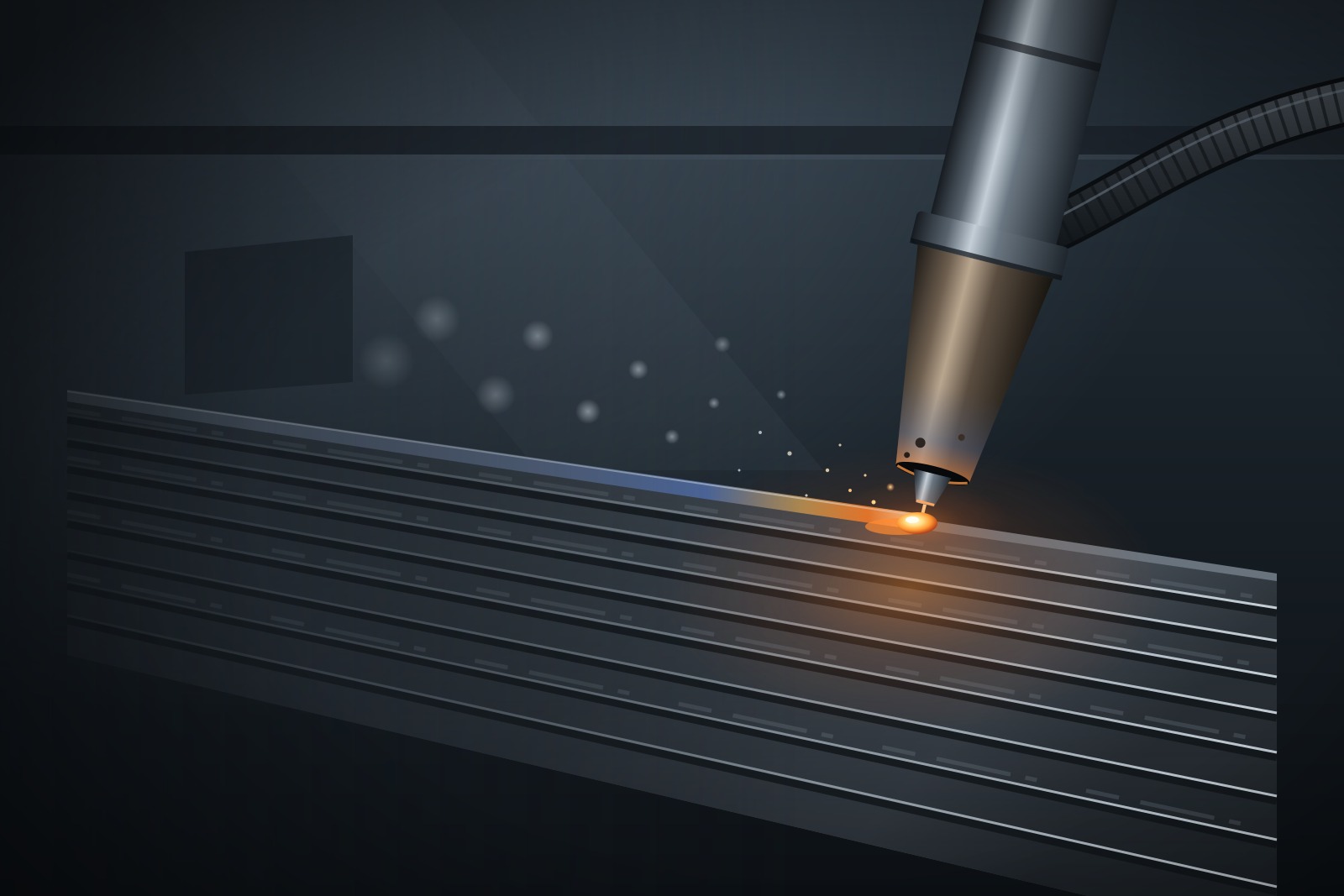
On deposition jobs with many start-stop moves, powder that sprays during each slow shutoff is pure scrap. That makes the switch the clearest cost-per-part story in Hall 11.0. Ask how it retrofits to existing LMD heads and how it would be licensed.
Two other ILT exhibits deal with function rather than cost. In the BMWE-funded LPBFCells project, ILT uses PBF-LB/M to build dense and permeable zones in one monolithic part without post-processing. The demonstrator is an electrolyzer cell with a graded porous transport layer in pure titanium. "By treating porosity as a design feature, we can tailor dense and permeable structures," said Alexander Neuke. The second exhibit is a "smart wrench": an LPBF metal wrench with a strain gauge printed into it by inkjet, aerosol jet or pad printing, during or after the build, to measure deformation and stress in real time. "Everyone is looking for additive sensor solutions, but robust, efficient processes and suitable materials are still lacking," said Dr. Samuel Fink. Dr. Tim Lantzsch, who heads ILT's Laser Powder Bed Fusion department, gave the institute's aim plainly: "Our goal is to make AM more cost-effective and more competitive."
The November 6 release also lists the following:
-
Copper pulsating heat pipes from Fraunhofer IWU and IPM that moved about 1,200 W in preliminary tests at a height of 2.8 mm.
-
Laser Direct Plating from Fraunhofer IWS, with energy use reduced by up to 90 percent.
-
Sinter-based processing of nickel superalloys from Fraunhofer IFAM to avoid the cracking and residual stress of laser processes.
-
Computed tomography from Fraunhofer IMTE for nondestructive dimensional checks and internal-defect detection.
All of these are research demonstrators. The questions to ask are about licensing terms, industrial partners and how long it would take to reach a commercial product.
Large-format metal: WAAM, DED and toolpath control
For parts too big for a powder bed, TCT highlights GEFERTEC (Hall 12.1, B101), which has launched arc10X and arcTitan wire-arc additive manufacturing (WAAM) platforms. Parts on display include a 700 kg compressor impeller and a titanium aircraft emergency-exit frame. AltForm (Hall 12.0, E139) is showing ZENIT Modular, three directed energy deposition (DED) systems with different build volumes for large reactive-alloy parts in aerospace and defense.
Xact Metal (Hall 12.0, C89) launches Tuesday at 16:00 with Dyndrite LPBF Pro running on its metal systems. This adds toolpath controls including arcs, Bezier curves, wobble, delay and skywriting. Xact expects shorter print times, fewer defects and smaller files.
For all three, ask the same thing: have the faster prints and fewer defects been shown on qualified production parts, or only on demo coupons? For WAAM and DED, also ask what machining allowance the near-net shape needs and who does the machining.
Polymer production machines from EOS and Stratasys
EOS (Hall 12.0, D71) reveals a new polymer production platform on Tuesday at 11:00. 3DPrinting.com reported no specifications ahead of the show. Two hours later, at 13:00, Stratasys (Hall 12.1, D129) unveils a new machine that was unnamed before the show. 3DPrinting.com describes it as a serial-production printer. Stratasys is also giving the F870 its first European demonstrations after its September unveiling. TCT lists a 1000 x 610 x 610 mm heated chamber and Nylon 12CF, ASA and ABS materials.
Polymer production economics depend on cost per part at volume. Build speed is only one input. Ask for packing density on a representative build, powder refresh ratio for powder-bed systems, material cost per kilogram, and labor per build from unpacking to finished part.
Post-processing and quality, where hidden costs sit
Several smaller launches deal with the labor that follows the print:

-
AM Solutions D3 (Hall 12, E79): a three-station enclosed unpacking system for the EOS P 770. TCT says parts cool to about 60°C before unpacking, a PA 12 job takes about 20 minutes, and it handles builds up to 90 kg.
-
DyeMansion Powershot Go (Hall 12.1, C32): priced below €14,000 and aimed at smaller shops that finish SLS and MJF parts by hand, per 3DPrinting.com.
-
amsight (Hall 12.1, E81): AM quality-management software that combines production, machine and lab data into one record per part.
-
AMIS and Phasio (Hall 12.1, F91): a linked demo workflow from order intake to delivery.
-
Fraunhofer IMTE (Hall 11.0, D31): the CT inspection work noted above.
A shop that finishes by hand can work out payback for a sub-€14,000 finishing unit from its current labor hours per batch. A one-record-per-part system is worth asking about if your customers' audits already ask for traceability you assemble from spreadsheets.
Examples of production evidence
A couple of exhibits show the kind of evidence worth asking every vendor for. At Meltio (Hall 12.0, C119), there's a Fiat Abarth 500 exhaust manifold made by DED and produced by DMZ. TCT reports that assembly time fell from eight hours to one and that the car has reportedly covered more than 10,000 km. Carbon (Hall 12.1, F109) recently passed one million bike saddles produced, according to TCT. Production figures like these, with a named part, a volume and a time or cost result, are more useful than a build-speed claim.
Ceramics buyers can visit Lithoz (Hall 11.0, B50). TCT says its Performance Pack for the CeraFab S65 doubles light intensity and increases resolution by 60% with 4K projection. Admatec's Admaflex Discovery desktop ceramic printer is priced at $92,500, with orders from November 2026 and shipments expected in spring 2027.
One-page booth checklist
| Area | Ask |
|---|---|
| Cost per part | Machine price and lead time; gas use per build; powder utilization and refresh; operator hours per build including unpacking |
| Qualification | Available parameter sets and material data; who validated them; what transfers from your existing machines; who owns a failed qualification |
| Post-processing | Depowdering method and time; heat treatment; support removal; inspection method and traceability record |
| Evidence | A named production part, its volume and its measured cost or time result |
| Research exhibits | Licensing terms, industrial partner and timeline to a commercial product |
MACHX specifications won't be known until the November 17 unveiling at 10:00. If you're comparing it with an SLM 280 or SLM 500 already on your floor, bring that machine's parameter list and part mix to the booth.
Related reading
-
How the silicon interposer became the bottleneck in AI chip supply
-
How to Check Metal 3D Printing Post Processing Cost in Supplier Quotes
-
How to Find the Cost Crossover Between Binder Jetting and Metal Injection Molding
Sources
-
TCT Magazine: Formnext 2026, The machine launches & applications not to miss! (November 2, 2026)
-
Fraunhofer ILT: Faster, more porous, smarter (October 7, 2026)
-
Fraunhofer: More Functionality in the Part (November 6, 2026)
-
3DPrinting.com: Formnext 2026 Preview, What to See, With Booth Numbers (November 11, 2026)