For the first time, a tier-one consultancy is bundling U.S. manufacturing reshoring into the same demand curve as hyperscaler data centers and broad electrification — and telling operators that the binding constraint on greenfield industrial siting is no longer capital. In a May 2026 framing, Wood Mackenzie argues the U.S. has entered a new era of soaring electricity demand, and that the limiting variable for the 2027–2029 cohort of factories is grid interconnect position and long-lead electrical equipment, not balance-sheet capacity. Bloomberg's independent reporting on the same outlook reaches the same conclusion: grid limits, not capital, are now the gating item.
For executives running site-selection memos, this is a regime change. The traditional triad of land, labor, and incentives has acquired a fourth pillar — and that pillar is now first in line.
The demand stack: data centers, electrification, and a reshoring layer on top
Wood Mackenzie projects U.S. data center capacity will grow from roughly 24 GW today to about 110 GW by 2030, accounting for roughly 68% of total U.S. load growth over the period. Approximately 600 GW of announced data center projects currently lack secured power capacity, against just 183 GW with signed power agreements. That gap — three times more announced load than there is contracted electricity to serve it — is the single most important number in U.S. industrial planning right now.
On top of that, U.S. utilities have already committed to connect more than 160 GW of new large-load demand, with PJM utilities alone projecting 55 GW of new demand by 2030 and 100 GW by 2037. Reshoring announcements in semiconductors, batteries, EVs, defense, and pharmaceuticals are layered onto that same load curve, competing for the same substations and the same delivery slots.
The implication is uncomfortable for industrial buyers. A new fab or battery cell plant does not negotiate with utilities in a vacuum; it negotiates inside a queue that is dominated by hyperscalers with deeper power-procurement teams and a willingness to write checks years ahead of permits.
The queues: from two years to eight
The clearest evidence that capex is no longer the bottleneck is in the interconnection queues themselves. PJM's average interconnection timeline has climbed from under two years in 2008 to more than eight years by 2025; FERC-ordered reforms aim to compress new Generation Interconnection Agreement processing to a 1–2 year window going forward, but that schedule applies only to future cohorts.
ERCOT had more than 2,000 active interconnection requests as of May 2025, and aggregate U.S. interconnection queues — generation plus storage — sit above 2,060 GW per Lawrence Berkeley National Laboratory's Queued Up dataset. Independent analysis from Carbon Direct and RMI's PJM speed-to-power analysis corroborate the basic shape: too many projects, too few interconnection engineers, too little transmission.
The Southeast shows the starkest gap. In Northern Virginia, Dominion Energy is processing roughly 60 GW of power applications against approximately 8 GW of available capacity — a ratio that effectively forecloses opportunistic siting in the country's densest data-center corridor and, by extension, pushes industrial loads looking at the mid-Atlantic into a similar queue dynamic.
Why supply can't close the gap by 2028
The supply side cannot catch up on a relevant timeline. Wood Mackenzie projects gas turbine prices will reach roughly $600/kW by the end of 2027 — a 195% jump from 2019 — with large gas turbines ordered today carrying delivery lead times of about five years and smaller units running 18–36 months. Roughly 63 GW of planned gas additions are slated for 2026–2030 across the U.S., but the order books for OEM-grade large frames are effectively closed for the back half of the decade.
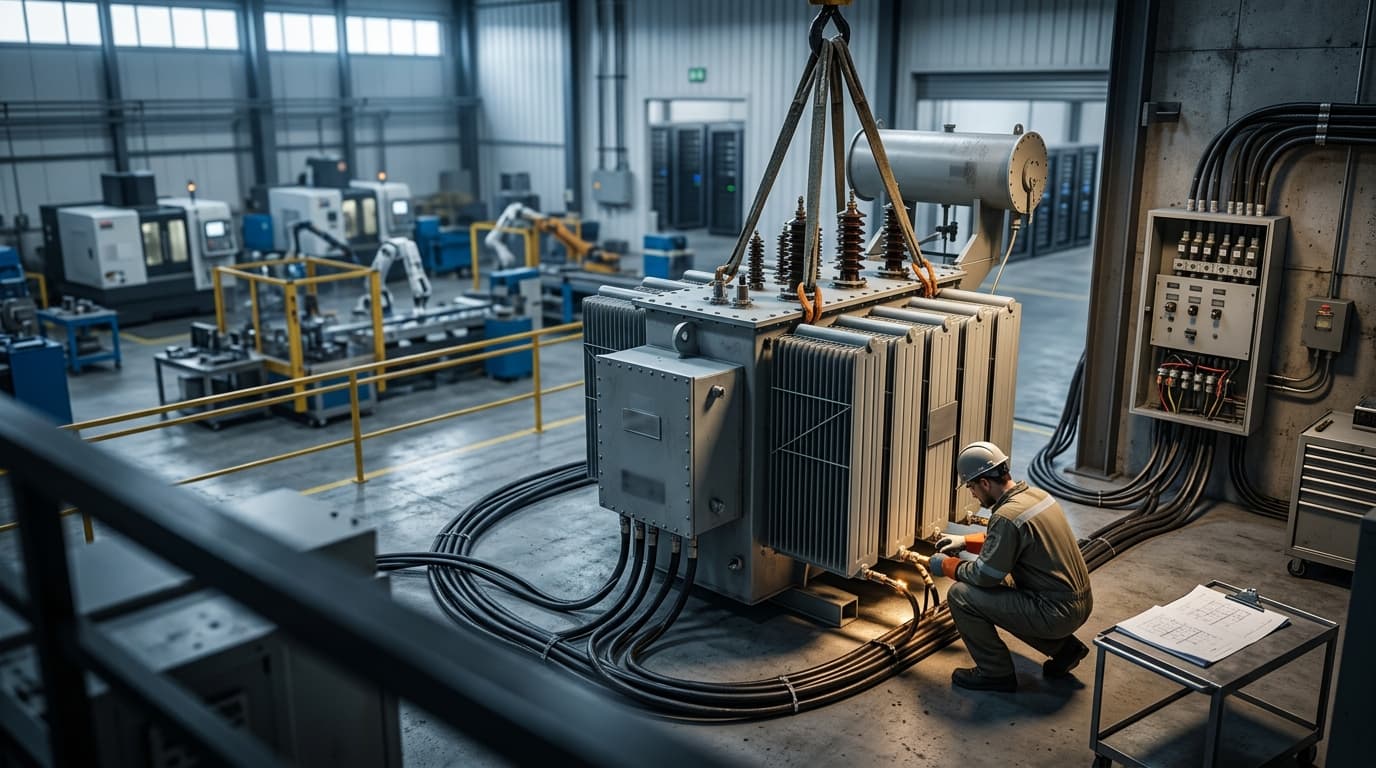
Transformers tell a similar story. By Q2 2025, large power transformer lead times averaged about 128 weeks, with generator step-up units at roughly 144 weeks, and some specialty orders stretching toward four years. POWER magazine's 2026 deep-dive frames this as a structural shortage, not a cyclical one — the result of two decades of underinvestment in domestic transformer manufacturing colliding with a synchronized global build-out.
The supply-side response is real but slow. Prolec GE — acquired by GE Vernova in February 2026 — is investing more than $300 million to expand transformer capacity, including a medium-power plant in Goldsboro, North Carolina, and additional pad-mount capacity in Louisiana and Mexico. Useful, but not the kind of capacity that arrives in time to unblock 2027 startups. The 600 GW of unsecured data center pipeline is, in effect, competing with industrial reshoring loads for the same physical equipment slots.
The operator playbook shift: PPAs and BTM before permits
Disciplined operators have already adjusted. The newer sequencing is to lock in long-dated power purchase agreements and behind-the-meter (BTM) generation contracts before committing to a site — inverting the order in which most U.S. industrial projects have historically been scoped.
Foley & Lardner's 2026 data center survey found 56% of developers are exploring co-located or on-site generation — the third most common power-sourcing tactic, behind PPAs and early interconnect filings. pv magazine USA's January 2026 reporting documents how the same playbook is being adapted by industrial and reshoring operators, not just hyperscalers, with on-site generation evaluated as both bridge capacity and permanent hedge. Bloom Energy's March 2026 data center survey reports that time-to-power now runs roughly 1.5–2 years longer than developers had previously planned for, which is the operational pressure driving the BTM pivot.
The regulatory machinery is following. PJM has filed BTM colocation reforms at FERC, attempting to formalize a framework that grew up ad hoc inside its highest-pressure corridors. For manufacturers, the practical lesson is that the same legal and commercial instruments — 10-year+ PPAs, gas-tolling deals, BTM gas turbines or fuel cells — are now standard items in a site-selection package, not exotic ones.
Proof point: the Northern Virginia transformer crunch
The Dominion 60-versus-8 GW gap is the cleanest documented case of the supercycle's mechanics. Roughly 60 GW of applications are sitting on the desk of one utility; about 8 GW of capacity is actually available to allocate. The arithmetic is brutal — even with FERC-ordered queue reforms, the majority of those applications will either be deferred, redirected to other PJM zones, or paired with BTM generation to bypass the wait.
The Prolec GE / GE Vernova investments — Goldsboro, Louisiana, Mexico — are the supply-side correction, but on a 2028-and-beyond delivery curve. For an industrial buyer making a 2026 siting decision, that calendar is too late: equipment slot reservations, not factory commissioning, are now the leading indicator of when the line will actually run.
Strategic implication for U.S. manufacturers
Site-selection memos that do not lead with grid queue position, equipment slot reservations, and a power-procurement strategy are already obsolete. The 2027–2029 cohort of U.S. greenfields will be sorted by who locked power first, not by who had the strongest incentive package or the cheapest land. Tax credits, IRA-era subsidies, and state matching grants remain meaningful, but they are now downstream of an electrical question that did not exist on the same timeline ten years ago.
For operators, three working rules follow from the data. First, treat the interconnection queue position as a hard input to capacity planning — equivalent in importance to long-lead tooling. Second, sign PPAs and pre-order long-lead equipment before, not after, the FID memo lands on the CEO's desk. Third, evaluate BTM generation not as a backup story but as a primary load-serving option for any project that wants to be operating before 2030.
The Wood Mackenzie thesis, in plain terms: the cost of capital used to be the thing that sorted winners and losers in U.S. industrial siting. For this cycle, electrons sort first.
Related reading
Sources
-
Data center demand drives US electrical equipment market to $65B — Wood Mackenzie press release
-
US Data Center Boom Slows Due to Power Grid Limits, Wood Mackenzie Says — Bloomberg (March 16, 2026)
-
Gas turbine supply crunch set to raise prices 195% by 2027: WoodMac — Utility Dive
-
U.S. transformer market faces severe supply constraints — pv magazine USA (May 11, 2026)
-
US utilities commit to connect 160GW of new large-load demand — DCD
-
FERC orders changes to PJM's grid interconnection process — Utility Dive
-
New analysis of power grid interconnection queues in PJM and ERCOT — Carbon Direct
-
More than half of data centers may be delayed due to lack of transformers — Energy News Beat
-
Transformers in 2026: Shortage, Scramble, or Self-Inflicted Crisis? — POWER Magazine
-
PJM proposes behind-the-meter reforms in data center colocation effort — Utility Dive
-
Rising Wholesale Power Prices: PPA Risk in 2026 — Foley & Lardner