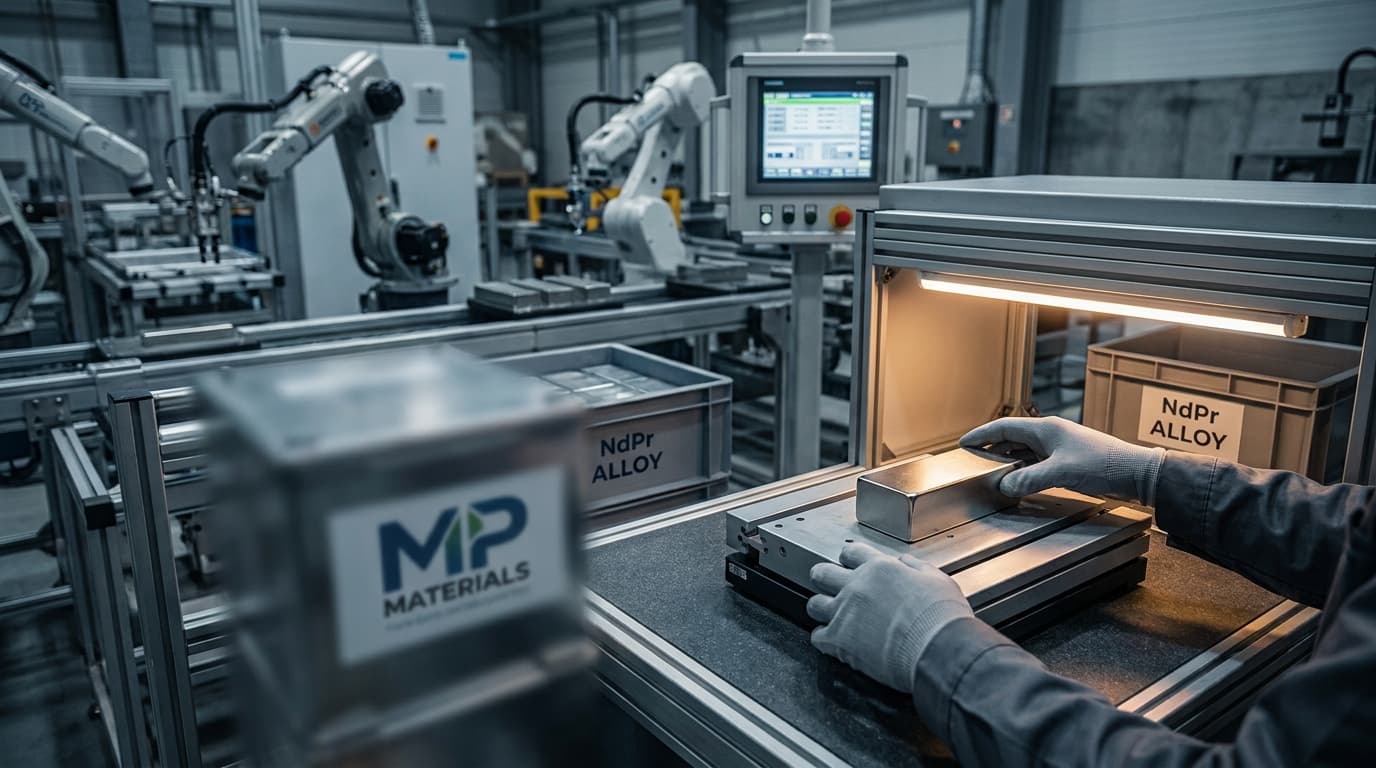
The Department of Defense is now an equity holder in a publicly traded U.S. miner. That sentence, more than the dollar totals attached to it, is the structural break the rare-earth industry has waited two decades for. On July 10, 2025, MP Materials and DoD announced a multibillion-dollar partnership that takes the Pentagon's industrial policy past grants, loans, and Defense Production Act Title III awards and into the capital stack itself.
The headline grab is the roughly 15% stake DoD now holds in MP via $400 million of Series A convertible preferred plus warrants, with up to $350 million in additional preferred committed. The operational mechanism, though, is buried two paragraphs deeper in the 8-K: a ten-year contract-for-difference that pins neodymium-praseodymium (NdPr) at a $110 per kilogram floor across concentrate, oxide, and metal. That floor is what finally converts a Chinese-priced commodity into a regulated-utility-style cash flow — and it is the part of the deal that procurement officers, lenders, and OEM CFOs are actually pricing off.
What the deal actually is
Strip out the press-release language and the structure is five interlocking pieces:
-
~15% DoD equity via $400M Series A convertible preferred plus warrants, with up to $350M of additional preferred committed.
-
A 10-year contract-for-difference price floor of $110/kg on NdPr content. DoD pays the shortfall when the market clears below $110/kg and captures 30% of the upside above it — the Payne Institute's walkthrough is the cleanest public explanation of the mechanics.
-
A $150 million DoD loan earmarked for expansion of heavy rare-earth separation — dysprosium and terbium — at Mountain Pass. This is the first U.S. commercial-scale heavy-rare-earth separation work since the original Mountain Pass shutdown in the early 2000s.
-
A 10-year DoD magnet offtake tied to a new ~7,000-tonne-per-annum facility branded "10X," with the site confirmed in Northlake, Texas.
-
A $140 million minimum-EBITDA backstop on the 10X offtake — a structural floor that turns the magnet plant's cash flow into something a project-finance desk can underwrite.
It is important to separate the two physical assets sitting under this paperwork. The Independence facility in Fort Worth — roughly 1,000 tpa of NdFeB capacity ramping from late 2025 — was built around the pre-existing General Motors Ultium supply agreement and the 2025 Apple recycled-magnet deal. It is online, it is contracted, and it predates the DoD transaction. 10X, at seven times the capacity, is the new build the Pentagon is underwriting. Independence is the pilot; 10X is the program.
Why a price floor at all
Every U.S. midstream rare-earth project of the last fifteen years has failed at the same point in the cost curve. NdPr has cycled between roughly $40 and $200 per kilogram, with the troughs deep enough and long enough to bankrupt any Western producer carrying separation or metalmaking opex. The structural problem is not geological — Mountain Pass has been producing concentrate for years — it is that the marginal Chinese tonne sets price, and Chinese producers are vertically integrated, subsidized, and willing to operate at thin or negative spreads to keep Western entrants from clearing project finance.
A contract-for-difference is the standard regulatory tool used on offshore wind and nuclear in the U.K. and elsewhere for exactly this problem. It does not subsidize the commodity; it removes price risk from the producer in exchange for handing the government the upside above strike. Columbia's Center on Global Energy Policy frames the policy break correctly: prior instruments handed cash to projects and then watched China price them out. The CFD does not require Beijing to behave; it just changes who absorbs the volatility when Beijing does not.
The trade-off is on the upside. DoD's 30% share above $110/kg means that in any tight-market regime — exactly the scenario in which MP would historically have re-rated — the Pentagon takes a third of the windfall. That is the price of compressing the downside. For a producer trying to finance a $700 million-plus magnet campus, the math is straightforward.
What changed for U.S. OEMs
The contracted demand book under this deal is narrower than the post-announcement coverage often implied. Two non-DoD offtakes are public and confirmed: General Motors' long-term alloy and magnet agreement for Ultium electric motors, originally signed in 2021 and expanded in 2022, and Apple's roughly $500 million 2025 deal for magnets produced from recycled feed at Independence. Other OEMs frequently named in coverage — Lucid, Lockheed Martin — are not publicly disclosed direct MP customers; they are indirect end-users via Tier-1 motor and actuator suppliers and should be treated as beneficiaries of a domestic supply curve, not as contracted offtakers.
What changes for the broader OEM base is more important than any specific name. For the first time since Magnequench's last Indiana and Ohio production was shut and tooling shipped to Tianjin in 2004 — the closure documented in the Heritage Foundation's CFIUS case study — procurement departments at U.S. automakers, drone primes, robotics builders, and wind OEMs have a domestic NdFeB supply curve with a known price ceiling-from-below and a credible delivery timeline. That is the bankability problem the previous decade of grant funding could not solve.
The heavy rare-earth piece is the underrated half
The $150 million separation loan is the line item that maps directly to the part of the supply chain China actually weaponized. Beijing's April 4, 2025 export-license regime targeted dysprosium, terbium, samarium, gadolinium, lutetium, scandium, and yttrium — exactly the heavies needed for high-temperature NdFeB grades used in EV traction motors, missile actuators, and radar. CSIS mapped the scope at the time; customs data as of mid-2026 shows yttrium, dysprosium, and terbium exports running roughly 50% below the pre-control baseline. The October 2025 APEC stand-down paused the broader October 9 measures into November 2026, but the April licensing regime — the one that actually matters for magnets — was untouched.
Reporting on stockpile drawdown indicates U.S. heavy rare-earth inventory is now short of one year of programmed military demand at current burn rates. The DoD loan funds the only U.S. asset with both the feedstock chemistry and the permitted footprint to close that gap on a commercial-scale timeline.
The forcing clock is statutory. FY2023 and FY2024 NDAA language bars Chinese-origin rare earths at any stage — mining, refining, alloying, or magnet manufacture — in magnets delivered to DoD effective January 1, 2027. Every line item in the MP deal lines up to that deadline. Independence ramps in late 2025. Heavy separation expands through 2026. 10X starts breaking ground while the NDAA bar is still 18 months out. The deal is not a strategy paper; it is a build sequence.
The under-covered angle: this is a template
The piece of the MP deal that has gotten the least coverage is the one that will define the next 24 months of industrial policy. Multiple independent analyses — the Federation of American Scientists, CSIS, the Payne Institute, and InvestorNews's February 2026 critical-minerals brief — explicitly identify the equity-plus-CFD-plus-offtake structure as the playbook being adapted to gallium, germanium, tungsten, antimony, and uranium.
That list is not arbitrary. Every one of those commodities is on the 2025 USGS Critical Minerals List, and every one has been brought under a Chinese export-license regime between 2023 and 2025. The War on the Rocks analysis lays out the defense-industrial dependency chain on each. The MP transaction is, in policy terms, a template instrument — the first deployment of a structure that DoD now has institutional muscle memory to repeat.
The candidates likely to absorb it first are the companies with permitted Western projects, identified offtake, and a recognizable commodity-price problem that mirrors NdPr's: antimony (Perpetua Resources, United States Antimony Corp.), tungsten (a small set of Western names), and on the energy side, several uranium developers where the price-floor logic maps cleanly. The next DoD critical-minerals announcement that uses preferred equity plus a CFD should be read as confirmation that the MP deal was a template, not a one-off.
What this does not fix
Three constraints temper the structural read. First, execution risk on 10X is real — a 7,000 tpa NdFeB campus on a greenfield site is a multi-year, capital-intensive build, and rare-earth metalmaking is a process discipline that has been almost entirely lost in the U.S. labor market. The Independence ramp is the early read on how much of that capability MP can rebuild in-country versus how much has to be re-sourced.
Second, the political durability of a contract-for-difference across administrations is untested in U.S. industrial policy. The structure binds DoD for ten years, but appropriations risk and a future administration's willingness to actually pay the shortfall in a sustained low-price regime are open questions. The CFD is a contract; contracts can be challenged.
Third, even at full 6,000-plus tpa of U.S. NdFeB capacity projected by 2027 — Independence plus 10X plus a handful of smaller efforts — the U.S. accounts for roughly 2% of the global magnet market. MacroPolo's quantification puts Chinese NdFeB output at roughly 300,000 tpa. The MP deal solves the defense and high-value-OEM problem. It does not displace China as the marginal global producer, and it does not change the fact that the price of an unsubsidized magnet still gets set in Ganzhou.
What to watch
Three near-term signals matter more than any quarterly NdPr print. First, 10X groundbreaking and the construction milestone cadence in Northlake — the gating constraint on whether the DoD offtake actually clears by the 2027 NDAA deadline. Second, the next DoD critical-minerals MOU and whether it uses the same equity-plus-CFD structure on antimony, tungsten, or uranium; that is the template-confirmation event. Third, any NDAA 2027 waiver activity, which would signal that DoD's own program offices are reading the build sequence as unable to deliver on schedule.
The Pentagon now owns roughly 15% of a rare-earth miner. The more durable consequence is that the federal government, for the first time, has a financial structure that makes domestic critical-minerals midstream investable when China is the marginal price-setter. That is the part of the deal worth re-reading.
Related reading
-
Caterpillar and Cummins Generator Backlogs Are Now the Real Cap on AI Data Center Buildouts
-
U.S. Battery Cell Capacity Is Now Outrunning Demand — and the First Gigafactory Lines Are Going Cold
-
Foxconn's Wisconsin Pivot to AI Server Assembly Quietly Hits Full Tilt
Sources
-
MP Materials – Transformational Public-Private Partnership with DoD (press release)
-
MP Materials – Northlake, Texas selected for 10X magnet campus
-
Federation of American Scientists – Unpacking the DoD/MP Partnership
-
Rare Earth Exchanges – U.S. Heavy Rare Earth Stockpile Strain
-
War on the Rocks – Materials That Could Cripple the U.S. Defense Industrial Base
-
Heritage Foundation – Magnequench, CFIUS, and 2004 U.S. Magnet Closure
-
[MacroPolo – The Impermanence of Permanent Magnets](https://archivemacropolo.org/analysis/permanent-magnets-case-study-industry-chinese-production-supply/)