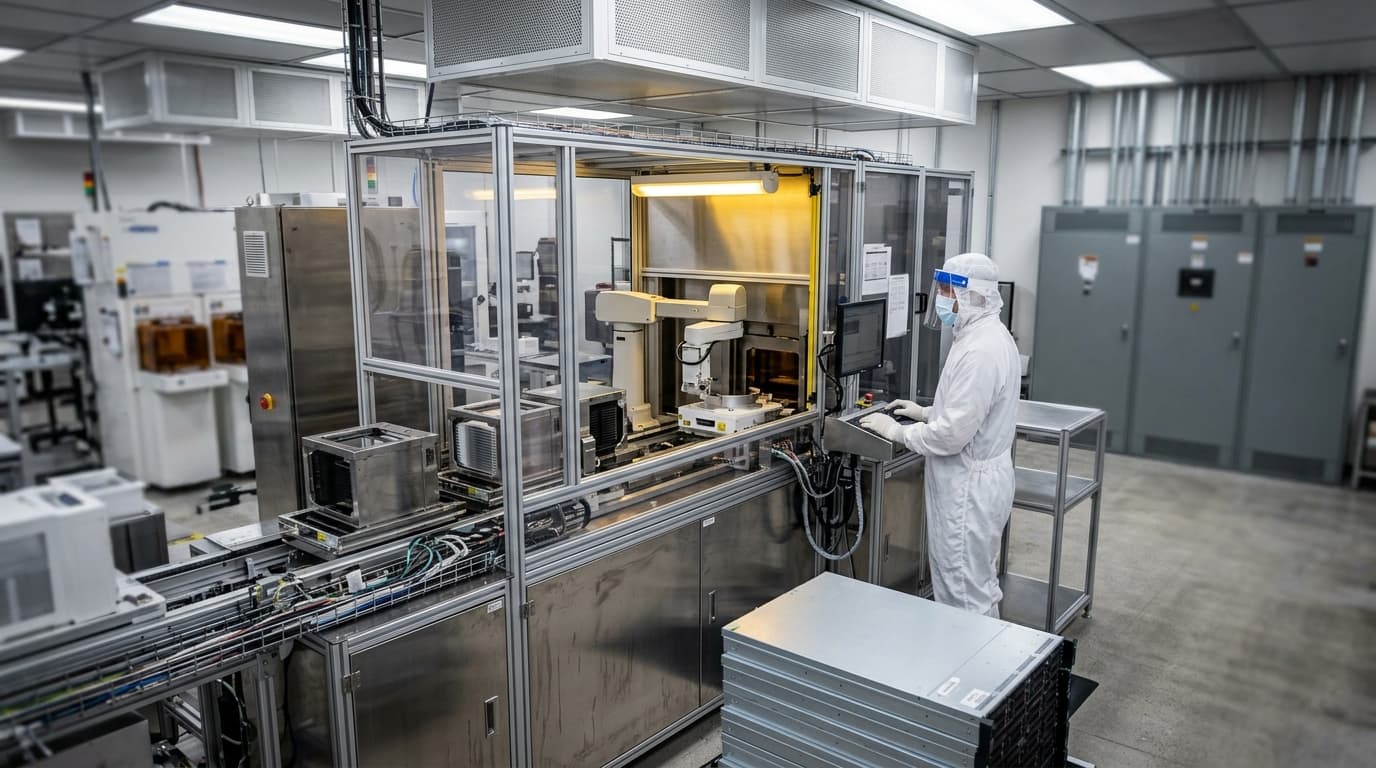
Micron's May 22, 2026 announcement that 1α DRAM is now in production at its Manassas, Virginia fab does two things at once. It reframes a site historically known as a long-life, trailing-node DDR4 supplier into what Semiconductor Digest characterizes as the most advanced DRAM node ever produced in the United States. And it opens a second active U.S. fab geography for Micron — one that will absorb the same grid, water, and labor pressures that have defined semiconductor capex in Arizona, only against a Northern Virginia utility backdrop that is arguably tighter.
What was actually announced
The headline numbers are concrete. Micron is investing more than $2 billion to expand and modernize Manassas, backed by a $275 million direct-funding award from the NIST CHIPS Program Office. The expansion quadruples Micron's DDR4 wafer supply at the site, with qualified production expected by the end of calendar 2026. The product mix is deliberately long-lifecycle: DDR4 and LP4 memory aimed at automotive, defense and aerospace, industrial, networking, and medical device customers — segments where 7-to-15-year supply visibility matters more than bleeding-edge density.
That positioning matters. Manassas is not chasing HBM or DDR5 leading-edge bins. It is converting an existing node-trailing footprint into a node-current site that supplies the customers least willing to qualify a Taiwan- or Korea-sourced part: tier-one automakers building ADAS, defense primes shipping radar and EW gear, and medical OEMs with FDA-bound bills of materials.
Why Virginia, why now
Micron's U.S. roadmap has been visibly rebalancing for a year. According to Tom's Hardware, the company's first leading-edge Boise fab is targeting first wafer output in the second half of 2027, with a second Idaho fab breaking ground in 2026 and reaching operational status by the end of 2028. The New York HBM cluster, by contrast, has been pushed back hard: CHIPS Act funding originally earmarked for New York has been reallocated to accelerate Idaho Fab 2, and meaningful NY supply is now expected in 2030 and beyond.
Bringing Manassas to 1α is the hedge inside that rebalance. Until this week, Micron's active U.S. node-current production was effectively single-region. Standing up a second geography on the East Coast — one already approved, permitted, and staffed — lets the company keep its ~$150 billion U.S. memory manufacturing ambition and 40% domestic-DRAM target on the board while New York slips and Idaho ramps.
The grid math is the binding constraint
Silicon is the easy part. Power is not. Dominion Energy is currently sitting on roughly 50 GW of data-center capacity in its interconnection queue against a historical average add of about 15 data centers and roughly 1 GW per year. Loudoun County alone hosts about 199 operational data centers with another 117 in development. The 22-mile Southern Loudoun 500 kV transmission line is racing to a 2026 completion to relieve Eastern Loudoun bottlenecks — and that is just to maintain headroom, not expand it.
The forward gap is starker. Dominion is forecasting roughly 4,000 MW of additional data-center load by 2028 against about 2,100 MW of current substation capability in the relevant footprint. Dominion has publicly acknowledged it cannot keep pace with the data-center load curve. A fab is not a hyperscaler, but it is competing for the same kilowatts at the same substations against the same queue.
PJM amplifies the problem. The PJM interconnection queue can take 5 to 6 years for typical generation and up to roughly 15 years for large-load customers — the slowest of any U.S. RTO. Any incremental Manassas load that requires new transmission, not just distribution upgrades, is implicitly subject to that clock.
Policy overhang
Virginia's General Assembly has now passed a law mandating independent review of Dominion's data-center-driven load forecasts. That regulatory move is aimed at hyperscaler load, but it sets the planning envelope every large industrial customer in Dominion territory will operate under, Micron included. The political mood — slow data-center growth, force ratepayer protection, scrutinize forecasts — is not aimed at fabs, but fabs do not get a separate queue.
Water and wastewater: the quieter constraint
Water is the constraint nobody outside Prince William County is pricing. Micron is already the largest water user in Manassas. Its prior $1.3 billion expansion was projected to add roughly 1.3 million gallons per day of demand, and the city's 9.19 MGD Upper Occoquan wastewater allotment is expected to be exceeded around 2030 — explicitly contingent on Micron's draw. The multi-jurisdictional capacity expansion required to keep up could cost on the order of $100 million.
For operators, that is the planning detail to track. The Manassas 1α ramp does not break the system today. But the next investment decision — whether a third expansion, a packaging line, or a co-located supplier — collides directly with the wastewater capacity ceiling and the cost of building past it.
Talent: a community-college bet
Workforce risk is being mitigated through the Micron Registered Apprenticeship Program with Northern Virginia Community College and the National Institute for Innovation and Career Advancement. Micron has committed more than $325 million across Virginia, Idaho, and New York for curriculum, apprenticeships, and community programs. The Virginia footprint targets roughly 400 direct manufacturing jobs at Manassas and up to 2,700 community jobs at peak.
The community-college pipeline is the right vehicle for a DDR4/LP4 node-current fab — these are technician-heavy, not PhD-heavy, headcounts. The realistic read is that NOVA can supply the equipment-technician and process-tech ranks at scale, but the senior process-integration and yield-engineering layer will still pull from Boise, Hsinchu, and Pyeongtaek. That is a relocation cost, not a recruiting one, and it shows up in housing and total-comp inflation around Prince William County before it shows up in the P&L.
Operator takeaways
For non-Micron memory and advanced-packaging entrants evaluating Virginia as a CHIPS-supported site, three things have changed this week:
-
Node-current precedent. Manassas at 1α removes the argument that the East Coast is structurally a trailing-node region. A second 1α-or-better operator can credibly site near the existing supplier base, NOVA pipeline, and federal coordination.
-
The kilowatt is the deal. Site selection in Loudoun-adjacent Virginia is now a Dominion-and-PJM negotiation first and a real-estate decision second. Watch Dominion's next IRP and any PJM queue-reform outcome more closely than the incentive package.
-
Wastewater is the second deal. The Upper Occoquan ceiling means any large process-water user landing in Manassas after Micron is implicitly underwriting part of the $100M wastewater upgrade. Price it.
What would change the call
The strategic logic of Manassas as Micron's second active U.S. fab front holds as long as the rest of the roadmap holds. The scenarios that would force a rethink: a further slip in the New York HBM schedule beyond the current 2030+ window, Idaho Fab 2 missing its end-2028 operational date, a Dominion IRP or PJM ELCC shock that materially repricings Virginia power, or a state-level cap on large-load interconnections that catches industrial users in the same net as hyperscalers. None of those are base-case. All of them are now on the same dashboard as the Manassas ramp.
Related reading
-
Micron's Manassas 1α DRAM Start Gives the U.S. a Third Memory Geography
-
The U.S. Trade Chief Just Sequenced Chip Tariffs — Memory and Mature Nodes Are the Exposed Surface
-
Power Has Overtaken Capex as the Reshoring Bottleneck, Wood Mackenzie Says
Sources
-
Micron Advances Made-in-America Memory with Manufacturing Expansion in Virginia — HPCwire
-
Micron Announces Investment in Manassas Facility — City of Manassas, VA
-
Prince William, Manassas wastewater capacity expansion could cost $100M — InsideNoVa
-
Dominion Resumes New Connections, But Loudoun Faces Lengthy Power Constraints — Data Center Frontier
-
Dominion Energy admits it can't meet data center power demands in Virginia — DataCenterDynamics
-
Pricey transmission upgrades stalling much-needed Virginia energy projects — VPM News
-
New state law mandates review of Dominion's load forecasting — Virginia Mercury
-
Micron accelerates second Idaho fab and reallocates CHIPS Act funding — Tom's Hardware