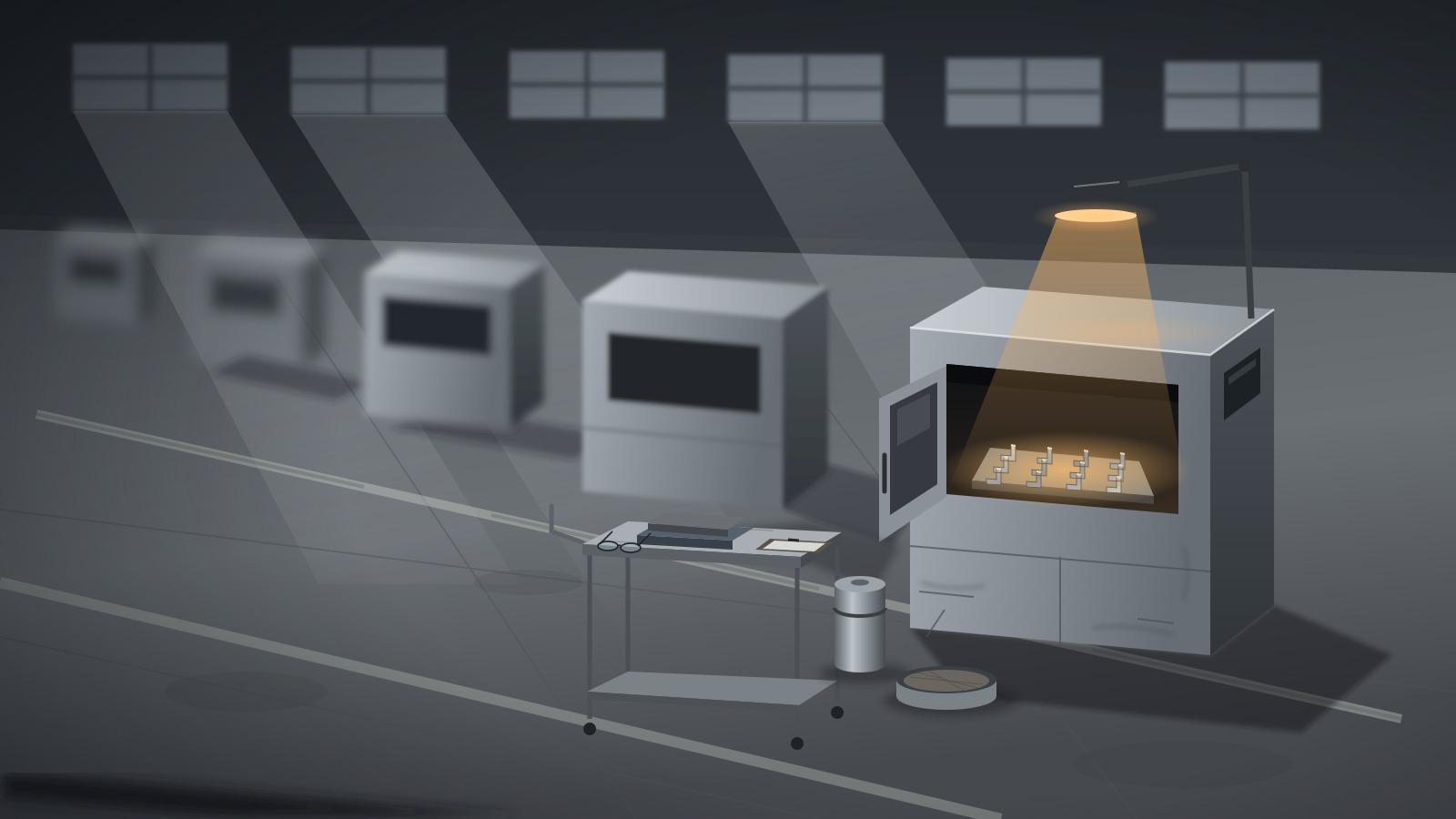
On Nov. 16, 2026, the Department of War (DOW) and the Commerce Department's Bureau of Industry and Security (BIS) opened a national assessment of the additive manufacturing qualification barriers that keep printed parts from scaling in defense production. ExecutiveGov reports that roughly 500 U.S. entities started getting digital notices that day: manufacturers, service providers, and printer and material producers. The survey runs under Section 705 of the Defense Production Act, so answering it is mandatory. According to DOW, the aggregated answers will shape common qualification standards across the military departments.
A shop that received a notice has two things to do. The legal one is filing a complete answer on time. The strategic one is answering from records that show what qualification really costs the shop. DOW says it wants to act on those numbers, and a shop can only give them if it has been tracking them.
What is the DOW-BIS additive manufacturing assessment?
The official release is titled "Launch Of Nationwide Assessment To Dismantle Barriers To Additive Manufacturing In Defense Production." It says DOW and BIS "announced a national assessment to identify and dismantle the qualification cost and timeline barriers" to scaling AM in the defense industrial base. The legal authority is 50 U.S.C. 4555, the Section 705 provision that lets the government study the industrial base and require information from companies.
ExecutiveGov's account covers five sectors: aerospace, ground vehicles, maritime, munitions and space. The survey asks about four topics: capital spending, software integration, machine use, and supply lines for powder and feedstock. DOW says it will use the results in three ways: to direct capital investment into domestic capacity, to help set common qualification standards across the military departments, and to inform future acquisition policy. The aggregated findings will feed a joint DOW-Commerce strategy for streamlining defense qualification. ExecutiveGov quotes Under Secretary of War Michael Duffey, who said the Commerce partnership is meant to ease regulatory bottlenecks and speed certification, and that a modern industrial base must move new technologies "from prototype to production at speed."
Do you have to answer the Section 705 survey?
Yes, unless BIS grants an exemption. Supplement No. 1 to 15 CFR Part 702 says a "reply to a survey request is compulsory." Under 15 CFR 702.4, recipients must submit "a complete and adequate response to BIS" by the deadline printed in the survey. Several details in that rule catch first-time respondents:
-
Aggregates don't count. If you send aggregate data where the survey asks for specific information, BIS treats the response as noncompliant. A single blended "AM cost of quality" figure in place of the requested breakdown can fail the standard.
-
Requests don't pause the deadline. Asking for an exemption or an extension does not stop the clock.
-
Extensions are short. BIS can grant one when more time is reasonably needed and the company is making progress. The rule says "Generally, extensions will be for no more than two weeks." You can request more than one.
-
An NDA is no excuse. A private non-disclosure agreement with a customer does not exempt a company from responding.
The exemption grounds are narrow: no physical presence in the U.S., no association with the items being surveyed, operations that ended more than 12 months ago, less than a year in operation, or extenuating circumstances. A shop that prints defense parts and has been running for a while almost certainly doesn't qualify.
Enforcement is set out in 15 CFR 702.5. BIS can issue a subpoena, and the government can ask a federal court for an order. A willful failure to comply can bring, on conviction, a fine of up to $10,000, up to a year in prison, or both. Per the Part 702 supplement, a survey's cover page usually shows a burden estimate, an OMB control number and an expiration date, and the general instructions list who to contact for survey support. Look for those on your notice before anything else.
Will your cost and customer data stay confidential?
Yes, with one narrow exception. Under 15 CFR 702.3, BIS "deems all information submitted in response to a survey" to be confidential. That information can't be published or disclosed unless the Under Secretary for Industry and Security decides that withholding it is contrary to the national defense interest. Anyone who willfully discloses it without authorization faces up to a $10,000 fine, up to a year in prison, or both. Subsection (d) of 50 U.S.C. 4555 puts the same rule in statute. ExecutiveGov also reports DOW's statement that individual submissions are confidential under the DPA and exempt from FOIA requests.
This matters most for the numbers a supplier usually keeps behind an NDA: which prime required which tests, what a requalification cost on a particular program, and how long a powder source took to approve. The regulation already decided that the NDA doesn't excuse the response, and the statute protects what you submit. Defense-specific detail is what the survey is trying to collect, so a cautious, scrubbed answer helps nobody.
Build a qualification cost ledger before you open the survey
The survey's exact questions haven't been published. ExecutiveGov describes only its topics. The ledger below is a suggested set of internal records, organized by those four topics so the numbers are ready whatever form the questions take. It doesn't reproduce the survey. It also matches the four things DOW says must be validated together to qualify an AM part: final geometry, printer calibration, the build's software workflow, and raw feedstock.

| Level | What to log | Reported survey topic it supports |
|---|---|---|
| Per machine | Requalification events and their cause; calibration hours; days idle while waiting on customer or government approval; utilization on qualified versus unqualified work | Machine use; capital spending |
| Per powder or feedstock lot | Lot acceptance tests run; approval lead time; lots quarantined or scrapped; number of approved sources per alloy or polymer | Powder and feedstock supply |
| Per software workflow | Build-file or software changes that triggered revalidation; integration and license cost tied to qualified builds | Software integration |
| Per part | First-article cost; CT and other NDI hours; coupon and density-cube testing; drawing-change cycles; parts tested to failure | Capital spending (inspection equipment); machine use |
| Per customer | Requirements duplicated across services or primes for the same part, material or machine; cost of each repeat | Cuts across all four |
Pull hours from timecards and quality records, not from memory. If a figure has to be estimated, write down how you estimated it. Survey responses are compulsory and federal enforcement stands behind them, so you should be able to show where every number came from.
Separate one-time costs from repeated ones
The most persuasive thing a supplier can show is the split between costs paid once and costs paid again and again. Buying a CT system or validating a new alloy is a one-time investment. Requalifying the same part because it moved to a different printer, rerunning lot acceptance for a second customer's spec, or repeating first-article testing for each military department are repeated costs. They come from process, not physics.

Common qualification standards across the military departments, one of the uses DOW names for the results, would mainly reduce the second category. A response that tags each cost line as one-time, per machine, per lot or per customer hands policymakers a map of what harmonization would save. A single total doesn't.
What does a defense AM approval chain look like in practice?
The Army's Corpus Christi Army Depot (CCAD) has published a useful example. Army.mil reports that in October 2025, CCAD started printing replacement tail fins for the UH-60 Black Hawk's Crashworthy External Fuel System because the OEM was short on parts. The approval chain had several steps:
-
Structural analysis and technical evaluation, with Redstone Arsenal leadership signing off
-
A production fin made of polyetherimide thermoplastic, printed in four segments, with 16 hours of inspection per segment
-
A Certificate of Conformity for each part
-
Material traceability back to the original source
-
Compliance with FAR flame, smoke and toxicity requirements
-
About two months to get the material and software in place
Separately, ExecutiveGov's report on the DOW announcement says Army Secretary Dan Driscoll cited a 3D-printed fin for a Black Hawk external fuel tank that cost just over $3,000, against about $14,000 for the vendor's replacement. The same report mentions an Army effort aimed at 60 components in 60 days.
The unit price comparison gets attention. The approval chain is where the time goes, and few shops track it with the same rigor. Inspection hours per segment, sign-off cycles, traceability paperwork and material lead time all belong in your ledger. Those costs are what the assessment is trying to measure.
Where defense AM qualification policy is already moving
Several earlier moves point the same way as the survey. They're useful reference points when you describe which requirements in your own work feel redundant.
-
June 2021: DoD Instruction 5000.93, "Use of Additive Manufacturing in the Department of Defense," was published. Its key areas include "Use of risk-based approval approaches and promotion of research to enhance qualification" (DoD CTO).
-
May 19, 2026: America Makes and NCDMM named six Group 1 awardees for the $1.7 million Joint Additive Qualification for Sustainment, Supplier Qualification (JAQS-SQ) program: 3D Systems, Alloyed, Howco Additive, Rennscot, Velo3D and Divergent Technologies. Up to five awards had been expected. The Office of the Under Secretary of War's Manufacturing Technology Office funds the program. It trains and supports AM contract manufacturers to meet the process control documents required for qualified production, with the goal of bringing non-traditional suppliers into the defense supply chain. The announcement calls today's part-by-part qualification restrictive and says it limits capacity and efficiency. 3D Printing Industry reports that Group 1 focuses on laser powder bed fusion.
-
Aug. 11, 2026: The Navy released technical requirements for metal AM in submarine construction, maintenance, overhaul and repair. Per ExecutiveGov, the aim is to cut redundant engineering assessments, drawing changes and first-article testing when printed parts replace cast and wrought parts. Level I material control and SUBSAFE applications stay under the applicable Navy quality requirements. Vice Adm. Robert Gaucher, director of submarine programs, said "Additive manufacturing gives us a tool to get after supply chain constraints and part obsolescence." The Navy's "1+2" goal is one Columbia-class and two Virginia-class submarines a year.
-
Nov. 16, 2026: DOW and BIS launched the Section 705 assessment.
Taken together, these steps move qualification away from approving each part toward controlling each supplier's process, with the most critical applications still fenced off. If your ledger shows that most of your repeated cost comes from part-by-part approval, that fits the direction policy is already taking.
Why is qualifying additive parts so expensive?
Qualification takes a lot of testing and a long time. NIST's AM Part Qualification project says "extensive empirical testing consisting of thousands of individual tests, costing millions of dollars" and "necessitating several years to complete, is required to qualify parts built through additive manufacturing (AM)." According to ExecutiveGov, DOW says validating geometry, calibration, software workflow and feedstock at the same time creates steep cost premiums and testing that can run for years. The burden falls hardest on lower-tier suppliers, small businesses, and new or commercial entrants.
At a 2024 National Academies workshop, Mark Benedict of the Air Force Research Laboratory called qualification the main barrier to Air Force adoption of AM parts. He said it took seven years before a fused-deposition material was test-flown on a crewed aircraft. The workshop discussion also noted that laser calibration in laser powder bed fusion is slow and lasers drift during long builds, which makes it hard to get the same result from one machine to the next. Flight-critical parts need volumetric inspection, and CT is the standard method. Benedict described a certification path for a fighter-aircraft part: demonstrate coupon and density-cube quality, verify geometry on printed parts, then test many parts to failure. He said the strongest near-term business case is where AM replaces a lower-quality material or a highly variable process.
Commercial aviation faces similar friction. An SME article by Erik de Zeeuw of Materialise notes that EASA's 2020 memorandum separates low-criticality from high-criticality AM parts. It lists re-engineering budgets, the lack of a standardized certification approach, and different data requirements among design organizations and regulators as barriers.
Who should own the response inside your company?
Treat the survey as a cross-functional deliverable with a single owner, usually the quality or AS9100 lead, who already keeps first-article, NDI and traceability records. The other inputs come from:
-
Finance: capital spending on printers, inspection and post-processing, plus cost of quality broken out by the ledger categories
-
Operations: machine utilization, calibration time, and idle days spent waiting on approvals
-
Purchasing: powder and feedstock sources, approval lead times, and single-source exposure
-
Engineering or IT: build software, integration cost, and revalidation triggered by software changes
Set an internal deadline well before the date on your notice. An extension request doesn't stop the clock, and extensions generally run two weeks or less, so plan to finish without one. Contracts staff should know before submission that a customer NDA doesn't exempt the company and that BIS holds the response confidential.
A response built from your own records goes into the strategy DOW and Commerce say they will write. A guessed or aggregated response teaches policymakers nothing and may fail the 15 CFR 702.4 standard. Keep the ledger going after you file. The same records support customer audits, and they give you a head start on the supplier-level process control documents that programs like JAQS-SQ are built around.
Related reading
-
What the China block on the ABB Robotics SoftBank deal means for robot buyers
-
Formnext 2026 new printers worth a production engineer's time
-
How to Check Metal 3D Printing Post Processing Cost in Supplier Quotes
-
How to Find the Cost Crossover Between Binder Jetting and Metal Injection Molding