
On November 4, 2026, China's Office of the Working Mechanism for Foreign Investment Security Review notified SoftBank Group that it had prohibited the acquisition of ABB's robotics business in China. ABB disclosed the block on November 5, and SoftBank confirmed it in a press release on November 6. The ruling covers the China portion of the ABB Robotics SoftBank deal. The overall sale hasn't been cancelled. It also hasn't closed, so ABB still owns the robots, the factories and the service organization that plants deal with today.
For a plant running ABB cells or holding an open quote, nothing in the companies' disclosures changes service, spare parts, pricing or product roadmaps. Neither company has said anything about those topics. What has changed is that the eventual owner, the shape of the business and the closing date are less certain than they were a month ago. That's a contract question you can start working on now.
The timeline
-
October 8, 2025: ABB agrees to sell its robotics division to SoftBank Group for $5.375 billion. Closing is expected in mid-to-late 2026, subject to regulatory approvals (Automation World).
-
February 2026: The deal clears China's competition review, according to the Financial Times as cited by Silicon Republic.
-
November 4, 2026: SoftBank receives notice that the security review office has prohibited the acquisition of ABB's robotics business in China.
-
November 5, 2026: ABB discloses the block and confirms it to The Robot Report.
-
November 6, 2026: SoftBank publishes its own update.
Neither company has given a revised timetable or a new deal structure (Robotics & Automation News).
The baseline terms haven't changed. The business SoftBank agreed to buy had 2024 revenue of $2.3 billion, about 7% of ABB Group revenue, and roughly 7,000 employees. Masayoshi Son framed the purchase as a bet that "SoftBank's next frontier is physical AI," according to Automation World.
Who blocked the China portion, and on what grounds
SoftBank's release names the Office of the Working Mechanism for Foreign Investment Security Review as the body that issued the prohibition. The Financial Times, as reported by swissinfo.ch, attributes the decision to the National Development and Reform Commission (NDRC). The two companies haven't used that name.
Neither ABB nor SoftBank has given a reason, and both declined further comment. The reasons in circulation come from the FT. According to its reporting, as cited by Silicon Republic, authorities feared "potential transfers of Chinese-made assets and data to Japan for use in training AI models," including by OpenAI, which is a major SoftBank holding. Swissinfo, also citing the FT, reports that the review examined ABB's Chinese supply chain and wanted some manufacturing to stay in China. Regulators also looked at keeping some robotics IP in China, which could require parts of the business to be spun off to Chinese owners.
Samantha Mou, senior analyst at Interact Analysis, told Robotics 24/7: "Data security is likely a key concern behind the deal's blockage." This matters on the plant floor because the deal clearly passed a competition test in February. The objection appears to be about where data, IP and production capacity go after the deal, not market share.
Who owns ABB Robotics today
ABB does. The sale hasn't closed, so your purchase orders, service agreements and warranties are still with ABB entities. SoftBank's release says SBG manages the regulatory approval process and commits to "promptly announce any decisions on matters requiring disclosure."
ABB's statement, as reported by Robotics 24/7, reads: "ABB and SoftBank are in close dialogue and are working constructively on the transaction." It adds that "the transaction is subject to regulatory approvals and customary closing conditions." That language tells you both parties still want a deal. It doesn't commit to a structure, a date or a price, and it doesn't mention customers.
One part of ABB's former robotics segment was never in play. The Machine Automation division, the rest of the old Robotics & Discrete Automation segment, was excluded from the sale and was to move into ABB's Process Automation business area in Q4 2025, according to Automation World. If your ABB spend is on that side, the deal doesn't touch it.
How much of ABB Robotics depends on China
Three figures are circulating, and they measure different things.
-
About 50% of global industrial robot shipments. Mou told Robotics 24/7 that "China accounts for around 50% of ABB's global industrial robot shipments." This counts units by destination: robots delivered to customers in China, wherever they were built.
-
About 30% of robotics revenue. Manufacturing Dive (November 10, 2026, republished on Yahoo Finance) puts China at roughly 30% of ABB's robotics revenue. Revenue and unit share can diverge when product mix, pricing and service income differ by region. The gap suggests China-bound robots bring in less revenue per unit than the global average, though neither source breaks that down.
-
About 90% of China-bound robots built locally. Robotics 24/7, citing The New York Times, reports that "roughly 90% of its machines built for Chinese customers are manufactured within the country." This is a production measure, and it shows how far ABB's China supply chain is built to serve the Chinese market.
The local production base is substantial. ABB's Shanghai robotics mega factory opened in December 2022 at a cost of $150 million, with 67,000 square meters of factory space and an 8,000-square-meter R&D center (Plant Services). ABB Robotics' U.S. headquarters and factory are in Auburn Hills, Michigan, per The Robot Report.
Mou drew the valuation conclusion directly: "An acquisition excluding China would therefore significantly undermine the value of the proposed $5.4 billion deal."
Four ways the deal could resolve
Analysts expect a compromise, and four paths have been reported:
-
A China carve-out. Bloomberg first reported carve-out discussions, according to Manufacturing Dive.
-
A spinoff of parts of the business to Chinese owners. The FT, via swissinfo, reports that regulators' interest in keeping IP in China could lead to this.
-
Another buyer China would approve. Analyst Erik Nieves told Manufacturing Dive that "all options are on the table," including that route.
-
Reapplication. Swissinfo reports that SoftBank is trying to work out whether it could seek approval again.
None of these is simple. Ash Sharma, managing director at Interact Analysis, told The Robot Report that "separating the Chinese operation from a global transaction of this scale would be extremely challenging." He added that "robotics data, intellectual property, and local manufacturing capability are becoming important considerations" in cross-border M&A. A business that builds about 90% of its China-bound robots in China and sends about half its global units there doesn't split cleanly along a border.
The IRC5 to OmniCore transition runs on its own clock
Keep the deal news separate from a controller change that was already scheduled. In June 2024, ABB said its OmniCore platform replaces the IRC5 controller, "which will be phased out in June 2026," according to The Robot Report. ABB also said it will "continue to support its customers with spare parts and services" for the "remaining lifetime of robots using it."
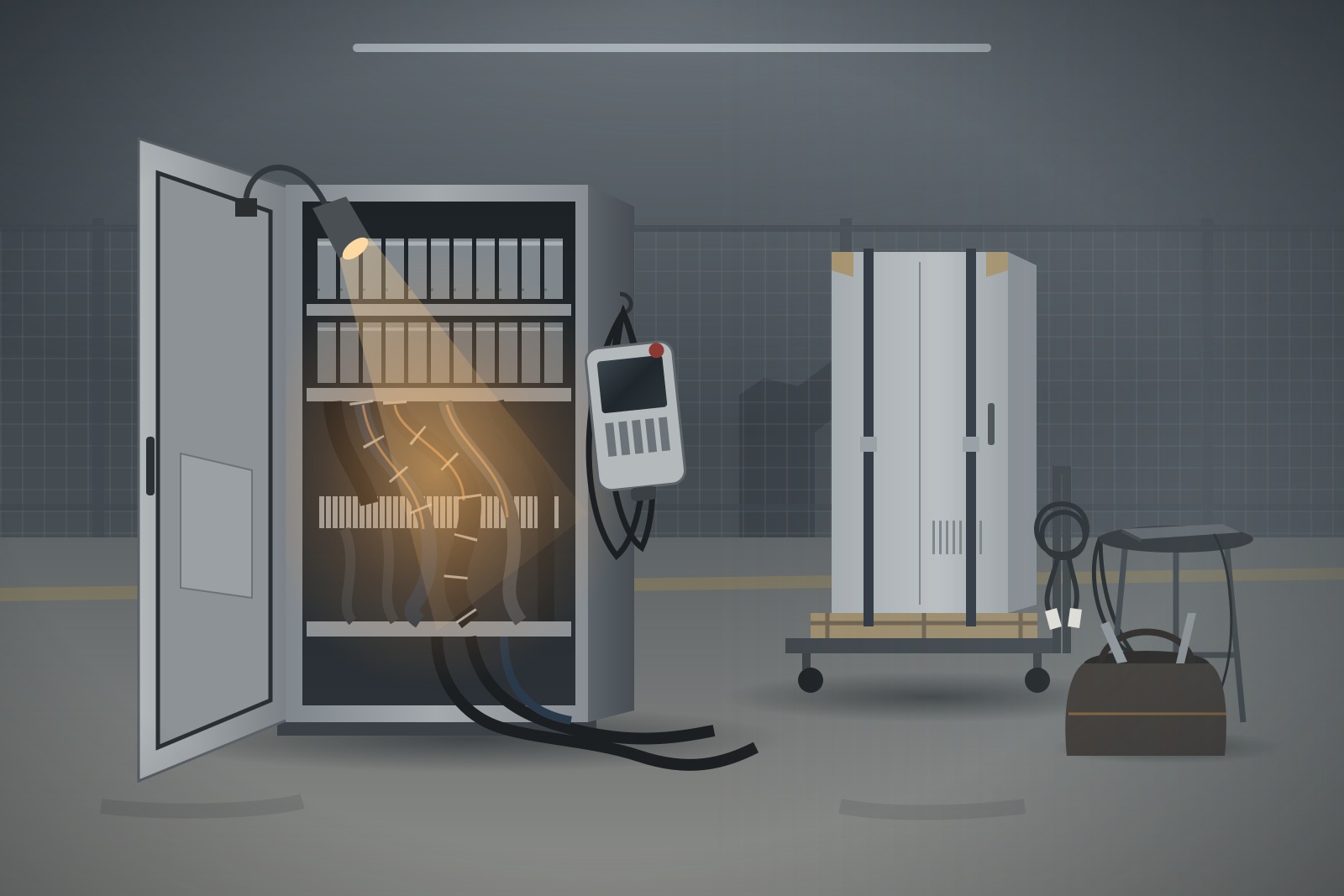
If you run IRC5 cells, your migration planning depends on that commitment and on your own line economics, not on whether SoftBank closes. The deal question is narrower: whether a future owner, or a split business, honors the lifetime support commitment ABB made. Get that answered in writing.
Questions to put to your ABB account rep this quarter
Your rep may not have answers yet, but asking now puts your concerns on record before any restructuring and gives you a basis for contract language.
-
Which plant builds the models I buy, and could that change in a China carve-out? If your robots or key subassemblies come out of Shanghai, a split could change sourcing, lead times or part numbers.
-
Will my service contract and parts pricing be honored by whoever owns the business? Ask whether existing agreements transfer automatically and on what terms.
-
Will robot and cloud data be stored or processed differently? Data flows appear to be at the center of China's objection, so connected-robot data handling could be part of any restructured deal.
-
What is the OmniCore migration plan for my IRC5 cells? Ask for model-specific timelines and confirmation of the lifetime parts-and-service commitment.
-
Will warranty terms change after a change of control?
-
Who will be the contracting party after closing? You need to know which legal entity carries your warranty, service and parts obligations.
Where service and spare parts could be exposed
To date, nothing has been announced. None of the reports reviewed include any company statement on customer service, spare parts, pricing or product roadmaps after the block. Everything below is risk, not fact.
The risk comes from the seams a carve-out could create. If the China business ends up under different owners, a model or part built in Shanghai for global customers could end up being supplied by another company. That could affect parts availability and pricing for plants outside China, depending on how supply agreements between the two sides are written. Data from connected robots is a second seam. If regulators' concern is data leaving China, a split could mean separate data infrastructure, and connected services could look different depending on where the robot is installed.
To size your exposure, look at which critical spares you'd wait on during a disruption and what a week of lost output on that cell costs. ManufacturingMag's downtime cost calculator separates lost contribution from recovery costs, which gives you a number to set against the cost of stocking critical spares now.
Should you delay a robot purchase or quote?
Ownership uncertainty is one side of the decision. Market pricing is the other. Robert Little, former chief of robotics strategy at Novanta, told The Robot Report that subsidized Chinese robot makers are "becoming stronger competitors at home and expanding into Europe," which puts pressure on pricing and margins. A supplier facing that pressure, and an uncertain change of ownership, has reasons to negotiate.
For most plants, a pause makes less sense than writing the uncertainty into the contract. Ask for parts-pricing protection over a defined period, service terms that survive a change of control, and named obligations on whichever entity succeeds ABB. If a project depends on connected services or a model you know is built in Shanghai, ask the questions above before you sign. If ABB can't answer them, get competing quotes, including from suppliers whose ownership isn't in question.
Related reading
-
How to Find the Cost-per-Move Break-Even for AMR vs Conveyor
-
Auto Parts Makers Nearly Doubled Robot Orders as Food Plants Pulled Back
Sources
-
SoftBank Group press release: update on acquisition of ABB's robotics business (Nov 6, 2026)
-
Robotics 24/7: SoftBank's proposed $5.4B acquisition of ABB Robotics blocked by China
-
The Robot Report: Industry experts discuss China blocking SoftBank acquisition of ABB Robotics
-
The Robot Report: Chinese regulators block SoftBank's $5.4B acquisition of ABB Robotics
-
Silicon Republic: China blocks SoftBank's $5.4bn ABB robotics unit acquisition
-
swissinfo.ch: China blocks SoftBank's $5.4bn takeover of ABB's robotics division
-
Robotics & Automation News: China blocks SoftBank's $5.4 billion takeover of ABB Robotics
-
Plant Services: ABB opens $150 million robotics factory in Shanghai
-
The Robot Report: ABB releases OmniCore platform for control across robotics line
-
Manufacturing Dive, November 10, 2026, as republished on Yahoo Finance