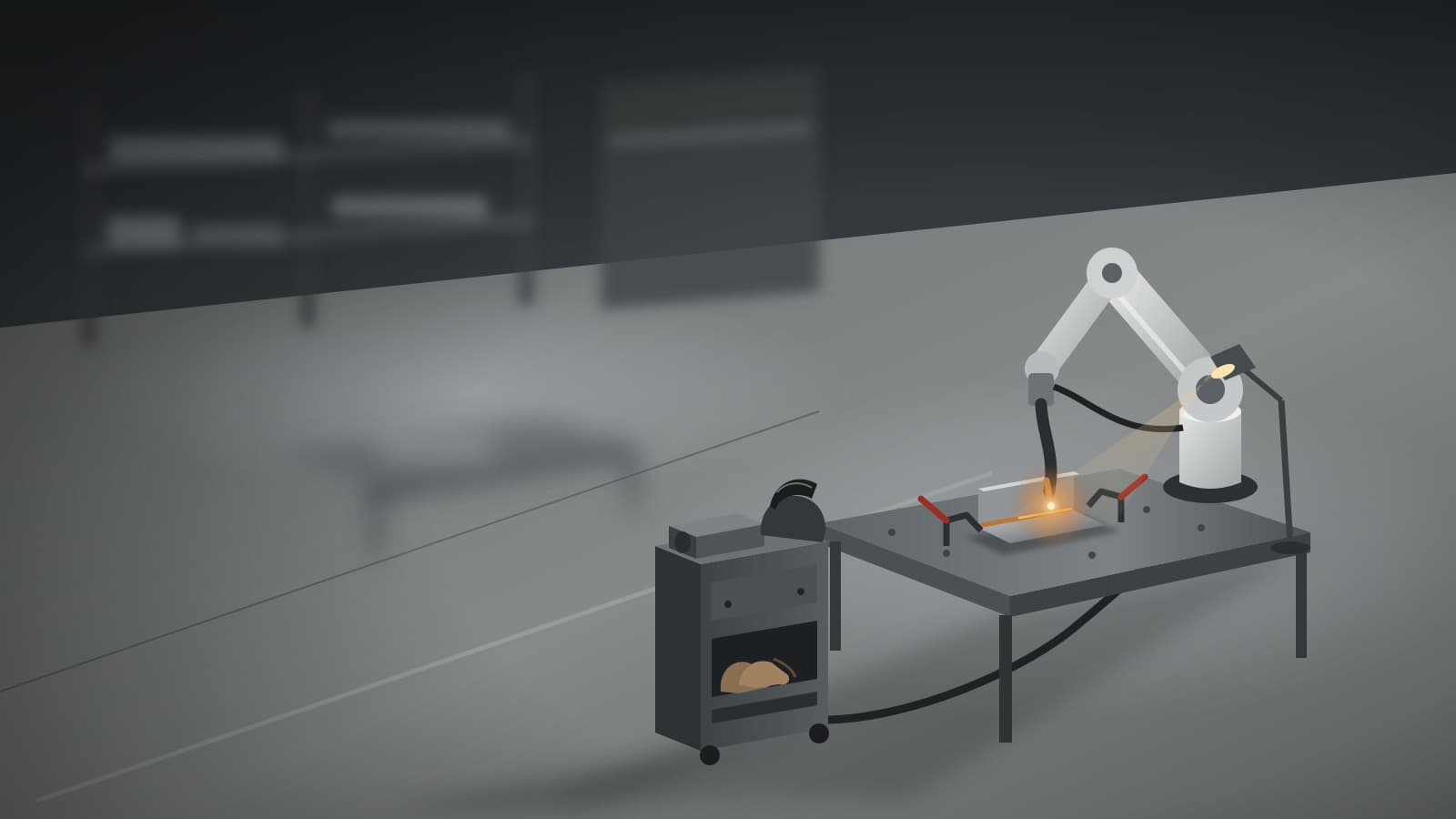
For a mid-market fabricator, cobot welding cell cost usually comes to about $100,000 to $150,000 installed for a MIG cell, and the robot arm is well under half of that. In one independent line-item estimate, the arm and controller came to 39% of a $113,336 UR10e cell. So the arm is the smallest decision on the purchase order. Most of the money goes to everything around it: the power source, fixturing, guarding, fume extraction, and the engineering hours that turn a robot into a cell that makes parts.
This guide covers what a published "starting price" includes, goes through the cost stack one line at a time, separates the costs that grow with part mix from the ones that are fixed per cell, and ends with a worksheet and a list of questions to settle before you call an integrator.
How much does a cobot welding cell cost?
Expect roughly $100,000 to $150,000 for a working collaborative MIG cell. Simple entry packages start lower, and heavily customized cells cost more. These public benchmarks give the range:
-
Packaged vendor cell: Hirebotics lists its Cobot Welder at a "$105,000" starting price. On the same page it lists its plasma Cobot Cutter at $100,000 and its Cobot Painter at $140,000.
-
Independent bottom-up estimate: Open Factory, which says it takes no money from equipment makers, built a line-item stack for a UR10e MIG cobot cell that totals $113,336.
-
Torch maker's tiers: Binzel-Abicor sorts cobot welder systems into three bands: entry-level at $52,000 to $70,000, mid-range at $80,000 to $110,000, and high-end at $120,000 to $150,000 and up. Across the tiers, fixturing, integration and training go from "standard" to "customized" to "highly customized."
-
Full welding cells generally: Writing in Automation World in April 2026, THG Automation CEO Matt Hendey put the range wider: "A full robotic welding cell cost can range from $120,000 to $500,000 or more." That figure covers traditional and collaborative cells.
Integrator Relling, which says no robot vendor pays it, offers a rule of thumb: a working cobot cell "usually costs two to three times the arm, sometimes more." Relling cites no study for that ratio, so treat it as one integrator's heuristic. It does hold up against the Open Factory numbers. Relling lists a UR10e on a Vention cart at $44,636 (read October 24, 2026, and marked obsolete), which matches Open Factory's arm line exactly. Two to three times that is about $89,000 to $134,000. Open Factory's $113,336 total is about 2.5 times the arm.
What does a cobot welder "starting price" include?
It covers a base hardware and software package. It usually does not cover the fixturing, motion and sensing options your parts will need. The Hirebotics pricing page is a useful example because it lists the components.
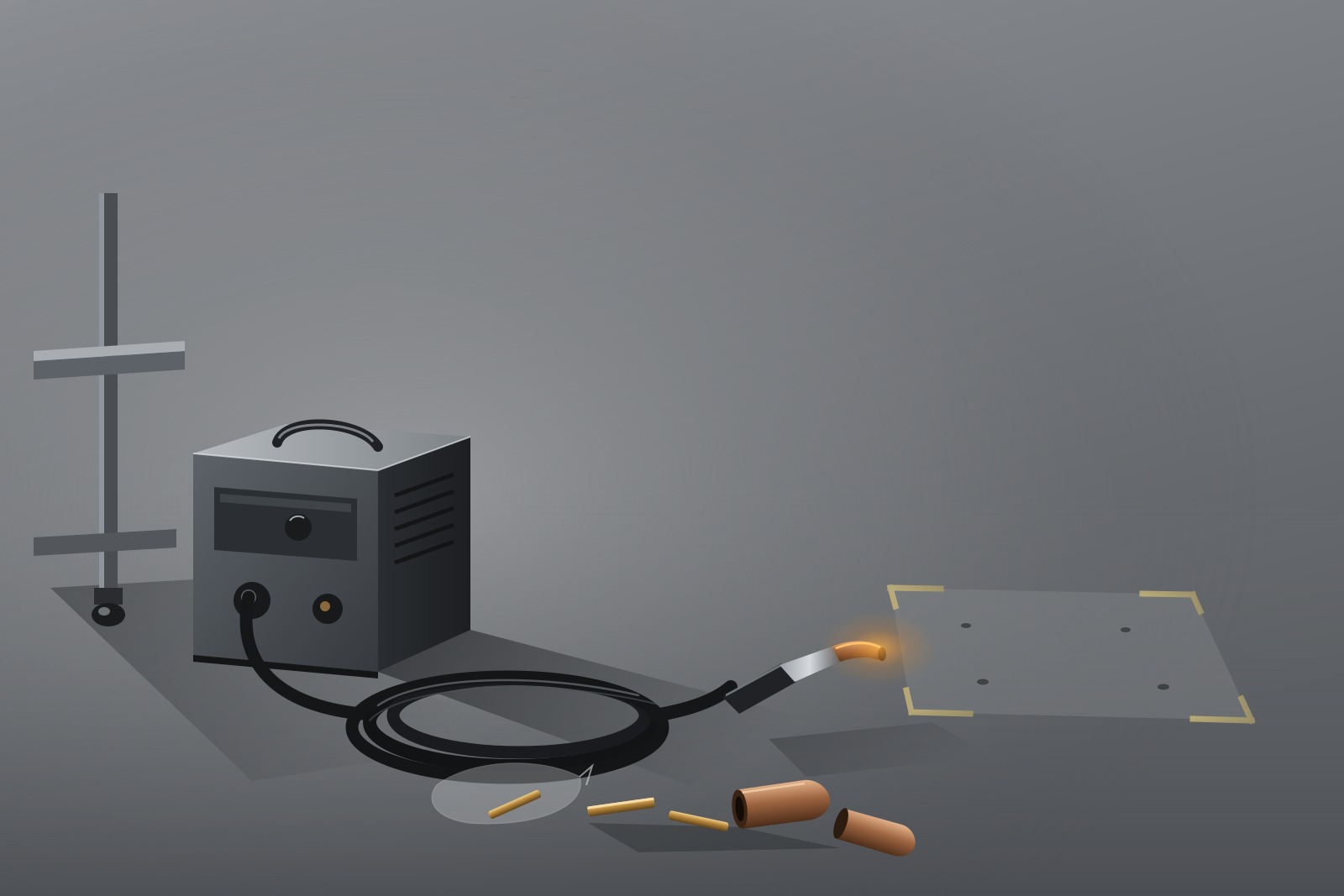
The base Cobot Welder includes:
-
A Universal Robots UR8 Long arm (68.9-inch reach)
-
A Miller Auto Deltaweld 350 power source (the OTC P 400-L and Deltaweld 500 are upgrades)
-
A Tregaskiss Tough Gun air-cooled MIG torch
-
A 48-by-32-inch mobile cart workstation
-
An operator panel with e-stop
-
Beacon software with Smart Puck
-
A 17-piece consumables kit
These are sold separately as options: fixture table, linear rail, index table, overhead gantry, headstock/tailstock, rotary kit, water-cooled torch kit, and the Beacon Pro, Beacon Care, Multipass Welding and Seam Tracking software. The page gives no prices for the options, for Beacon Care or for training. Hirebotics says purchase is a one-time cost with no required subscription. It offers rent-to-own after a demo and financing through partners, and it quotes a typical lead time of about two weeks from PO. Warranty is 15 months on the UR arm, 3 years on the welder and 2 years on other components.
For a buyer, the point is that two quotes at the same headline number can describe very different cells. One may include a fixture table and seam tracking. Another may include a bare cart and a power source. Before comparing totals, line the quotes up item by item using the stack below.
What makes up the cost of a cobot welding cell?
The Open Factory estimate (published May 8, 2026, revised October 11, 2026) is the most detailed public stack. It prices integrator labor at $150 per hour, the low end of the $150 to $225 OEM distributor range it cites from Hymson. Lines marked (A) are the publisher's own assumptions. Open Factory says these "are where the Equipment Price Benchmark will replace our guesses with contributed quotes."
| Cost line | Open Factory estimate | Share of total | Scales with part mix? |
|---|---|---|---|
| Arm and controller (UR10e) | $44,636 | 39% | No |
| Power source, feeder, torch (A) | $7,500 | 7% | Steps up with process |
| Cart | $5,800 | 5% | No |
| Fixture table | $8,000 | 7% | Part-specific fixtures do |
| Fume extraction (A) | $6,000 | 5% | Mostly no |
| Screens and light curtain (A) | $5,000 | 4% | Mostly no |
| Integration engineering (60 h) | $9,000 | 8% | Grows with change orders |
| Programming (40 h) | $6,000 | 5% | Yes |
| Commissioning and risk assessment (56 h) | $8,400 | 7% | Mostly no |
| Spares | $3,000 | 3% | No |
| Training | $5,000 | 4% | Mostly no |
| Freight | $5,000 | 4% | No |
| Total | $113,336 | 100% |
Shares other than the arm's 39% are ManufacturingMag's arithmetic from Open Factory's line items and are rounded.
Two things stand out. First, the three engineering labor lines (integration, programming, commissioning and risk assessment) add up to 156 hours and $23,400, about a fifth of the cell. Second, the three lines Open Factory marks as guesses (power source package, fume extraction, screens) are the ones you should replace with real quotes first. Each depends on your shop's process, building and layout.
Hendey's Automation World piece explains why the labor lines matter more than their dollar share suggests: "What makes or breaks welding automation is the integration quality." A cheap integration line that leads to rework or a long ramp-up is not cheap.
Which cobot welding costs grow with part mix?
This is the part of the budget that separates a cell that pays back from one that sits idle. Programming hours and part-specific fixturing grow with every part family you add, and integration hours grow with change orders. Most of the other lines are paid once per cell.
Programming
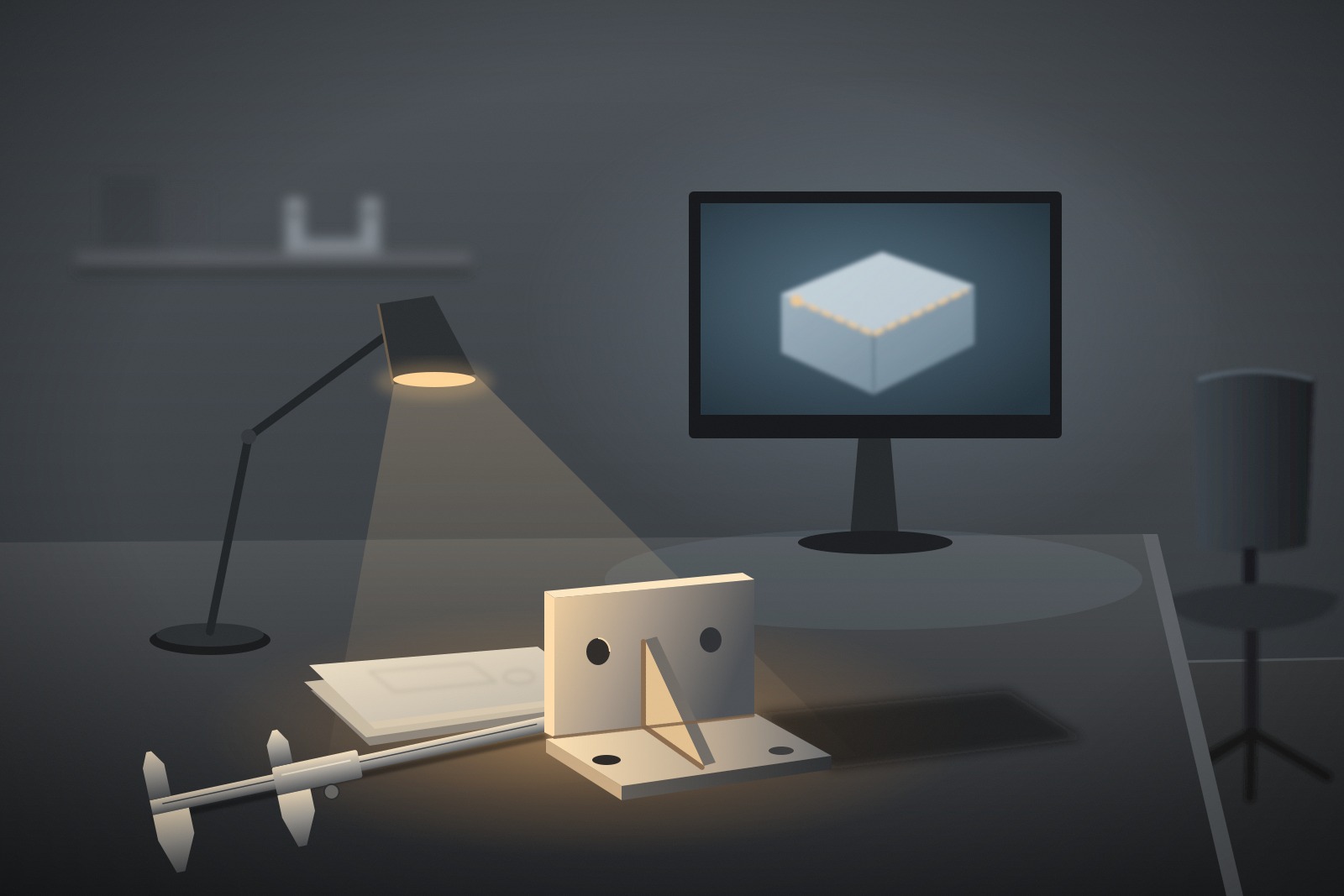
Open Factory estimates that "every extra part family is another 8 to 16 hours of programming." At its $150 per hour rate, that is about $1,200 to $2,400 of programming per added part family. At the top of the $225 per hour range it cites, the same hours cost about $1,800 to $3,600. A high-mix shop that plans to run a dozen families through one cell should budget for that line explicitly. It should not assume the base 40 hours covers it.
Fixturing
A Hirebotics blog post says fixturing costs rise with part size and complexity, and that vision or ultrasonic sensing "can cost several thousand dollars USD." There is no reliable public per-fixture figure, so get one quoted for each part family you plan to run.
Fixturing is also where cobots can change the economics for short runs. In a 2020 SME case study, Processed Metal Innovators of Bloomer, Wisconsin, said its traditional welding robots needed fixtures that "can take up to 16 weeks to build," and that for small-run parts "the fixtures weren't cost-effective." With a Hirebotics BotX cobot, billed hourly for arc time at the time, the company reported swapping parts "within a matter of 15 minutes." The lesson for a budget is not that cobots need no fixtures. It is that your fixturing strategy (dedicated versus modular, how many part families) drives a big share of the variable cost.
Integration change orders
Open Factory notes that integration hours go up with change orders. Every part added after the scope is set, every tolerance surprise and every layout change lands here. Hendey also lists fixturing tolerances as a cost driver. Parts that vary from batch to batch push you toward seam tracking or more robust fixtures, and both add cost.
Which costs are fixed per cell?
The power source, cart or table, guarding and screens, fume extraction, risk assessment and initial training are mostly one-time costs per cell. You pay them whether the cell runs one part or twenty.
"Fixed" still has steps. Larger or heavier parts can push you into a water-cooled torch kit, a rotary kit or headstock/tailstock positioner, a linear rail, or a bigger table. Each of these is a separate option on the Hirebotics list. A higher-amperage process can call for an upgraded power source. Size the fixed lines for the largest part you expect to run, not the first one.
Does a cobot welding cell need guarding?
Yes. A collaborative arm does not remove the arc. The arc light is a hazard no matter what holds the torch, so screens stay on the budget.
OSHA's general welding rule, 29 CFR 1910.252(b)(2)(iii), says that where the work permits, the welder should be enclosed in a booth (screens can be used instead), and that "Workers or other persons adjacent to the welding areas shall be protected from the rays" by screens or shields, or must wear appropriate goggles. A "fenceless" cobot cell still has a screens line for that reason. Open Factory's estimate puts screens and light curtain at $5,000, which it marks as its own assumption.
The robot-safety framework also changed recently. A3 announced the revised ISO 10218 in February 2025, its "first major revision since 2011." It builds safety requirements for collaborative applications into the standard and absorbs the previously separate ISO/TS 15066. The US adoption, ANSI/A3 R15.06-2025, adopts ISO 10218 Parts 1 and 2, revises ANSI/RIA R15.06-2012, and brings in the ISO/TS 15066 collaborative guidance.
Know who owns the risk assessment. The Hirebotics blog says "Risk mitigation is often the responsibility of the end-user." Open Factory budgets 56 hours ($8,400) for commissioning and risk assessment. If your quote has no such line, the work has not disappeared. It has been left to you.
What soft costs should you plan for?
Hendey's Automation World piece lists operator training and "ramp-up until the team gains full confidence" as costs to plan for, along with downtime during installation. None of these appear on a hardware quote, but all of them show up in the first quarter's numbers.
Installation downtime is the easiest to estimate. If the cell goes where a manual station runs today, price the lost output and the recovery cost (overtime, expediting) separately. Our downtime cost calculator separates lost contribution from incremental recovery costs, and you can enter the result as its own line in the budget request.
How do you build the budget request?
Use this structure. It keeps the variable lines visible, so the finance team can see what happens when the part list grows.
-
Hardware package: arm, controller, power source, torch, cart or table, and the operator panel. Check which of these the quote includes.
-
Motion and sensing options: rotary, positioner, rail, seam tracking, multipass software, as your parts require.
-
Fixturing: number of part families × quoted fixture cost per family.
-
Programming: base programming + (added part families × 8 to 16 hours × integrator rate).
-
Integration engineering: quoted hours, plus a change-order allowance.
-
Safety and environment: screens, light curtain, fume extraction.
-
Commissioning and risk assessment: quoted hours, with a named owner.
-
Training, spares, freight.
-
Installation downtime and ramp-up.
-
Contingency.
A worked example on the programming line: a shop that adds four part families beyond the base scope, at $150 per hour, should carry 32 to 64 extra hours, or $4,800 to $9,600. That is before any fixtures for those parts.
For the payback side, use the labor benchmark. The Bureau of Labor Statistics puts the median annual wage for welders, cutters, solderers and brazers at $53,750 in May 2025 ($25.84 per hour). That is wages only, not fully loaded cost. On that basis, the $113,336 Open Factory cell equals about 2.1 years of one median welder's pay. Whether the cell pays back depends on how many welder-hours it actually frees or adds, which depends on part mix and utilization. BLS also projects about 40,300 openings a year from 2025 to 2035, across about 437,700 jobs in 2025. That is relevant if your case rests on capacity you cannot hire for, rather than on headcount reduction.
Hirebotics says most of its systems pay back within 18 months. That is a vendor claim. Build your own case from your arc-on hours and your part list.
What should you ask an integrator before signing?
-
Is the power source included, and which model? Is the torch air-cooled or water-cooled?
-
How many fixtures and part programs are in scope, and which part families exactly?
-
What is the hourly rate for adding part families after installation?
-
Who performs and documents the risk assessment, and against which standard (ISO 10218:2025 / ANSI/A3 R15.06-2025)?
-
Are screens, light curtain and fume extraction quoted, or left to the buyer?
-
What training is included, and for how many operators and programmers?
-
Is seam tracking or other sensing needed for your part tolerances, and what does it add?
-
Is there a rent-to-own, financing or hourly option? Hirebotics offers rent-to-own and partner financing, and PMI's 2020 deployment was billed hourly for arc time.
The arm price is the easiest number to find and the least useful for a budget. Fixturing, programming and the hours to bring each part family online are what decide whether a cobot cell pays back.
Related reading
-
How to Check Metal 3D Printing Post Processing Cost in Supplier Quotes
-
Food Plants, Not Car Plants, Drove US Robot Installations in 2025
Sources
-
Relling: Cobot Price (2026): Real Listed Prices and Full Cell Cost
-
Binzel-Abicor: Cobot Welder Price: How Much Will It Really Cost?
-
Automation World: Robotic Welding Cells: Why the Robot Shouldn't Be Your First Area of Focus
-
29 CFR 1910.252: Welding, cutting and brazing, general requirements (Cornell LII)
-
Robotics & Automation News: A3 releases new American National Standard for industrial robot safety
-
BLS Occupational Outlook Handbook: Welders, Cutters, Solderers, and Brazers