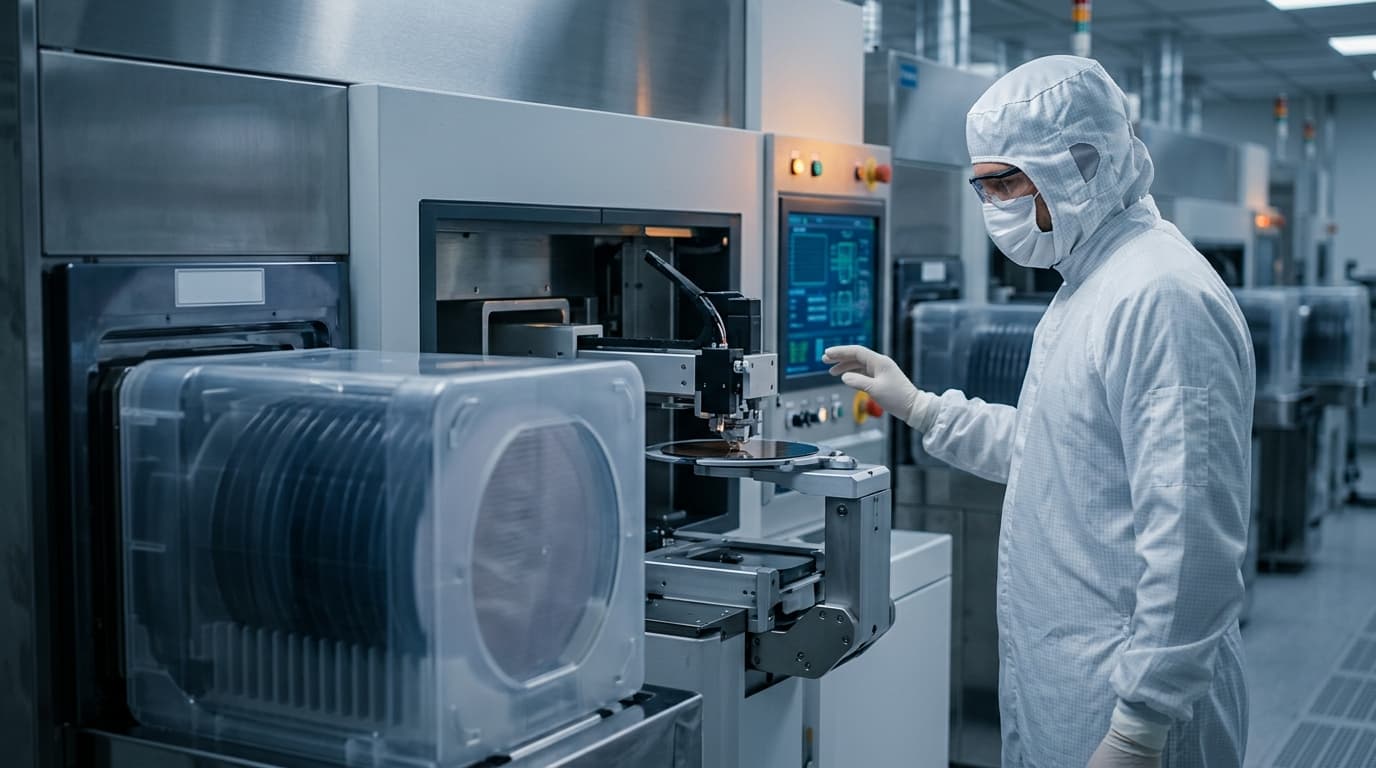
Micron's Manassas fab spent the better part of two decades as a mature-node afterthought — a long-lifecycle DRAM outpost serving cars, networking gear, and industrial controls. As of May 22, 2026, that label is obsolete. Micron announced the start of 1α (1-alpha) DRAM production at the Virginia site, describing the node as the most advanced memory ever manufactured in the United States. The U.S. now has three distinct memory geographies: leading-edge DRAM ramping toward Boise, a multi-fab buildout under way in Clay, New York, and — newly — long-lifecycle 1α DRAM coming out of Manassas.
What Micron actually announced
The Manassas commitment is $2.17 billion in expansion and modernization capital, creating 340 new direct jobs. The federal piece is a finalized [$275 million CHIPS Act direct funding award](https://www.semiconductor-digest.com/micron-advances-made-in-america-memory-with-manufacturing-expansion-in-virginia/) tied specifically to the Virginia site — separate from the larger CHIPS award Micron received against its Idaho and New York leading-edge fabs. Virginia layered on roughly $46 million in repackaged, previously unspent state incentives that had been earmarked for the site under a prior $70 million package.
The capacity story is concrete. Micron expects the 1α retrofit to quadruple DDR4 wafer output at Manassas, with qualified 1α production targeted by the end of calendar 2026. The Virginia Economic Development Partnership puts approximately 3,100 jobs in the surrounding ecosystem tied to the facility, alongside the 340 direct hires.
Why 1α at Manassas is a deliberate node choice
1α is not Micron's bleeding edge — that label belongs to the LPDDR5X and HBM products feeding AI accelerators. It is, however, well-suited to DDR4 and LP4 long-lifecycle parts, the memory variants specified into a vehicle program, a missile system, or an industrial controller and locked in for a decade or more. Putting 1α at Manassas means the U.S. now produces these long-tail parts on a node that didn't exist domestically before — and on a wafer-fab footprint Micron already owns.
The customer mix is the tell. Manassas 1α output is targeted at automotive, defense and aerospace, industrial, networking, and medical device customers. Those are exactly the buyers — Tier-1 auto suppliers, DoD prime contractors, networking OEMs, medical-device manufacturers — whose qualification cycles make supply continuity more valuable than chasing the latest node.
From mature-node site to national-security retrofit
Manassas began life as Dominion Semiconductor, an IBM-Toshiba joint venture that Micron acquired from Toshiba in the early 2000s as a commodity DRAM operation. For most of the years since, the fab was a paid-for workhorse — useful, but not the place a CEO went to talk about technology leadership. The 1α retrofit reframes the asset entirely: a legacy site is now where the U.S. makes its most advanced memory, with the same end markets — autos, defense and aerospace, industrial — that the state of Virginia identified as the strategic rationale for the expansion package.
The three-node U.S. memory map
Manassas is the third leg of a stool Micron has been building for several years.
Boise, Idaho. Micron's first leading-edge DRAM fab in Idaho is targeted to produce first wafer output in the second half of 2027, with a second Idaho fab announced in June 2025 set to break ground in 2026 and operate by the end of 2028. CHIPS terms for the Idaho project sit on the NIST CHIPS program's Idaho-Boise page.
Clay, New York. Micron's New York project covers up to four fabs over a multi-decade horizon. Fabs 1 and 2 are estimated to come online in 2029 and 2030, with Fabs 3 and 4 phased to 2035 and 2041 — consistent with the project scope on NIST's CHIPS Clay page.
Manassas, Virginia. 1α DDR4/LP4 production starting now, with qualified output expected by end of 2026.
The geography isn't coincidental. Boise and Clay carry the leading-edge load — including the HBM economics that AI buildouts depend on. Manassas carries the long-tail load that DoD programs and Tier-1 OEM supply chains actually run on, in the geography closest to those customers.
The CHIPS reallocation signal
Commerce and Micron rephased the buildout in 2025. Roughly $1.2 billion of CHIPS funding was redirected from Clay to Idaho, with Clay's allocation adjusted from $4.6 billion to $3.4 billion to accelerate near-term advanced DRAM and HBM output in Boise. Read that as a near-term capacity decision: HBM economics are time-sensitive, New York construction is multi-decade, and the federal-private package was tuned accordingly.
The broader frame, per Micron's own filings, is approximately $200 billion of U.S. investment over 20-plus years — about $150 billion in manufacturing and $50 billion in R&D — with roughly 90,000 direct and indirect jobs projected. Manassas is the only one of those buckets producing 1α today.
Memory is being treated as a distinct national-security commodity
Logic and memory got fundamentally different CHIPS treatments, and Manassas illustrates why. Global DRAM is a three-supplier oligopoly — Micron, Samsung, and SK hynix — a structure the Congressional Research Service flags explicitly in [its CHIPS Act global-context report (R47558)](https://www.congress.gov/crs-product/R47558). That concentration is what makes a retrofit at an existing, otherwise-mature fab strategically interesting: there is no fourth DRAM source to fall back on if one of the three becomes unavailable to U.S. buyers.
The funding pattern tracks the structure. The largest CHIPS awards went to logic — $8.5 billion to Intel, $6.6 billion to TSMC, and $6.4 billion to Samsung, per the Council on Foreign Relations. Memory awards, including the $6.14 billion Micron secured for the Idaho and New York fabs and the separate $275 million for Manassas, are smaller in aggregate but more concentrated in strategic intent. Manassas is the cleanest example: it converts an existing site to a node tuned for the end markets Washington most wants insulated from supply shock.
What this means for U.S. industrial buyers
For operators in automotive, defense and aerospace, industrial controls, networking, and medical devices, the operational signal is concrete: a U.S. source of 1α DDR4/LP4 should be available for design-in once qualified production hits Micron's end-of-2026 milestone, on a node materially newer than Manassas has historically run. That changes the qualification calculus for programs where component sourcing has to survive multi-year vehicle and weapon-system cycles. It also explains the site selection: the customer base for long-lifecycle automotive, defense, and industrial DRAM is geographically concentrated on the East Coast and within the defense industrial base.
What to watch
-
Qualification timeline. Micron's end-of-2026 "qualified production" milestone is the date Tier-1 supplier qualification flows will track.
-
Further Clay rephasing. If HBM demand keeps accelerating, expect more dollars to migrate toward Boise's leading-edge capacity, on the pattern already established in 2025's $1.2 billion reallocation.
-
Other mature-node retrofits. Manassas is now a template — an existing fab moved to a more advanced node specifically to serve long-lifecycle customers. Whether Samsung's and SK hynix's U.S. sites get similar treatment is the next question for industrial buyers.
Related reading
Sources
-
Micron to invest $2.17B in Manassas expansion — Virginia Business
-
[Micron Technology to Expand Semiconductor Manufacturing Facility in Manassas — Virginia Economic Development Partnership](https://www.vedp.org/press-release/2024-12/micron-manassas)
-
Micron Technology plans $2.2B Virginia plant expansion — Manufacturing Dive
-
Micron Brings 1α DRAM Manufacturing to Virginia — Converge Digest
-
Semiconductors and the CHIPS Act: The Global Context — CRS report R47558