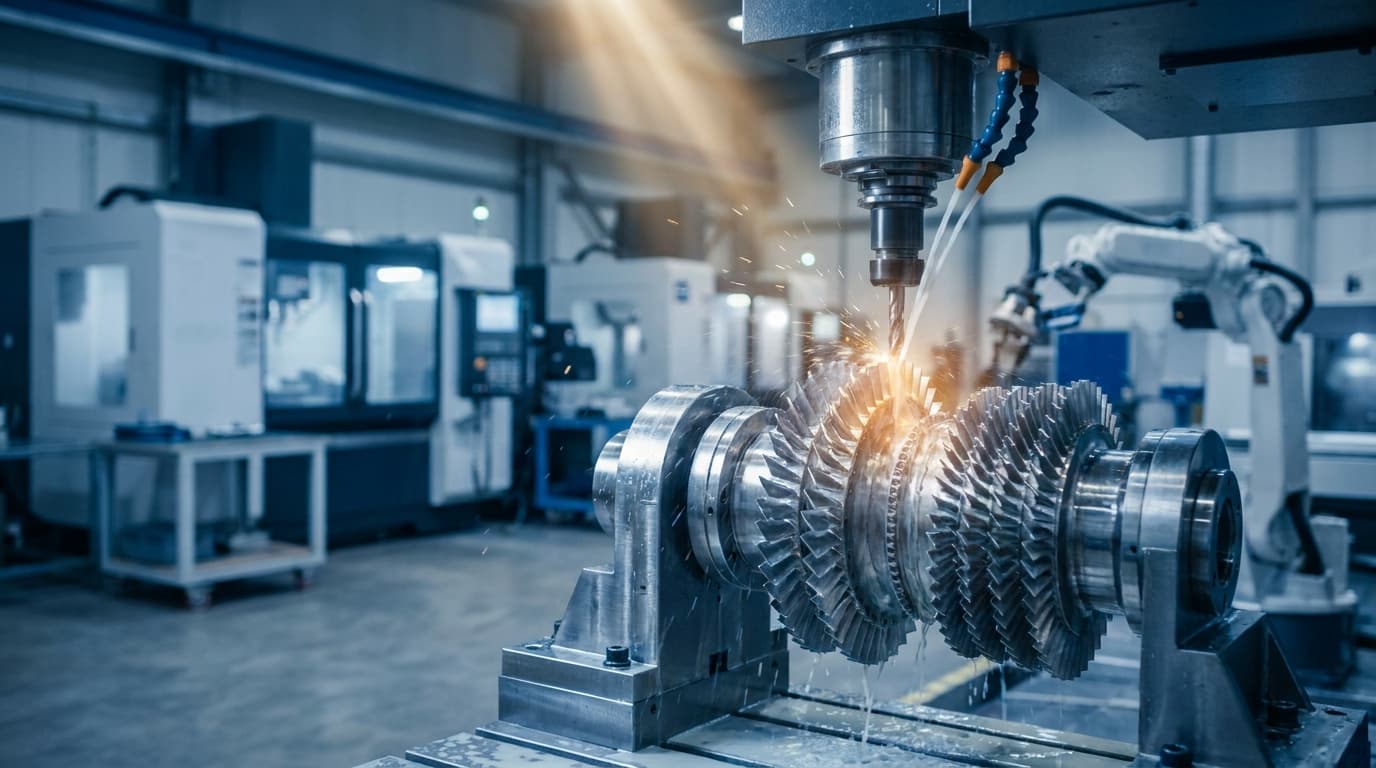
American manufacturers committed $3.44 billion to metalworking machinery in the first half of 2026 — the largest half-year for order value since the U.S. Manufacturing Technology Orders (USMTO) series began collecting data in 1998, and 36.0% above the first half of 2025, according to AMT's August 10 release.
They did it while buying fewer machines. Total units ordered in H1 2026 came to 11,243 — 2.6% below the July–December 2025 half, per American Machinist's breakdown of the release. Divide one number by the other and the story stops being a headline and becomes a thesis: roughly $306,000 per machine. This record was bought with capability, not count.
The numbers, and why they are not a one-month artifact
June carried the half. Orders reached $672.7 million, up 15.6% sequentially and 56.8% year over year, with machine tools alone accounting for $627.7 million of the total. AMT notes the month came in at more than double the average monthly order value since January 2000.
A single hot month invites suspicion of a pull-forward or a lumpy multi-unit order. The trailing sequence does not support that reading. Year-over-year growth accelerated through the second quarter:
- April 2026: $593.6 million, +33.2% YoY
- May 2026: $583.4 million, +47.8% YoY
- June 2026: $672.7 million, +56.8% YoY
Year-to-date through May stood at $2.77 billion, +31.9%. The slope is steepening, not flattening. AMT has revised its outlook accordingly, projecting H2 2026 orders 1.5% above H1 and putting the full year at nearly $7 billion.
Who is signing
Aerospace led every buying sector in both value and units, posting its largest half-year on record — value up roughly 33% and units up roughly 25% versus the second half of 2025. Note that aerospace is the exception to the fewer-but-bigger pattern: it bought more machines and spent more per machine.

That order flow is backed by contracted demand rather than sentiment. As of June 2026, Airbus carried a commercial backlog of 9,216 aircraft and Boeing 6,814, per Forecast International. Against an 870-aircraft annual delivery target, the Airbus figure represents about 10.6 years of coverage; Boeing's implies about 10.2. Half-year deliveries ran 351 and 314 respectively — the gap between backlog and delivery rate is the machine-tool order.
Boeing is actively closing part of that gap. The 737 line ran at 42 per month in Q1 2026 with plans to reach 47, and a fourth 737 line entered low-rate production in July 2026 pending FAA production certification. Rate increases of that kind are not staffed and tooled at the OEM alone; they propagate down through structures, engine components, and machined details at hundreds of tier suppliers, each of whom needs spindle capacity in place a year or more before the rate lands.
The second buyer nobody forecast
The genuinely new entry in the H1 data: power generation, engine and turbine manufacturers ordered 14% more machinery than the automotive sector. For a metalcutting market that has been organized around Detroit's capital cycle for most of its modern history, that is a structural reordering, not a rounding error.

The chain behind it runs through AI data-center electricity demand. Power Engineering reports that GE Vernova's gas power gigawatts under contract rose from 83 GW to 100 GW during Q1 2026 — backlog from 40 to 44 GW, slot reservations from 43 to 56 GW — with roughly 20% tied to data-center customers and only about 10 GW of slots remaining across 2029 and 2030 combined. That is a step change from the company's position entering the year, when it expected to close 2025 with an 80-GW backlog stretching into 2029.
Turbine work is heavy, large-envelope, tight-tolerance metalcutting: casings, rotors, blades. A slot reservation for 2029 delivery is a machining capacity decision in 2026. The data-center buildout does not just consume power — it consumes machine tools, two steps upstream, on a lag most capex models never priced.
Why Detroit isn't in this story
Precision matters here. The AMT data shows automotive was out-ordered by power generation. It does not show that automotive capital spending collapsed in absolute terms, and nothing in the USMTO release supports that stronger claim.
The defensible read is that automotive is capital-concentrating rather than capital-cutting: fewer, larger programs following EV timeline resets across the industry, with tooling packages consolidated onto platforms that have survived review. Platform indecision is precisely the condition that stalls a tooling purchase order — a transfer line or a dedicated machining cell is a bet on a specific part geometry for a specific vehicle at a specific volume, and none of those three variables sits still during a program replan. Aerospace and turbine buyers are not facing that ambiguity. Their part geometries are locked and their backlogs are contracted a decade out.
The apparent paradox, resolved correctly
The instinct is to pair a capex record against a weak labor market and call it automation displacing workers. The 2026 data does not permit that framing.
Manufacturing added 5,000 jobs in July 2026, and June was revised upward from +3,000 to +11,000, per BLS data. Transportation equipment added 11,900; food manufacturing shed roughly 6,200. Total nonfarm payrolls fell 23,000 that month — manufacturing outperformed the broader economy rather than lagging it. On the activity side, the [ISM Manufacturing PMI registered 55.6% in July](https://www.prnewswire.com/news-releases/manufacturing-pmi-at-55-6-july-2026-ism-manufacturing-pmi-report-302840669.html), the highest since May 2022 and a seventh consecutive month of expansion, with New Orders at 56.7%, Production at 58.5% (best since November 2021), Backlog of Orders at 55.0%, and Employment at 52.8% — its first expansion in 33 months. Fifteen industries grew; only chemical products contracted.
The real reconciliation is not capex versus labor. It is buildings versus machines. U.S. manufacturing construction spending peaked in Q3 2024 at an annual average of roughly $235.6 billion, then declined 6.7% from Q4 2024 through Q3 2025, with the downtrend continuing to about $174.8 billion by May 2026, according to Census data analyzed by FactCheck.org.
Read the two series together and the sequencing is obvious. The semiconductor fabs and battery plants broken ground in 2022–2024 are exiting their heavy-construction phase. The shell-building boom is over; the equipping phase has begun. Concrete spending falls, spindle spending rises, and both are the same capital program at different stages.
Forward indicator, current output — both pointing the same way
Machine tool orders are a forward read, typically 12 to 24 months ahead of the production they enable. H1 2026 is therefore a statement about intended 2027–2028 capacity, not about what is being cut today. That distinction is what makes the units-down/value-up mix legible: buyers are purchasing throughput per machine — automation, pallet pools, 5-axis single-setup work — rather than headcount-matched capacity.
The useful cross-check is the consumption-side indicator. Cutting tool shipments are described by AMT and USCTI as "a true measure of actual production levels", in contrast to capital equipment orders that signal future intent. Consumables get bought when metal is actually being removed. That series hit $270.5 million in June 2026, up 12.8% sequentially and 31.7% year over year, with H1 year-to-date at $1.47 billion, +19.3%.
This is the part that should raise conviction. A capex surge running against falling tool consumption would read as speculative overbuilding. A capex surge running alongside a 31.7% jump in consumables reads as capacity being added on top of production that is already straining. The forward bet is being placed on top of real current output, not instead of it.
What it does to a quote book
The sharpest supplier-side signal in the release comes from contract machine shops. Job shops posted their highest first-half order value since 1998 while their unit purchases fell nearly 8% versus H2 2025 — the fewer-but-bigger pattern in its purest form, and a direct read on what shops expect their quote books to look like. A shop replacing three standalone machines with one automated 5-axis cell is not adding capacity in the count sense; it is adding hours of unattended cutting per operator, which is the only kind of capacity that scales without hiring.
The open question — and the one that will determine whether these orders convert on schedule — is delivery. There is no authoritative published lead-time series for 5-axis machining centers, and we are not going to assert one. What we can report is the constraint set shops describe: the historically normal four-to-seven-month order-to-receipt window, with some builders now quoting materially longer against availability of ballscrews, bearings, and linear rails. Treat that as a hypothesis being reported out with named builders and distributors, not as a citable statistic. If it holds, it changes how a shop bids 2027 work it cannot yet cut — you either price the risk of quoting against a machine that has not landed, or you decline the work and cede it.
The honest caveat
These are orders. They are not shipments, not installations, and not output. Orders get rescheduled, and slot reservations are not deliveries.
AMT itself lists the environment against which this money was committed: the U.S.–Iran war, rising inflation, trade-war-driven supply challenges, tariff uncertainty, and a new Federal Reserve chair offering less forward guidance — a set of headwinds that has been running through AMT's commentary all year. The orders were placed anyway, which is itself information, but it does not make them immune.
What would falsify the thesis: value and units declining together in the second half, which would mark demand contraction rather than a mix shift; or aerospace rate increases slipping on FAA production certification, which would push the tier-supplier tooling that follows them to the right by quarters. Watch the cutting tool series too — if consumables roll over while orders hold, the capacity being built has outrun the work.
The bottom line
The reshoring conversation has spent three years counting announcements and construction dollars, both of which measure intent. The USMTO series measures the moment intent becomes a purchase order with a delivery date and a deposit attached. For the first time in its 28-year history, it says the money is landing — and it is landing on aerospace and power generation spindles, aimed at 2027 and 2028.
Related reading
-
[$1.966 Trillion Announced, 22% Less Built: The Reshoring Boom Is a Press-Release Boom](/article/reshoring-announcements-vs-census-construction-spending-2026)
-
[GM Walked Away From a 680-Acre Battery Plant. Samsung SDI Is Finishing It for the Grid.](/article/gm-exits-new-carlisle-battery-plant-samsung-sdi-ess-pivot)
-
If Boeing Engineers Strike, Who Signs Off on Supplier Deviations?
-
Will Boeing's Engineer Offer Reset Pay at Aerospace Suppliers?
Sources
- AMT — U.S. Manufacturing Technology Orders press releases ("Manufacturing Technology Orders Set Half-Year Record," Aug. 10, 2026)
- American Machinist — Machine Tool Demand is Booming in 2026 (USMTO Report, June 2026)
- Metrology and Quality News — U.S. Machine Tool Orders Reach Highest First-Half Level on Record
- AMT — Cutting Tool Market Report (June 2026 data)
- Advanced Manufacturing / SME — U.S. Cutting Tool Shipments Report
- ISM — Manufacturing PMI at 55.6%, July 2026 Manufacturing PMI Report
- Manufacturing Dive — Manufacturing jobs continue upwards, adding 5,000 jobs in July
- FactCheck.org — Manufacturing Construction Spending Declines (Census Bureau data)
- Forecast International Flight Plan — Airbus and Boeing June 2026 Orders and Deliveries
- Power Engineering — Data centers drive record surge in GE Vernova power equipment orders
- Utility Dive — GE Vernova expects to end 2025 with an 80-GW gas turbine backlog
- Industrial Distribution — Machinery Orders Continue Rally in Q1 2026 Despite Uncertainty From Iran War