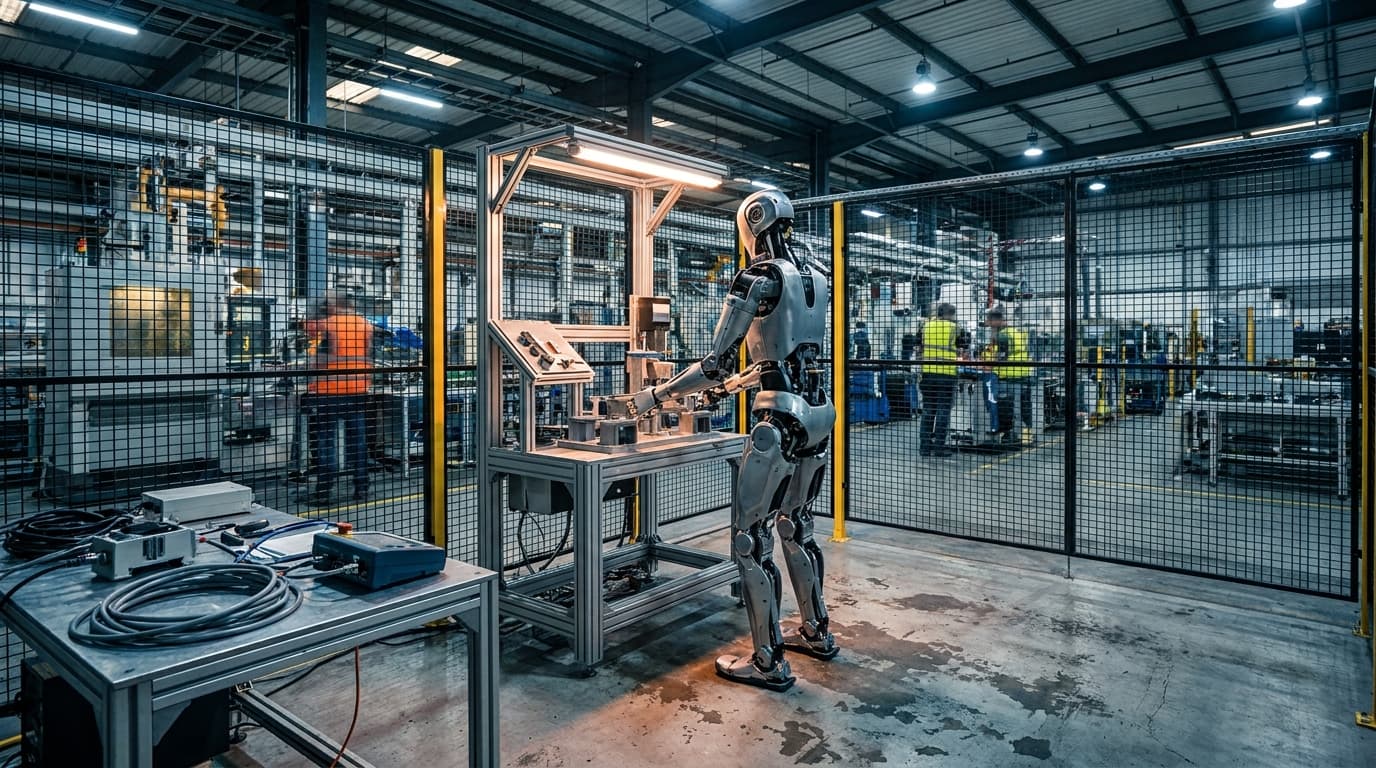
On August 19, 2026, Hexagon Robotics and Schaeffler said the AEON humanoid had entered something the two companies call the "Humanoid Gym" - a dedicated industrial training facility in Germany where the robot will learn factory work by imitation and repetition before it is allowed anywhere near output that ships. The framing is Train-Validate-Deploy, and the stated horizon is six months.
Strip away the branding and what you have is a capital-equipment buyer telling you, in public, that it does not consider a humanoid safe to fail on a live line. Schaeffler has committed to at least 1,000 AEON units across its global production system by 2032. The gym is the admission that getting the first ones working is not a procurement problem. It is a training problem, and training costs a building and half a year.
What the gym actually is
The method is imitation learning plus repeated execution: the robot's policies are refined and validated against representative applications lifted from Schaeffler's real plants, in an environment where a failure interrupts nothing. The companies' own justification is explicitly about risk, not capability - training off-line "minimises operational disruption while ensuring new capabilities will perform reliably once deployed in production."
There is a second purpose in the announcement that got less attention than it deserves, and it is arguably the more durable one. Schaeffler is using the facility to build its own in-house expertise to operate, train and integrate humanoids. That is a bet that the scarce resource in this market will not be robots but the people who can make a robot useful in a specific cell - and that a manufacturer that owns those skills internally does not have to rent them from a vendor at every deployment.
What has not been disclosed is more instructive than what has. No specific tasks have been named. There is no construction cost, no floor area, no location beyond "Germany." Independent coverage confirms the task list is simply absent. Six months of training toward unnamed use cases is a schedule, not a plan you can audit.
The bottleneck is the policy, not the machine
AEON itself is not an unknown quantity. Hexagon launched it on June 23, 2025 with wheel-based locomotion - legs terminating in wheels rather than a conventional bipedal gait - multimodal sensing, a battery-swap mechanism to avoid recharge downtime, and reality-capture and digital-twin capability inherited from Hexagon's metrology business. NVIDIA supplies Jetson compute, Omniverse and Isaac GR00T; Microsoft Azure the cloud layer; maxon the locomotion actuators. Payload, runtime and degrees of freedom are not public.
Nor is this a standing start with Schaeffler. The April 22, 2026 announcement in Zurich expanded an existing relationship following a completed 2025 pilot in which AEON operated a multi-machine station to load, unload and inspect parts in an actual manufacturing operation. It was shown at Schaeffler's Global Production Forum 2025 and Partner Days 2026. No quantitative success metrics were released - a pattern worth holding onto. Automated part inspection is targeted for rollout from end-2026.
So the hardware exists, the pilot ran, and the order is signed - and the next step is still a six-month detour through a purpose-built room. This publication's read, and it is analysis rather than a sourced figure: if every deployment wave carries a dedicated facility plus roughly six months of validation before value accrues, then the dominant line in the business case is not the robot's sticker price. It is the overhead. Nobody has published a per-unit AEON cost, and nobody has published a gym cost, so the ratio cannot be computed from outside. But a 1,000-unit program executed in waves of this shape implies a training and integration burden that scales with use cases, not with units - which is exactly the cost structure that makes the second thousand robots far cheaper than the first hundred, and exactly the cost structure that punishes anyone who has budgeted for hardware alone.
The reality check: a gym is not required
It would be easy to read the Humanoid Gym as the industry conceding that off-line training is the only viable path. That reading does not survive contact with the evidence.
Figure ran an 11-month project at BMW's Spartanburg plant: two Figure 02 robots on 10-hour shifts Monday to Friday, 1,250-plus hours of runtime, more than 90,000 sheet-metal parts loaded, contributing to over 30,000 BMW X3 vehicles, roughly 200 miles walked, approximately 99% loading accuracy at a 5mm placement tolerance on an 84-second cycle. BMW has since stood up a Center of Competence for Physical AI in Production and is extending humanoid work to Plant Leipzig from summer 2026. That is a live line, in production, for the better part of a year.
And Schaeffler itself is not applying the gym doctrine uniformly. Humanoid Ltd's units go straight into live production - box handling at Herzogenaurach from December 2026 - alongside a Schweinfurt phase running a three-month capability demonstration then three months of on-site validation between December 2026 and June 2027. Agility Robotics' Digit, meanwhile, has accumulated more than 65,000 operating hours across nine customer facilities, with Schaeffler named as a commercial customer alongside GXO, Toyota Motor Manufacturing Canada and Mercado Libre.
The honest framing, then: the gym is AEON-specific de-risking inside a hedged portfolio. It is not the industry conceding a bottleneck. It is one buyer choosing different risk postures for different platforms - which is what a serious buyer does.
The loop: Schaeffler sells the actuators, then buys the robot
The commercially interesting structure here is not the training method. It is the circuit.
Schaeffler supplies the high-precision actuators that go into AEON, and then buys AEON. The platform is built around electric motors with integrated power electronics and high-precision encoders, configurable with either two-stage planetary or strain wave gears. Its distinguishing trick is a bearing integrated directly into the rotor, which cuts installation footprint by around 20%, saves up to 500 grams, and comes in up to 10mm more compact than alternatives. The platform won the Hermes Award, presented on April 19 by Federal Minister Dorothee Bär at the opening ceremony of Hannover Messe, with series production of the components planned to begin within the year.
"Our innovative actuator platform is the technology backbone for the next generation of humanoid robots," said Dr. Jochen Schröder, Chief Operating Officer of Schaeffler AG, at the April announcement. (Schröder took the COO role effective April 1, 2026, succeeding Andreas Schick, with Production, Supply Chain and Procurement in his remit - which is precisely why he, and not a technology chief, fronts these announcements. At least one trade outlet has captioned him as Schaeffler's CEO. He is not.)
Walk the unit economics. A 1,000-unit purchase commitment is an operating-expense line for Schaeffler's plants and a captive order book for Schaeffler's components division at the same time. Margin captured on the actuators offsets the acquisition cost of the robots containing them, and the transfer prices inside that arrangement are not visible to anyone outside it. The 2032 order is, in effect, an internal demand signal that de-risks series production of a component the company also wants to sell on the merchant market.
Not a partnership. A portfolio.
AEON is one of four relationships, and not the tightest.
With Humanoid Ltd - the UK company founded in 2024 by Artem Sokolov - Schaeffler is investor, preferred supplier and customer simultaneously. A binding phased deployment and supply agreement announced May 13, 2026 covers a four-digit number of wheeled units across Schaeffler's global facilities by 2032, with expansion planned into assembly and packaging. Alongside it runs a five-year supply agreement making Schaeffler the preferred supplier for more than 50% of Humanoid's joint-actuator demand for wheeled platforms through 2031 - expected to mean a seven-digit number of actuators. Humanoid then raised a $152M Series A on July 21, 2026 at a $1.35B post-money valuation, Europe's first pure-play humanoid unicorn, led by Prime Movers Lab with Schaeffler, Bosch, Fubon Financial Holding Venture Capital and Bernard Arnault's Aglaé Ventures participating; Bosch Robotics is contract manufacturer. Its wheeled prototype was built in seven months on a simulation-first approach using NVIDIA's physical-AI stack and completed an eight-hour autonomous shift at a Siemens factory in 2026 at 60 tote moves per hour with better than 90% pick-and-place success. The company also claims 34,000 pre-orders worth roughly $2.4B - a company figure that has not been independently verified and should be treated accordingly.
With Agility Robotics, Schaeffler made a minority investment and agreed to purchase Digit humanoids in November 2024, signalling potential deployment across its network of 100 plants by 2030. "We are excited to welcome Schaeffler as a customer and investor," said Agility CEO Peggy Johnson at the time - a sentence that describes the whole strategy in eight words.
With VinDynamics, the Vingroup subsidiary in Vietnam, Schaeffler signed an MOU in Hanoi in late April 2026 - its first humanoid cooperation in Southeast Asia. Schaeffler supplies planetary gearboxes; VinDynamics optimises its control software for compatibility and shares operational product data back to Schaeffler.
Four platforms. Equity in two. Actuators into three. Purchase commitments to three. This is not a partnership strategy; it is an arms-dealer strategy with a captive first customer attached.
What that does to everyone else
Two consequences follow for any humanoid maker not on that list.
The first is queue position and price. If the supplier of your most cost-sensitive, longest-lead component is also an equity holder in your competitors and the anchor customer for their output, you are negotiating from a structurally weaker position than they are - on allocation during series ramp as much as on unit price. Series production of Schaeffler's actuator platform was only planned to start within the year; early capacity is finite, and it is already spoken for by counterparties in which the supplier holds an economic interest.
The second is information. The VinDynamics arrangement routes operational product data from a fielded platform back to the component supplier by explicit agreement. Whatever the intent, the effect is that Schaeffler gets a telemetry feed on how its actuators behave in real deployments across multiple vendors' robots, while each of those vendors sees only its own. In a market where the binding constraint is validated real-world behaviour rather than spec-sheet performance, that asymmetry compounds.
The backdrop nobody in the press releases mentions
All of this is happening while Schaeffler shrinks in Europe. The company has announced structural measures cutting up to 4,700 jobs - net roughly 3,700 after relocations - with around 2,800 falling on major German sites and about 1,900 elsewhere in Europe, and closures at Berndorf, Austria (wheel and transmission bearings) and Sheffield, UK (clutches, moving to India and Hungary). The target is €290M in annual savings by 2029 at a one-time cost of €580M, driven by the Vitesco integration and the EV-market slowdown.
Read the humanoid program against that and its logic sharpens. It is a productivity play against a legacy cost base the company is already cutting, and simultaneously a new-revenue play - a precision-actuator growth business bolted onto a contracting industrial portfolio. The gym, in that light, is not only about protecting production uptime. It is about proving out a component franchise using the company's own factories as the reference installation.
What to watch
Four dated tests, all falsifiable:
-
Does AEON exit the gym on schedule? Six months from August 19, 2026 lands around February 2027. Slippage there is the clearest signal that policy validation is harder than the timeline assumes.
-
Does automated part inspection ship by end-2026? It is the one concrete application both companies have committed to publicly.
-
Does Humanoid Ltd beat AEON to live production? Herzogenaurach box handling is scheduled for December 2026 - on a line, not in a gym, at the same customer. If the live-deployment vendor gets to useful work first, the gym's premise weakens considerably.
-
Do the headline numbers hold? 1,000 AEON units by 2032, four-digit Humanoid units by 2032, 100 Agility-equipped plants by 2030. Multi-year commitments announced during a capability boom have a way of being quietly restated.
The metric that would settle it
"The real value creation comes when humanoids perform multiple tasks reliably and at a high-performance standard in production," said Arnaud Robert, President of Hexagon Robotics. He is right, and his own company's disclosure does not yet meet that bar - the 2025 pilot produced no published metrics.
Which points at the number the whole sector should be publishing and mostly isn't: hours of validated autonomous task execution per deployment wave, and the failure rate inside them. Figure and BMW published theirs - 1,250 hours, 90,000 parts, roughly 99% accuracy - and that single disclosure is why Spartanburg functions as the industry's benchmark rather than as another press release. Agility's 65,000 operating hours across nine facilities is the other real number on the board.
Until the gym produces a figure of that kind, a 1,000-unit order remains a statement of intent with a purchase order attached. Units ordered is a procurement metric. Validated hours is an operations metric. Only one of them tells an operator whether the robot can do the job.
Related reading
-
[Before Robots Can Build Cars, Someone Has to Build the Robots: Boston Dynamics' $100M, 1,000-Job Bet on Manufacturing Atlas at Scale](/article/boston-dynamics-100m-waltham-atlas-manufacturing-scale)
-
38 Days to a 100% Pharma Tariff — and the Only Off-Ramp Closed in June
-
Lease or Buy the Next CNC Machine After the Fed's Rate Hike?
Sources
-
Hexagon and Schaeffler to deploy a fleet of AEON humanoids - Hexagon Robotics
-
[Hexagon starts training AEON humanoid robots at Schaeffler factories](https://roboticsandautomationnews.com/2026/08/19/hexagon-starts-training-aeon-humanoid-robots-at-schaeffler-factories/104280/) - Robotics & Automation News
-
AEON enters Schaeffler humanoid training facility - Engineering.com
-
Schaeffler plans to deploy 1,000 Hexagon humanoids by 2032 - The Robot Report
-
Hexagon launches AEON humanoid robot for industrial applications - The Robot Report
-
Humanoid raises $152 million at $1.35 billion valuation - Forbes
-
Agility Robotics announces strategic investment and agreement with Schaeffler Group - Agility Robotics
-
Schaeffler wins Hermes Award for innovative actuator platform - Schaeffler Group
-
Dr. Jochen Schröder, Chief Operating Officer - Schaeffler Group
-
Changes on Executive Board of Schaeffler AG - Schaeffler Group
-
Schaeffler announces structural measures in Europe - Schaeffler Group
-
Schaeffler to cut 4,700 jobs, close two sites - eeNews Europe
-
Schaeffler and VinDynamics sign strategic partnership for humanoid robots - PR Newswire
-
Humanoid robots complete trial project at BMW assembly plant - ASSEMBLY Magazine