STATUS AS OF AUGUST 21, 2026. This is a live story and the operative date has already moved once. The three Section 338 proclamations were signed July 20, 2026, with duties originally set to attach at 12:01 a.m. ET August 19. On the evening of August 18 the administration paused them roughly three days, citing a deal in principle. Prime Minister Mark Carney's official statement confirms the U.S. agreed to postpone implementation of the 50% Section 338 tariff "until end of day, August 21," noting "substantial progress" but "important work still to be done." The revised effective moment is 12:01 a.m. ET August 22, 2026. As of the last verified reporting on August 21, no final agreement had been announced. Confirm current status with CBP CSMS guidance and your broker before acting on anything below.
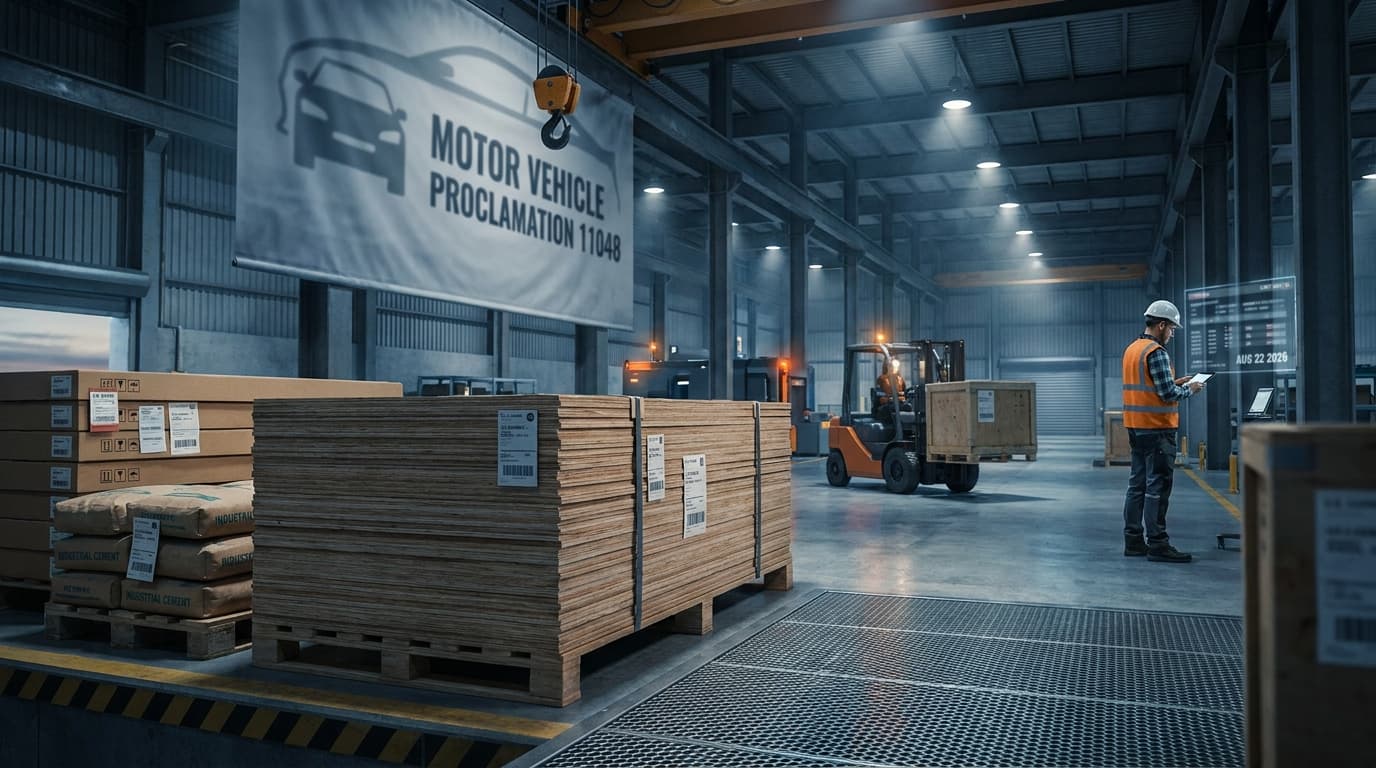
The most consequential thing about Proclamation 11048 is what its title does not tell you. It is called "Imposing Additional Duties to Offset Canadian Discrimination Against the Commerce of the United States with Respect to Motor Vehicles," and it contains essentially no vehicles. What it contains is 439 eight-digit tariff lines running across HTS chapters 4 through 97 — cement, plywood and veneered panels, furniture, textiles and apparel, leather, cosmetics, jewelry, toys, stationery, wigs, industrial machinery, printed circuit boards, fishing rods, swimming pools — each carrying an additional 50% ad valorem duty on entry.
If you buy anything from Canada and you skipped this one because you do not build cars, you read the wrong signal off the headline. So did a lot of procurement organizations.
Three proclamations, one dormant statute
On July 20, 2026 the President signed three proclamations under Section 338 of the Tariff Act of 1930 (19 U.S.C. 1338), also invoking Section 604 of the Trade Act of 1974 (19 U.S.C. 2483) and 3 U.S.C. 301:
-
Proclamation 11046 — alcoholic beverages (63 eight-digit lines)
-
Proclamation 11047 — dairy (52 lines)
-
Proclamation 11048 — "motor vehicles" (439 lines, an annex running roughly 18 pages)
Roughly 554 lines combined, per Global Trade Alert's tally, covering about $20 billion of Canadian imports — approximately 5.2% of the $382 billion in goods the U.S. imported from Canada in 2025, on USTR figures cited across the trade press and legal alerts.
Two structural facts about the authority matter more than the dollar figure.
First, this is the first time any president has used Section 338 to impose duties. The provision has sat unused since 1930. It caps offsetting duties at "not to exceed 50 percent ad valorem" — which means the rate chosen here is the statutory ceiling. Holland & Knight's framing is the right one: this is a 50 percent opening bid.
Second, Section 338 requires only a presidential finding and a proclamation. No ITC investigation. No USTR or Commerce proceeding. No comment period. That procedural thinness is why the action could be assembled in weeks — and it is also the principal reason to think the duty may not survive contact with a courtroom. More on that below, because it changes how you should structure your response.
Why a "motor vehicle" annex fills up with plywood
The mechanism is simple once you see it, and it is the single most useful thing to understand about this action.
Autos and auto parts already sit under Section 232. Every one of the three proclamations excludes articles already subject to a Section 232 action. So when the drafters went to build a 50% retaliation list under a proclamation nominally about vehicles, the vehicles themselves were off the table — already claimed by another authority. The annex filled with everything else. Global Trade Alert's conclusion is blunt: the motor-vehicle action does not cover vehicles themselves and "falls entirely on agricultural and industrial goods."
The title is a legal caption, not a product description. Section 338 permits the President to offset a foreign country's discrimination against U.S. commerce. The discrimination alleged is Canada's treatment of U.S. vehicles; the instrument chosen is a list of unrelated tariff lines. The grievance and the target were never required to match.
Worth stating precisely, because the number has been reported backwards: per the White House fact sheet, U.S. motor vehicle exports to Canada fell from $25.9 billion to $20.3 billion — down 22%, or $5.6 billion — for April 2025 through March 2026 against the prior year. That is the administration's stated grievance about the direction of the trade, not a measure of Canadian shipments into the U.S. The same fact sheet cites U.S. alcoholic beverage exports to Canada down roughly 81% ($582 million, March 2025–February 2026 versus prior year), with all but two provinces and territories halting purchase, distribution or retailing of U.S. alcohol, and alleges Canada's cheese tariff-rate quotas are more restrictive than those applied to EU cheese.
The second shock: USMCA origination buys you nothing
This is where five years of institutional muscle memory becomes a liability.
Holland & Knight states it flatly: "USMCA origination does not exempt covered goods from the Section 338 duty." MLT Aikins confirms from the Canadian side that duties apply to all covered goods regardless of whether a good originates under USMCA, and frames it as a departure from prior Canada actions. Thomson Reuters puts the operational point most usefully: "USMCA origin doesn't help here… a real departure from most earlier Canada tariff actions, where a valid certificate of origin meant an exemption."
Think about what is keyed to that certificate inside your company. Supplier scorecards. Landed-cost models. Duty-engine logic. Quote templates. The standing instruction to your broker. The mental shortcut every category manager uses — it's CUSMA-qualifying, so it's duty-free, move on. On annexed lines, all of that now returns the wrong answer, quietly, at entry, at 50%.
If your ERP or duty engine has a rule that suppresses further duty analysis when a valid certificate of origin is on file, that rule is now a defect. Find it this week.
Your exposure is an annex, not a sector
There is no shortcut here, and executives asking "are we exposed?" should expect a line-level answer, not a category-level one. The honest procedure is four steps:
-
Pull every eight-digit HTS line you import from Canada — not product families, not supplier names, the actual classifications on your entry summaries for the last 12 months.
-
Check each against Annex II of the relevant proclamation. The authoritative text is the Federal Register publication of July 23, 2026 (doc. 2026-14997), which includes the full annex. Secondary summaries and vendor category maps are for triage only; the annex governs.
-
Check whether a Section 232 action already claims the line. If it does, the 50% does not attach — a different rate does.
-
Confirm the Chapter 99 heading your broker will report. Published references map 9903.03.12 to alcoholic beverages, 9903.03.13 to dairy and 9903.03.14 to the Proclamation 11048 annex, with exclusions administered through 9903.03.15 and 9903.03.16. Note that at least one broker advisory has listed 9903.02.12 for alcohol. Verify the exact heading against the annex and CBP CSMS guidance before it goes on an entry.
Also confirm the blanket carve-outs, which are narrower than they sound: articles already subject to Section 232 duties; goods covered by the WTO Agreement on Trade in Civil Aircraft (except unmanned aircraft); and energy, potash, fish and critical minerals.
The building-products boundary — where classification error becomes a six-figure event
The sharpest illustration of why this is a line-level problem sits in a single lumber yard.
Softwood lumber and timber carry a 10% Section 232 duty imposed in October 2025. Upholstered wooden furniture, kitchen cabinets and vanities carry 25% under the same authority. Because Section 232 already claims them, they are out of the 50% Section 338 duty — as Wood Central reported, the 338 action spares lumber.
Meanwhile plywood, MDF, particleboard, fiberboard, moldings, doors and frames appear in the 338 annex. The Globe and Mail names plywood, doors and cement among the covered goods.
Same yard, same purchase order, same truck — different regime. A dimensional lumber SKU and a plywood SKU on adjacent lines of one invoice now face 10% and 50% respectively. That is not an edge case; for a building-products distributor it is the ordinary shape of a mixed load.
One caveat that reinforces the point rather than undercutting it: coverage reporting across sources is not perfectly consistent on individual wood products, precisely because the reconciliation is line-by-line rather than category-by-category. Do not resolve it by reading two articles. Resolve it by reading the annex against your own HTS codes.
The exempt side is not cheap, either. Canadian softwood separately carries antidumping duties of 20.56% and countervailing duties of 14.63%, with Commerce weighing a combined 24.83% at the preliminary stage; the Globe and Mail reports effective duties above 45% on most Canadian softwood producers. Canada supplied roughly 75% of U.S. softwood lumber imports in 2024, and Canadian market share has fallen from about 35% to an average of 19%, with imports down 28% in the year to January 2026. Lumber is roughly 8% of new-home construction value. "Exempt from the 50%" and "cheap" are not the same sentence.
Stacking and the landed-cost math
The 50% is additive. It sits on top of the ordinary MFN rate and on top of any AD/CVD, plus the usual fees. Nothing is displaced.
Work it on a single line. Take $500,000 of Canadian-origin plywood, a covered line, and hold everything else constant. Because MFN rates vary by line, the table below brackets it — substitute your own rate:
| Component | Before (MFN 0% / 5%) | After Section 338 | | --- | --- | --- | | Invoice value | $500,000 | $500,000 | | MFN duty | $0 / $25,000 | $0 / $25,000 | | Section 338 (50%) | $0 | $250,000 | | Duty-inclusive cost | $500,000 / $525,000 | $750,000 / $775,000 | | Increase | — | +$250,000 (+50% / +47.6%) |
Add brokerage, merchandise processing and harbor fees on your own schedule; they are rounding error against a quarter-million-dollar duty line. The number that should reach your CFO is not the percentage — it is the cash. A mid-size distributor running $8 million a year of covered Canadian lines is looking at roughly $4 million of incremental duty at a 50% rate, payable at entry, on ordinary working-capital terms. This is a treasury problem before it is a sourcing problem.
Absorb, re-source, or re-engineer — and why you should time-box the answer
At 50%, a Canadian supplier at $100 a unit lands near $150. A domestic, Mexican or Asian alternative at $140 wins the spreadsheet. It does not automatically win the decision, and the reason is on the front page of this article: this duty has already been paused once, and the authority behind it is untested.
Price the switch honestly and you are rarely comparing $150 to $140. You are comparing $150 to $140 plus qualification time, plus tooling or first-article costs, plus freight and lead-time extension, plus the inventory you carry to cover it, plus the cost of unwinding the whole thing if the duty is negotiated away in three weeks. The switching cost is real and largely sunk; the duty is contingent.
The disciplined posture, in rough priority:
-
Time-box everything. Make decisions with explicit expiry dates and named triggers — "if the duty is in force on October 1, we execute the Mexico qualification" — rather than permanent supplier moves against a rate that may not exist at year-end.
-
Fix it in the contract before you fix it in the supply base. Tariff-adjustment clauses, duty-sharing formulas, price-validity windows tied to duty status, and explicit Incoterms review (who is importer of record on your DDP lines?) move faster and reverse cleanly.
-
Re-engineering beats re-sourcing where classification is the whole problem. When two adjacent products sit on opposite sides of the 232 line, a specification change can be worth more than a supplier change — but only if the reclassification is defensible on the merits. Do not build a duty-avoidance strategy your own trade counsel will not sign.
-
Preserve optionality on price. If you pass through cost, structure it as a stated tariff surcharge that can be withdrawn, not a base-price increase you will have to defend later.
Timing mechanics that cost real money
Three operational details separate the companies that pay from the ones that do not.
Entry date controls, not ship date. The duty attaches to goods entered for consumption, or withdrawn from warehouse for consumption, on or after the effective moment. GHY International puts it plainly: "CBP calculates duty based on the date a shipment is entered for consumption at the U.S. border, which in practice means the arrival date."
There is no in-transit grandfather clause. A container that left Vancouver a week ago and clears after the effective moment pays. Ship-date arguments have nowhere to land.
The FTZ trap. Covered goods must be admitted to a foreign trade zone in privileged foreign status to lock in their pre-existing treatment; they then become subject to the applicable ad valorem rate on entry for consumption. Goods not admitted in PF status before the effective date inherit the duty. If you run an FTZ and have covered Canadian material sitting in non-privileged status, that is the highest-value hour of work available to you right now.
Pre-deadline checklist for brokers and carriers: confirm which in-transit shipments can realistically clear before the effective moment; confirm FTZ status designations on covered inventory; confirm the Chapter 99 heading your broker will report against CBP CSMS guidance; and confirm who is importer of record on every DDP inbound.
The legal overhang — and why it is an asset
Section 338 was not chosen for elegance. It was chosen because the alternatives ran out.
The Supreme Court struck down the IEEPA tariffs 6–3 in Learning Resources, Inc. v. Trump / V.O.S. Selections on February 20, 2026, holding that IEEPA does not authorize tariffs; collections terminated February 24. The administration moved to a 10% global tariff under Section 122 — capped at 15% and limited to 150 days — which the Court of International Trade found unlawful in early May 2026 and which lapsed around July 24. Section 338 is the next authority in the chain, and it arrives with the same defect that sank its predecessors: an aggressive reading of a statute nobody has litigated in this posture.
First-ever use. No investigative record. No notice period. That is genuine challenge risk — which, from an importer's seat, is also genuine refund optionality. Companies that paid IEEPA duties and kept clean records had a claim; companies that did not, did not.
So: preserve entry documentation, track Section 338 duty paid as a separately identifiable line rather than burying it in landed cost, calendar your protest deadlines, and talk to trade counsel about the mechanics of preserving refund rights now rather than after a decision comes down. This is cheap insurance on a duty with a plausible path to being refunded.
What to watch
-
Whether the August 21 deadline produces an announced deal or the duties attach at 12:01 a.m. ET August 22.
-
Whether any deal carves out USMCA-originating goods — the single provision that would most change the compliance picture.
-
Whether the Annex II line list is amended, expanded or narrowed.
-
CBP CSMS guidance, which is where the Chapter 99 heading ambiguity and FTZ mechanics get settled in practice.
-
Whether Section 338 becomes a template applied to other trading partners. A first use that survives is not a one-off; it is a precedent.
Sidebar: Is my line in the annex?
-
Is the good of Canadian origin and entering for consumption on or after the effective moment? If no — stop. If yes — continue. Remember: entry date, not ship date.
-
Is it energy, potash, fish, or a critical mineral? Excluded — stop.
-
Is it covered by the WTO Agreement on Trade in Civil Aircraft? Excluded, except unmanned aircraft — stop.
-
Is it already subject to a Section 232 action? If yes, the 50% does not apply — but the 232 rate does (10% softwood lumber and timber; 25% upholstered wooden furniture, cabinets and vanities).
-
Is the eight-digit HTS line listed in Annex II of Proclamation 11046, 11047 or 11048? Check the Federal Register text, not a summary. If yes — 50% ad valorem applies, on top of MFN and any AD/CVD, regardless of USMCA origination.
Chapter 99 headings (verify against the annex and CBP CSMS): 9903.03.12 alcoholic beverages · 9903.03.13 dairy · 9903.03.14 motor-vehicle annex · exclusions via 9903.03.15 and 9903.03.16. One broker advisory lists 9903.02.12 for alcohol — confirm before it goes on an entry.
Blanket exclusions: energy · potash · fish · critical minerals · goods already under Section 232 · civil aircraft agreement goods (except unmanned aircraft).
The takeaway
The lesson of Proclamation 11048 is not about Canada, or cars, or even 50%. It is that tariff exposure is no longer legible from a proclamation title, a product category, or a certificate of origin. It is legible from an eight-digit code checked against an annex — and from knowing which other authority might already have claimed that code.
The companies that get hurt over the next several weeks will not mostly be the ones that saw the duty coming and decided to eat it. They will be the ones that read "motor vehicles," concluded it was somebody else's problem, and found out at entry.
Related reading
-
[Washington Just Put a Price Floor Under Wafers: $100/kg, 15% on Top, and a Lifetime Import Ban for a Bad Certification](/article/polysilicon-section-232-minimum-import-price-wafers-proclamation-11052)
-
Washington Just Banned New Foreign Mobile Robots — and the Rule Doesn't Stop at Humanoids
-
[The Tariff Nobody's Tracking Swaps In on July 24: Section 122 Sunsets as a Forced-Labor 301 Duty Comes Into View](/article/section-122-sunset-july-24-forced-labor-301-duty)
Sources
-
Proclamation 11048, "Imposing Additional Duties to Offset Canadian Discrimination Against the Commerce of the United States with Respect to Motor Vehicles" — The White House
-
Federal Register text of the motor vehicles proclamation, FR-2026-07-23 (doc. 2026-14997) — includes full Annex II
-
Fact Sheet: President Donald J. Trump Imposes Additional Tariffs on Canada — The White House
-
Statement by Prime Minister Carney on ongoing Canada-U.S. trade negotiations, August 18, 2026
-
50 Percent Opening Bid: Canadian Imports Subject to Section 338 Tariffs Amid USMCA Talks — Holland & Knight
-
Section 338: The Return of the Authority — Global Trade Alert
-
Section 338 tariffs on Canada: what businesses may be missing beyond the headline categories — Thomson Reuters
-
What you need to know about the Section 338 proclamations — MLT Aikins
-
Section 338 Tariffs: How Canadian Exporters Should Prepare Before August 22 — GHY International
-
New 50% Section 338 Duties on Select Canadian Products — C.H. Robinson client advisory
-
Section 338 Tariffs on Canada — Zonos country guide
-
Section 338 Tariffs Hit Canada at 50% but Spare Lumber — Wood Central
-
With tariffs and war, Trump keeps pushing up U.S. housing costs — The Globe and Mail
-
After IEEPA: which tariff authorities does the U.S. government still have — Thomson Reuters
-
Learning Resources, Inc. v. Trump, No. 24-1287 (U.S. Feb. 20, 2026)
This article is reporting and analysis, not legal or customs advice. Classification decisions should be made against the published annex with qualified trade counsel and your customs broker.