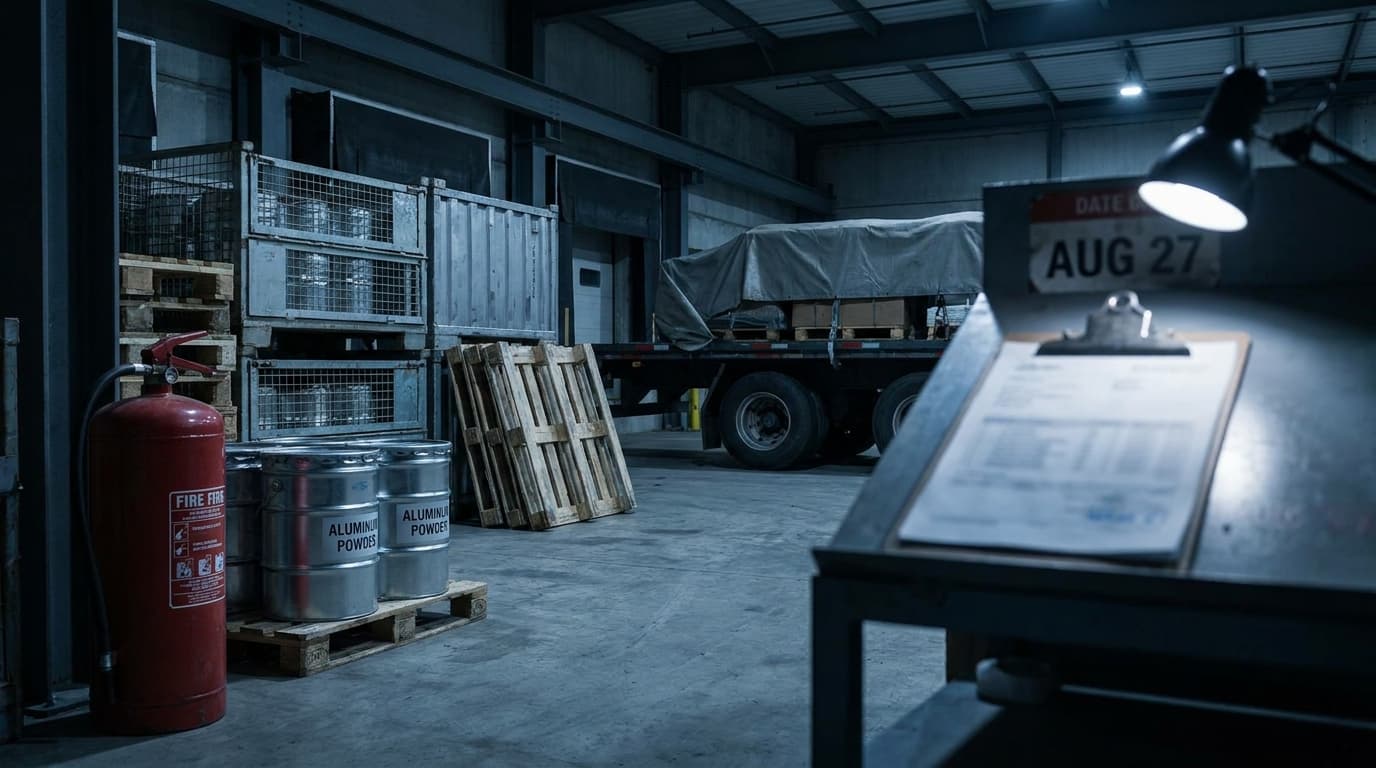
The Bureau of Industry and Security filed a notice on August 4, 2026 proposing to pull 14 additional product categories into the Section 232 tariffs on aluminum, steel and copper. The Federal Register published it two days later. Comments are due Thursday, August 27, 2026 — a 21-day window on FR Doc. 2026-15961, regulations.gov docket BIS-2026-0331.
The categories are not the ones a metals-tariff headline would lead you to expect. Aluminum powder of non-lamellar structure. Fire extinguishers. Free-standing floor safes. Parts of heat exchange units. Three separate classes of trailer and semi-trailer. Filled steel cylinders of propane, oxygen and propylene. And — the entry that proves what this proposal actually is — brass-wind musical instruments and their parts and accessories.
If your company imports tubas, you are about to become a steel importer. Not by choice, and not because anyone in your supply chain reclassified anything. By operation of a weight test you never opted into.
This is not a metals story. It is a bill-of-materials story.
BIS states its screen plainly in the notice: imports of these articles "tend to be composed predominately of aluminum, steel, and/or copper by weight," and those imports threaten to undermine the objectives of the actions taken under Proclamations 9704 (aluminum), 9705 (steel) and 10962 (copper).

Composition by weight is the entire qualifying question. Not your NAICS code. Not whether your industry has ever appeared in a trade case. Not whether you buy metal or buy finished goods. A fire-safety distributor, a propane filler and a musical-instrument importer are being evaluated on the same criterion as a rebar mill's customer, because the criterion is metallurgical mass, not industrial identity.
That is a structurally different exposure model from the one most compliance functions are built around. The question "are we a metals importer?" has stopped being answerable from your org chart. It is answerable only from your product weights and your HTS lines.
The rate table, with the carve-outs intact
Coverage in the trade press has compressed this to "25% on 14 things." That is right for ten of them and wrong for four. The proposal applies four distinct rate treatments:
| Proposed article | HTSUS | Proposed treatment | | --- | --- | --- | | Aluminum powder, non-lamellar structure | 7603.10.0000 | 25% — clause (3), Proc. 11021 | | Brass-wind musical instruments; parts and accessories | 9205.10.0000; 9209.99.4080 | 25% | | Parts of welding machines and apparatus | 8515.90.2000 | 25% | | Free-standing floor safes | 8303.00.0000 | 25% | | Electric conductor cables | 8544.49.2000; 8544.49.3040; 8544.49.3080; 8544.60.4000 | 25% | | Fire extinguishers | 8424.10.0000 | 25% | | Parts of heat exchange units | 8419.90.3000 | 25% | | Parts of linear acting hydraulic power engines and motors | 8412.90.9005 | 25% | | Tanker trailers and semi-trailers | 8716.31.00 | 25% | | Other trailers and semi-trailers | 8716.40.00 | 25% | | Mobile lifting frames on tires; straddle carriers | 8426.12.0000 | Proc. 11032 clauses (2)–(3) rates — "a type of mobile industrial equipment" | | Other self-propelled cranes and mobile lifting frames | 8426.41.0090 | Proc. 11032 clauses (2)–(3) rates | | Self-loading/self-unloading trailers for agricultural purposes | 8716.20.00 | Clause (5) tier, Proc. 11021 — "a type of agricultural equipment" | | Filled steel containers: propane (other than min. 90 liquid volume % purity), oxygen, propylene | 2711.12.0020; 2804.40.0000; 2901.22.0000 | 50% — clause (2), Proc. 11021, applied to container value only |
Two of these need unpacking, because both are widely mis-stated.
The agricultural trailer "15% tier" is not a flat 15%. Clause (5)(a) of Proclamation 11021 is a top-up mechanic: where the Column 1 HTSUS rate is below 15%, the Column 1 rate and the additional Section 232 rate must sum to 15%. Where Column 1 is already 15% or more, the additional Section 232 rate is zero. Model it against your actual Column 1 duty, not against a 15% headline.
The filled-container 50% applies to the container, not the gas. BIS's reasoning is that the same steel cylinders imported empty already carry 50%, so filling them should not change the treatment of the steel. The notice is explicit that "this tariff would only apply to the value of the metal container and would not apply to the value of a filled container's contents." At least one trade-press summary has rendered this as a duty on "50% of container value" — a materially different and incorrect statement. It is a 50% ad valorem rate assessed on the container's customs value, with contents excluded from the base.
The valuation change is the part that actually moves money
Everything above is scope. The mechanic that determines what scope costs changed four months earlier, and it is still under-absorbed.
Proclamation 11021 of April 2, 2026 (91 FR 18201) took effect at 12:01 a.m. ET on April 6, 2026. Recital 8 records the President's determination to modify the tariffs "so that they apply to the full customs value of aluminum, steel, and copper articles and their derivatives, regardless of metal content." That replaced the prior split-value method, under which an importer declared the metal content of a derivative article and paid duty only on that declared portion.
Run the arithmetic on an assembled article that is metal-heavy by weight but metal-light by value — which describes most of this list. The following is ManufacturingMag's own calculation, not a figure from the notice.
Take a $100,000 trailer containing $15,000 of steel. Under the old metal-content method at the then-applicable 50% derivative rate, the duty base was the steel: $15,000 × 50% = $7,500. Under Proclamation 11021's full-customs-value method at the proposed 25%, the base is the whole unit: $100,000 × 25% = $25,000.
Roughly 3.3 times the exposure — at half the nominal rate. And measured against the steel the policy exists to protect, the effective rate is about 167%.
Now notice which direction that ratio moves. The more value an assembler adds on top of the metal — better engineering, better finish, more content from a U.S. or allied supply chain — the higher the effective rate on the metal inside. Full-customs-value assessment taxes the value-add, not the tonnage. That is the reshoring paradox sitting inside this list, and it is why a category like brass-wind instruments produces an absurd-looking outcome: the metal is cheap, the craftsmanship is not, and the duty follows the craftsmanship.
The cadence changed, and almost nobody said so
Here is the fact that should reorganize your compliance calendar, and it is not in the August notice at all — it is in clause (11) of Proclamation 11021:
"The inclusion processes established pursuant to clause (7) of Proclamation 10895, clause (6) of Proclamation 10896, and clause (3) of Proclamation 10962 are hereby terminated."
The old regime was a calendar. Industry filed inclusion requests during fixed two-week submission windows several times a year — outside counsel summaries describe them as the first two weeks of May, September and January, under an interim final rule made public April 30, 2025 and published May 2, 2025. Requests were posted for a 14-day public comment period, and the Secretary was directed to determine each one within 60 days of receipt. You could diarize it.
Recital 10 of Proclamation 11021 replaced that with authority for the Secretary of Commerce and the U.S. Trade Representative, acting jointly, to add derivative articles "on a rolling basis" whenever they determine the statutory conditions are met — and to "solicit information, feedback, recommendations, or other relevant materials from domestic producers, industry associations, or other interested parties" as they see fit. They may also reconsider, modify or reverse their own inclusion decisions.
Rolling and agency-initiated. There is no window. There is no filing season. The August 27 notice is a discretionary, ad hoc comment solicitation, not a scheduled event — and the next one carries no obligation to look like this one.
How thoroughly has this failed to land? BIS's own Section 232 Steel and Aluminum program page still describes the superseded inclusions process, windows and all, months after clause (11) terminated it.
There is no lead time. That is not a risk assessment — it is in the text.
Clause (11) also sets the effective-date rule for anything newly included:

"Any inclusion shall apply to goods entered for consumption, or withdrawn from warehouse for consumption, on or after 12:01 a.m. eastern time on the date that the Secretary and the Trade Representative make the requisite finding or the first practicable effective date after that time, as set forth in a notice in the Federal Register."
No phase-in. No transition period. No in-transit relief anywhere in the language. The duty attaches on entry, and the trigger is the date of the finding — not the date you read about it.
The precedent is on the record. The first completed inclusions cycle under the old process took effect at 12:01 a.m. ET on August 18, 2025 — one day before the Federal Register notice adopting them published on August 19. That happened under the regime that had a published calendar and a 60-day determination clock. The current regime has neither.
Goods on the water are exposed. Price them that way.
How a company finds out its HTS is on the list
Since there is no longer a window to watch, there is only a docket to watch. Assign it to a named person and give them four standing items:
-
regulations.gov docket BIS-2026-0331 and its successors — where proposals and comments land.
-
The Federal Register "Bureau of Industry and Security" notice feed — where inclusions and effective dates are published, sometimes after they bite.
-
CBP CSMS bulletins — where the Chapter 99 heading changes actually appear for entry filing. CBP implemented Proclamation 11021 through CSMS #68253075 and issued Annex IV technical corrections through CSMS #68554727.
-
Quarterly reconciliation of your top 50 HTS lines against the current Annex I-A, I-B, I-C, Annex III and Annex IV.
That last item is not busywork. The annexes move between headlines: a technical-corrections notice published April 29, 2026 amended Annex IV retroactively to April 6, 2026. Your classification can change scope without any new proclamation, any new proposal, or any press coverage at all.
Two clauses belong in the same reconciliation. Clause (9) is the anti-stacking rule: a good listed as an article or derivative of more than one metal is subject to the clause (2), (3) or (5) rate only once, even if it contains aluminum and steel, aluminum and copper, steel and copper, or all three. Clause (9) also carves out goods in Annex I-B or Annex III that contain no aluminum, steel or copper content as set forth in Annex IV, and goods in those annexes not classifiable in HTSUS Chapters 72, 73, 74 or 76 that do not contain "sufficient" metal content per Annex IV. Several law-firm and broker summaries characterize that sufficiency threshold as under 15% metal by weight; we were unable to confirm that figure in the primary Annex IV text, so treat it as secondary reporting and verify against the annex before you rely on it.
What a substantive comment actually contains
BIS tells you exactly what it will read. The notice asks for comment on "(i) the aluminum, steel, and/or copper intensity of these products, (ii) whether imports of the products are of such volume as to undermine national security, (iii) the extent to which domestic production of the products can meet domestic demand, (iv) the effect on the economy, including domestic industry, if the products are included as derivative articles, and (v) any other relevant factors."
Structure the filing against those five, in order, and make each one evidentiary:
-
Metal intensity. State your specific HTS line and your role in the chain. Give measured metal content by weight and describe the measurement method — teardown, engineering bill of materials, certified supplier data. An assertion of intensity without a method is not usable to a technical reviewer.
-
Import volume and national security. Address whether volumes in your subheading plausibly bear on the objectives of Proclamations 9704, 9705 and 10962.
-
Domestic capacity. Document sourcing attempts, not conclusions: supplier names, dates, quoted prices, lead times, qualification test results and outcomes. "No domestic source exists" carries no weight; a record of five qualification attempts and their failure modes does.
-
Economic effect. Quantify. Unit volumes, dollar exposure at the proposed rate, downstream customers affected, headcount at risk.
-
The ask. Close with something specific and grantable: exclude the subheading, split the subheading to separate metal-intensive from non-metal-intensive product, apply a lower clause, or delay the effective date. A comment with no requested remedy is a comment with no decision attached to it.
Confidential submissions — read this before you file. Business confidential material must be identified at submission with a statement justifying nondisclosure that cites specific legal authority, and must be accompanied by a non-confidential version. The confidential file name must begin with BC and every page marked BUSINESS CONFIDENTIAL. The public version's file name must begin with P and be marked PUBLIC. Files that do not begin with BC or P are treated as public and posted. BIS explicitly encourages scanning a hard copy of the public version rather than applying digital redactions — because failed digital redactions expose the confidential text underneath, on a public docket, permanently.
The uncomfortable legal fine print
BIS states in the notice that the Administrative Procedure Act's notice-and-comment requirements "are inapplicable because this notice involves a military function of the United States (5 U.S.C. 553(a)(1))." And because no law requires comment here, the Regulatory Flexibility Act's analytical requirements do not apply and no Final Regulatory Flexibility Analysis was prepared. BIS is taking comment voluntarily, "because public input may help to better inform the decision-making process."
Read that operationally. There is no legal duty to respond to your comment point by point. There will be no small-business impact analysis for anyone to litigate against later. The comment period is a courtesy, and the courtesy can be shorter or absent next time.
That does not make commenting pointless — it changes what commenting is for. You are building a factual record for a technical reviewer and a working relationship with the Defense Industrial Base Division, which is the office that will be making rolling determinations about your HTS lines for the foreseeable future. The notice is signed by Jessica Curyto, Deputy Assistant Secretary for Technology Security; the contact is Stephen Astle, Director, Defense Industrial Base Division, (202) 482-4506, metals232inclusions@bis.doc.gov.
What to do regardless of whether you comment
The duty-engineering work is independent of the docket outcome and should start now:
-
Model landed cost at 15%, 25% and 50% for every potentially affected line — on full customs value, not metal content. If you are still running metal-content math anywhere in your costing model, that model has been wrong since April 6.
-
Verify smelt-and-cast / melt-and-pour documentation from suppliers. The 10% rate for derivative articles whose metal was smelted and cast or melted and poured in the U.S. is worth real money, and Proclamation 11032 lowered the "entirely U.S. metal" qualifying threshold from 95% to 85% of the weight of the aluminum, steel and copper in the product. Some suppliers that failed the old test now pass — but only if the documentation exists.
-
Check clause (9) so you are not stacking rates on multi-metal goods. Overpayment on stacked assessments is a real and recoverable error.
-
Review FTZ admissions. Clause (12) requires that covered products — except those eligible for domestic status under 19 CFR 146.43 — be admitted only under privileged foreign status (19 CFR 146.41) on or after the effective date. Privileged foreign status locks the classification and rate at admission, so a zone is not an escape hatch. But when you admit matters, because admission before an inclusion's effective date locks the pre-inclusion rate.
-
Test drawback eligibility against all four clause (13) conditions: the article is classifiable in an Annex I-B or Annex III provision or was brought in scope under clause (11); it is not a type subject to an AD/CVD order, regardless of country; it is a product of a Trade Agreement Partner (UK, EU, Japan, Korea, Mexico, Canada, or any partner with a concluded Agreement on Reciprocal Trade); and the metal content was entirely smelted and cast or melted and poured in a Trade Agreement Partner country. Note the first condition carefully — newly included articles can qualify. Clause (14) forecloses every other form of drawback.
The durable point
The proclamation set the rates. The docket now sets the scope — and it sets it continuously, without a schedule, with same-day effect, and with no legal obligation to warn you or to answer you.
August 27 will pass. Some of these 14 categories will be included, possibly with modifications, possibly not all at once. Then the next list will arrive, and there will be no window to have missed, because there are no windows anymore.
The standing instruction that follows is unglamorous and it is the whole job: put one named person on the Federal Register BIS feed and the CBP CSMS bulletins, and reconcile your top HTS lines against the current annexes every quarter. The companies that get caught by the next list will not be the ones that lost the argument. They will be the ones that never knew the argument was happening.
Related reading
-
[The "Motor Vehicle" Tariff With No Cars In It: Canada's 50% Section 338 Duty Lands on Cement, Plywood and Furniture — and USMCA Origin Won't Save You](/article/motor-vehicle-tariff-no-cars-canada-section-338-50-percent-duty)
-
38 Days to a 100% Pharma Tariff — and the Only Off-Ramp Closed in June
Sources
-
BIS, Request for Public Comments on the Proposed Implementation of Duties on Additional Aluminum, Steel, and Copper Derivative Articles Under Section 232 (FR Doc. 2026-15961; Docket No. 260803-0182; XRIN 0694-XC166; regulations.gov BIS-2026-0331). Public-inspection copy (PDF).
-
Adoption and Procedures of the Section 232 Steel and Aluminum Tariff Inclusions Process, Federal Register, August 19, 2025.
-
[KPMG TaxNewsFlash — BIS seeks comments on proposed Section 232 tariffs on additional derivative articles](https://kpmg.com/us/en/taxnewsflash/news/2026/08/us-bis-section-232-tariffs-derivative-articles.html).
-
White & Case — Commerce Department opens new steel and aluminum Section 232 tariff inclusions process (procedural detail on the now-terminated windows).
-
C.H. Robinson — CBP Updates to Metal Article Tariffs: CBP Guidance and HTS Changes (CSMS #68253075, #68554727; Annex IV technical corrections retroactive to April 6, 2026).
-
Mallory Alexander — Tubas, Cranes and Propane Tanks: 14 Products Could Join Section 232 Tariffs.
-
Allyn International — BIS Proposes Additional 232 Derivative Articles.
The $100,000 trailer / $15,000 steel-content comparison is ManufacturingMag's own illustrative calculation, not a figure drawn from the notice or from any cited source. The reported sub-15%-by-weight Annex IV exemption threshold is secondary reporting from law-firm and broker summaries and could not be confirmed in the primary annex text; verify before relying on it.