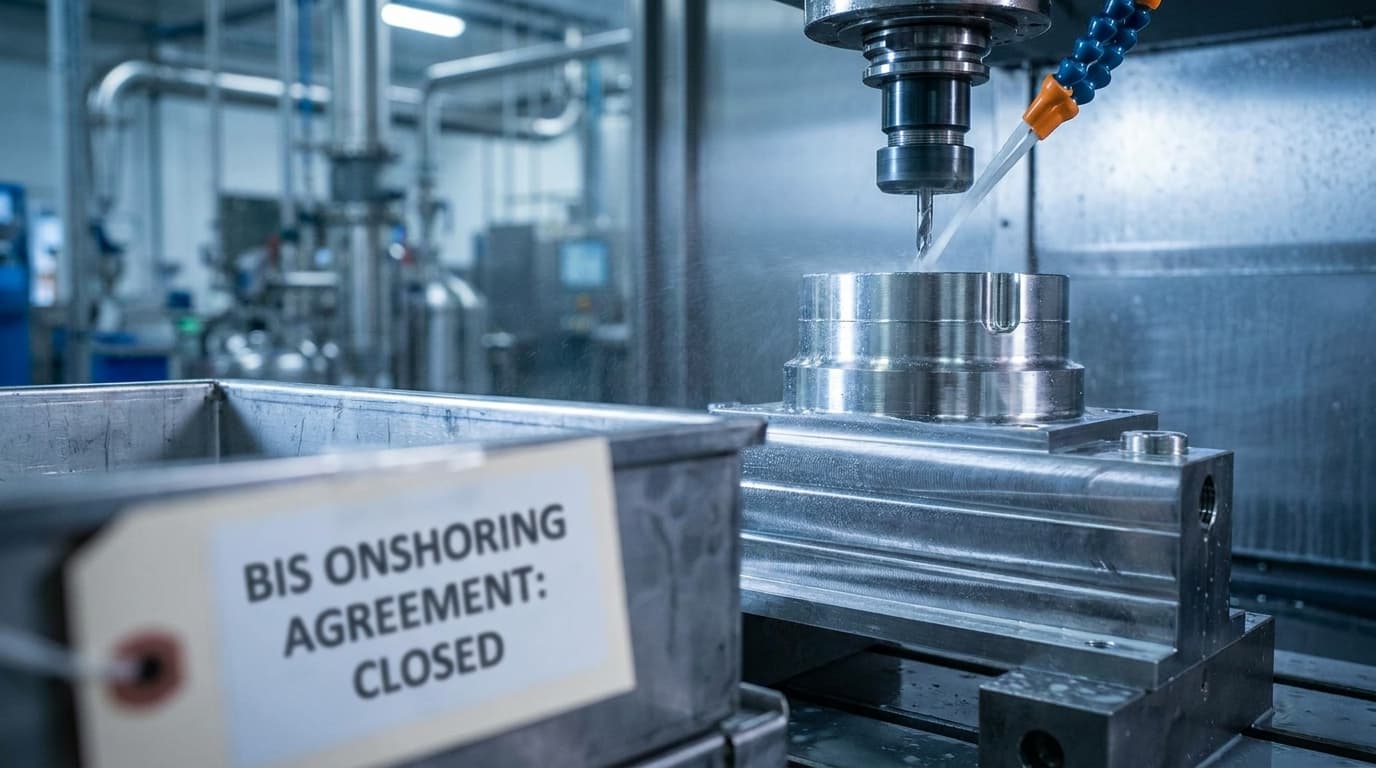
On September 29, 2026 — 38 days from now — the default 100% ad valorem Section 232 duty on patented pharmaceuticals and their associated active pharmaceutical ingredients extends to every remaining covered importer. The unusual feature of this deadline is not the rate. It is that the exit was sealed ten weeks before the duty lands.
Proclamation 11020, signed April 2, 2026 under Section 232 of the Trade Expansion Act of 1962, built exactly one company-specific mitigation path: a negotiated onshoring agreement with the Commerce Department, worth a 20% rate through April 2, 2030, or 0% through January 20, 2029 if paired with a most-favored-nation pricing agreement with HHS. The Bureau of Industry and Security published the application procedures in the Federal Register on May 13, 2026, requesting submissions within 30 days. The deadline was June 12, 2026. Neither the notice nor the subsequent wave of law-firm guidance from Skadden, WilmerHale, Holland & Knight or Troutman announced a second window or a late-filing accommodation.
So the policy question is closed. What remains for the next 38 days is entirely operational: classification accuracy, entry posture, exemption substantiation, and — over a much longer horizon than any tariff calendar — whether the domestic capacity the proclamation is meant to conjure can actually be qualified to produce.
Correcting the record on who is exposed
The annex architecture is being read backwards in a fair amount of commentary, and the error changes who thinks they have time.
-
Annex III is an acceleration list, not an exemption list. The 17 named companies — AbbVie, Amgen, AstraZeneca, Bristol Myers Squibb, Boehringer Ingelheim, Eli Lilly, EMD Serono, Genentech, Gilead, GlaxoSmithKline/ViiV, Johnson & Johnson, Merck Sharp & Dohme, Novartis, Novo Nordisk, Pfizer, Regeneron and Sanofi — hit the effective date at 120 days from signing, or July 31, 2026. Being named made them earlier, not safer.
-
Annex II is the relief list. Thirteen companies executed agreements with the Commerce Secretary before April 2, 2026 and qualify for the 0% rate through at least January 20, 2029.
-
Everyone else lands on September 29, 2026 — the 180-day date.
One caveat for anyone cross-checking secondary sources: at least one client alert, from Crowell & Moring, assigns the Annex III cohort the September date. That reading conflicts with the proclamation text and with every other source reviewed here. Work from the primary document.
The other correction worth making early: 100% is not the universal outcome. It is what you get when four things are simultaneously true — no onshoring agreement, no MFN pricing agreement, no country cap, and no product carve-out. The country caps are substantial: 15% for the EU, Japan, Korea, Switzerland and Liechtenstein; 10% for the UK. The product carve-outs are broader still. Between them, the 100% wall applies to a considerably narrower slice of trade than "all patented pharmaceuticals" implies.
What the 100% actually covers
The coverage test has two prongs, and a product must fail both to escape. A drug is "patented" for tariff purposes if it is listed in FDA's Orange Book (Approved Drug Products with Therapeutic Equivalence Evaluations) or Purple Book (Lists of Licensed Biological Products), and it is classified under an HTSUS code appearing in Annex I.
The rate ladder runs by HTSUS heading:
| Heading | Rate | Applies to | | --- | --- | --- | | 9903.04.60 | +100% | Default | | 9903.04.62 | +15% | EU, Japan, Korea, Switzerland, Liechtenstein | | 9903.04.63 | +10% | United Kingdom | | 9903.04.64 | +20% | Approved onshoring plan; escalates to +100% on April 2, 2030 | | 9903.04.65 | 0% | Onshoring plus MFN pricing; terminates January 20, 2029 | | 9903.04.66 | — | Specialty / orphan | | 9903.04.67 | — | Generics and biosimilars |
The classification exposure is where compliance teams are spending August. As ArentFox Schiff documents, Annex I carries roughly 120 ten-digit HTSUS codes at active rates while Annex IV carries more than 400 at zero. Critically, the split can run inside a single heading: some 10-digit suffixes land in Annex I and others in Annex IV. A classification that was directionally fine when the duty was a few percent is now a nine-figure question on a large entry, and a penalty question if it is wrong.
The sharper structural problem is dual-use API. A substance like metformin hydrochloride feeds both generic and patented finished dose. The generics exemption survives only if shipments are segregated and end-use is documented at entry — a warehousing and records discipline, not a tariff-engineering trick.
The full exemption list is wide: generics and biosimilars, US-origin products, orphan-designated drugs across all approved indications, nuclear medicines, plasma-derived therapies, fertility treatments, cell and gene therapies, antibody-drug conjugates, medical countermeasures, specified animal-health products, and development prototypes under HTSUS 9817.85.01.
The compliance mechanics operators are executing right now
Four items are live between now and September 29.
Entry declarations and rate claims. Every claim to a reduced heading — country cap, exemption, agreement rate — has to be supportable on its face at entry and reconstructable under audit later.
Foreign trade zones. Goods admitted to an FTZ on or after the effective date must enter as privileged foreign status under 19 CFR 146.41. That fixes duty exposure at the moment of admission. There is no zone-based deferral strategy that outlasts the date.
Drawback. Duty drawback is available for duties imposed under the proclamation — a meaningful recovery channel for product that is re-exported, and one that requires the tracking infrastructure to be in place before the duties start accruing, not after.
Stacking. The Section 232 rate is additive to the Column 1 rate; where Column 1 already exceeds the proclamation rate, only Column 1 applies. Antidumping and countervailing duties continue to apply additively on top.
The enforcement tail is the part that should be briefed to the board. Commerce may apply the 100% rate both prospectively and retroactively on a finding of fraud or deliberate misrepresentation, with additional exposure under 19 U.S.C. § 1592 and the False Claims Act. Agreements carry external audit requirements. A misclassification that looks like an accounting adjustment in a normal tariff environment looks like something else entirely against a 100% retroactive rate.
What a signed onshoring agreement actually obligates
For the companies that did file by June 12, the relief is not a signature — it is a multi-year performance contract. The BIS application, per WilmerHale's breakdown, requires corporate and beneficial-ownership information; total planned US investment from January 20, 2025 through January 20, 2029; product-by-product onshoring commitments with timelines that explicitly account for FDA approval; current and projected US-versus-global sales made domestically; annual spending commitments; audited annual progress reports against investment milestones; MFN agreement status; and product annexes carrying HTSUS codes, brand names, active ingredients, country of origin, importer and manufacturing-facility detail.
Then there are the two cliffs, which are being underpriced. The 20% onshoring rate under 9903.04.64 escalates to 100% on April 2, 2030. The 0% MFN heading under 9903.04.65 terminates automatically on January 20, 2029. Neither is permanent relief. Both are a fixed runway during which validated domestic output has to exist, backed by audited milestone reporting that creates a documented record of whether it does.
The capacity arithmetic
The number everyone cites is $480 billion. It deserves a date stamp and a discount.
Think Global Health's tracker, published November 24, 2025 — five months before the proclamation — counted more than $480 billion pledged across 4-to-10-year timelines, 22 new sites and approximately 44,000 jobs, spanning 14 firms including AbbVie, Amgen, AstraZeneca, BMS, Eli Lilly, Gilead, GSK, J&J, Merck, Novartis, Novo Nordisk, Pfizer, Roche and Sanofi. These are pre-tariff announcements being retrofitted into a post-tariff narrative.
The same tracker supplies its own skepticism, and it is the most useful part. Bioprocessing equipment supplier share prices did not move materially on the announcements. Suppliers projected groundbreaking on most projects in "2026 and 2027 at the earliest." And executives in the equipment channel — the people who would receive the orders if the capital were actually moving — treated only $50–100 billion of the headline total as high-confidence.
That is roughly a 10-to-20% conversion assumption from the firms closest to the purchase orders. Equipment vendors are a leading indicator; press releases are not.
Why the calendar cannot be beaten
The benchmark is Pfizer's sterile injectable facility in Portage, Michigan: $465 million, roughly 450 jobs, groundbreaking mid-2019, construction complete in 2021, production beginning in 2024. Read that sequence again. Three years elapsed between a finished building and commercial supply.
That three-year tail is where tariff policy and manufacturing reality diverge, and it decomposes into steps that cannot be run in parallel:
-
Commissioning and qualification of utilities, HVAC, cleanroom classification and equipment.
-
Tech transfer package — for a sterile fill-finish site, that means formulation, process parameters, filtration strategy, container-closure, aseptic processing or terminal sterilization, hold-time data, lyophilization cycles, analytical methods, stability data and batch history.
-
Analytical method transfer, routinely underestimated and frequently the actual critical path into a PPQ campaign.
-
Aseptic process simulation — full media fills at the receiving site.
-
PPQ batches under representative commercial conditions.
-
Facility evaluation and pre-approval inspection.
The industry rule of thumb for a new production line is two to three years, five or more for complex projects, with specialized-equipment lead times and talent shortages as the usual delay drivers. Fill-finish capacity compounds the problem from the other direction: slots have to be secured well ahead of PPQ readiness, submission and launch. A tariff that bites in September 2026 cannot pull 2028 capacity forward. Capacity booked is capacity booked.
What FDA PreCheck buys — and what it doesn't
FDA announced the seven participants in its PreCheck pilot on June 29–30, 2026, across four states: Amneal (Long Island, NY — small-molecule sterile liquids for pain, respiratory and ophthalmic); Regeneron (Saratoga Springs, NY — biologic drug substance, sterile injectables, novel protein therapeutics); Cellares (Bridgewater, NJ — cell-based gene therapy for oncology and hematology); Eli Lilly (Lebanon, IN — API and drug substance); Fujifilm Biotechnologies (Holly Springs, NC — commercial-scale cell culture); Kriya Therapeutics (Durham, NC — AAV gene therapy); and Kyowa Kirin (Sanford, NC — biologic drug substance for rare diseases). CNBC confirmed the cohort the same week.
The structure is two-phase. Phase 1 provides early FDA technical guidance and facility-specific Drug Master File review before the facility is operational. Phase 2 offers facility-focused pre-submission meetings supporting expedited facility evaluation and earlier inspection within the review cycle. Cellares SVP Eric Fulmer captured the value: PreCheck "moves that conversation up by several years, to a time before a facility is even in operation."
That is real, and it removes a genuine category of late-stage rework. But the reporting is explicit that PreCheck front-loads engagement — it does not compress statutory review clocks. It makes the qualification chain more predictable. It does not make it shorter.
Note also the composition. Exactly one cohort member — Lilly's Lebanon, Indiana site — is a pure API and drug-substance operation. API is the choke point the tariff is nominally aimed at: 70–80% of APIs used in US medicines originate abroad, and Indian API manufacturing itself depends on China for roughly 70% of intermediates and key starting materials. A pilot weighted toward biologics and cell and gene therapy is a pilot pointed slightly away from the dependency that motivated the policy.
The margin question
For any product whose domestic line does not qualify until 2028, someone absorbs a 100% duty in the interim. The candidates are the manufacturer, the wholesaler, the GPO, the payer and the patient, and the answer is contract-by-contract.
Three planning realities shape those negotiations. First, the duty is additive to Column 1 and stacks with AD/CVD, so the landed-cost delta is not capped at the headline rate. Second, the relief tiers have expiry dates — April 2, 2030 for the 20% escalator and January 20, 2029 for the 0% MFN heading — which means any multi-year supply agreement priced off a preferential rate needs a repricing trigger at those dates or it prices a benefit that contractually disappears. Third, inventory pre-positioning was the obvious first move and, for the July 31 cohort, it was largely executed months ago; FTZ privileged foreign status under 19 CFR 146.41 closes the remaining deferral. Drawback on re-exports is the durable recovery lever, and only for product that leaves.
The next deadline nobody is watching
The proclamation obligates Commerce to review, within one year of April 2, 2026, whether to extend Section 232 tariffs to generic pharmaceuticals. The generics exemption is explicitly provisional. That review — due by spring 2027 — matters more to US drug supply than the branded tariff does.
The reason is margin structure. USP data indicates 71% of drugs currently in shortage are sterile injectables — overwhelmingly generic, overwhelmingly low-price. A branded product with substantial gross margin can absorb a tariff, reprice, or eat it while a domestic line qualifies. A generic sterile injectable selling at low single-digit dollars per vial has no such buffer. Applying a Section 232 rate to that category does not redirect sourcing; it removes suppliers from a market that already cannot hold the ones it has.
What to do in the remaining 38 days
The strategic decisions are made. The executable list is short and unglamorous:
-
Run a line-level classification audit against Annex I and Annex IV, at the full ten digits. Assume nothing about heading-level consistency — the suffix split is the trap.
-
Map Orange Book and Purple Book status product by product. Listing status is the coverage trigger; it needs to be a maintained field, not a one-time lookup.
-
Fix FTZ admission posture now. Privileged foreign status under 19 CFR 146.41 fixes exposure at admission, so admission timing and status election are decisions with a hard September 29 boundary.
-
Stand up drawback capture for re-exported product before duties begin accruing.
-
Build the exemption evidence file. Generic and specialty claims — particularly dual-use API with segregated end-use — have to survive an audit conducted against a retroactive 100% rate with § 1592 and False Claims Act exposure attached.
None of that changes a rate. It determines whether the rate you pay is the one you actually owe, and whether you can prove it in three years. Given that the negotiated alternative closed on June 12, that is the entire remaining decision space.
Related reading
-
[The "Motor Vehicle" Tariff With No Cars In It: Canada's 50% Section 338 Duty Lands on Cement, Plywood and Furniture — and USMCA Origin Won't Save You](/article/motor-vehicle-tariff-no-cars-canada-section-338-50-percent-duty)
-
[Washington Just Put a Price Floor Under Wafers: $100/kg, 15% on Top, and a Lifetime Import Ban for a Bad Certification](/article/polysilicon-section-232-minimum-import-price-wafers-proclamation-11052)
-
Everyone Is Building Magnet Plants. Nobody Is Making the Iron
Sources
-
Adjusting Imports of Pharmaceuticals and Pharmaceutical Ingredients into the United States — Proclamation 11020, April 2, 2026
-
Procedures To Apply for Company-Specific Onshoring Agreements — Federal Register, May 13, 2026
-
Deadline Approaching for Companies Seeking Onshoring Deals — Skadden, Arps
-
Onshoring Pharmaceutical Manufacturing: Procedures to Apply for Onshoring Agreements — WilmerHale
-
A Hard Pill to Swallow: 100% Tariffs Hit Pharma — ArentFox Schiff
-
Section 232 Tariffs on Patented Pharmaceutical Imports — Crowell & Moring
-
From Zero to 100% — Troutman Pepper Locke
-
Tracking Pharma's Progress on U.S. Onshoring — Think Global Health, November 24, 2025
-
FDA picks seven companies for PreCheck pilot program — Pharma Manufacturing, June 30, 2026
-
Eli Lilly, Regeneron among first companies selected for FDA PreCheck — CNBC, June 29, 2026
-
Pfizer sterile injectable production facility, Portage, Michigan — Pharmaceutical Technology
-
Commercial Technology Transfer to a Sterile Fill-Finish CDMO — Adragos Pharma
-
Sterile Fill-Finish Capacity Planning from Phase I to Launch — Adragos Pharma
-
The Pharma Choke Point — Council on Foreign Relations
-
Geographic distribution of manufacturing remains a driver of drug shortages: USP — Pharma Manufacturing