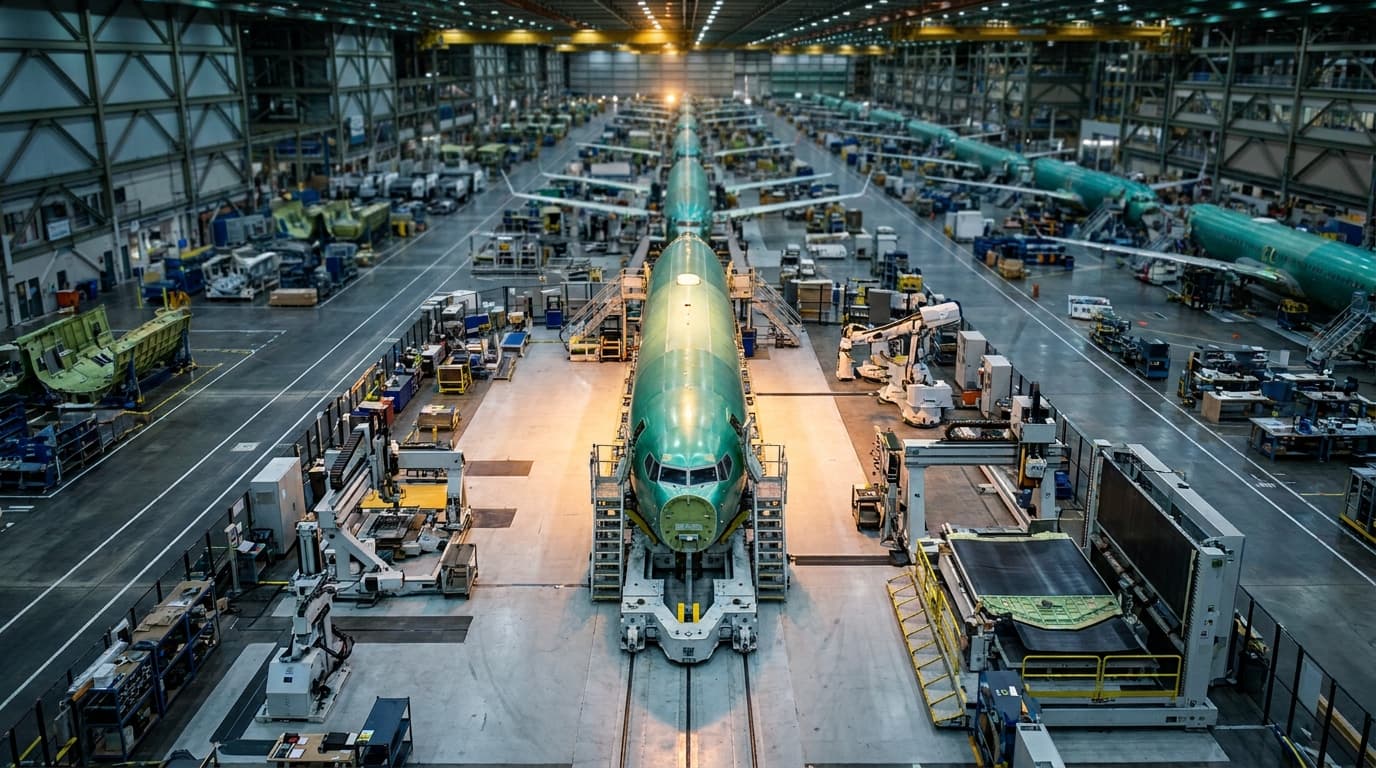
Walk into the north end of Boeing's Everett factory today and you will find a bay built for widebodies with a single-aisle fuselage in it. The first 737 MAX 10 fuselage was loaded on July 6, 2026. The line opened formally four days later, with Boeing Commercial Airplanes President Stephanie Pope on hand. It cost about $1 billion to convert. It is currently producing roughly one aircraft per month, with a target of five per month next year, according to on-site reporting from Leeham News.
Meanwhile, inside Boeing's planning organization, analysts are working the arithmetic on 70 jets a month. Not 70 a year for the North Line — 70 a month for the 737 program.
The distance between those two facts is the story. Not because the ambition is absurd, but because somebody other than Boeing has to fund the gap, and that somebody has spent eight years learning what happens when they do.
What Boeing has actually said in 2026
Getting the rate ladder right matters here, because the entire supplier-behavior question turns on how firm each rung is.
Boeing produced 737s at 42 per month in the first quarter of 2026 and began transitioning to 47 per month in the second. Its second-quarter results, released July 28, reported 171 commercial deliveries — 129 of them 737s, or an average of 43 a month across the quarter — on $24.6 billion in revenue, a core loss per share of $(0.76), $1.4 billion in operating cash flow and $0.6 billion in free cash flow. BCA's backlog stands above 6,200 airplanes valued at $597 billion. The 737-7 and 737-10 have completed certification flight testing, with certification anticipated in 2026 and first delivery in 2027.
Above 47, the ladder gets progressively softer. Rate 52 is the near-term goal that the North Line's capacity is meant to unlock. Rate 57 is planned. Rate 63 is CEO Kelly Ortberg's stated ambition. And roughly 70 is a study — a distinction Ortberg himself drew when he confirmed the number to CNBC on June 5, 2026, the day after The Air Current reported it:
"So we're always looking at further rates. I think right now 63 is our plan… We'll look at that to understand where our constraints are, what the resilience is of the supply chain, but that's a study activity right now."
One number worth retiring from the conversation: 75 a month. That figure belongs to Airbus, which has publicly targeted 75 A320-family aircraft monthly. In Boeing's case it traces to the pre-grounding era, before March 2019, when the company was moving toward 57 and had signaled higher. It is not a 2026 directive. The story is better for the correction — a live study of 70 is a harder fact than a seven-year-old signal, and it is closer at hand.
What the North Line is, and what it isn't
The North Line is genuinely significant. These are the first 737s built outside Renton since Boeing consolidated the program there in 1970. The second fuselage arrived by rail from Wichita. Boeing's own framing is that the line lets Renton stabilize at rate 47 while enabling "rate 52 and beyond," and that it will absorb the complex interior configurations that otherwise disrupt flow on a high-rate line. Notably, Boeing's public materials on the North Line do not name a rate above 52.
What it isn't is a path to 70. Leeham puts the North Line's ultimate capacity at 15 jets per month. Add that to Renton's three lines and you get to 63 — Ortberg's target, and no further. Which is exactly why Leeham's Aug. 24, 2026 analysis of the MAX 10 delivery stream concludes that a second final assembly line will be needed as early as 2028. Every rate above 63 implies another factory conversion that has not been announced, budgeted publicly, or scheduled.
The ceiling nobody names: 52
Here is the number that should anchor every conversation about Boeing's ramp, and almost never does.
Boeing's highest sustained 737 production rate in the program's history is 52 per month. It announced the plan in October 2014, describing 52 as "the highest rate ever for the world's best-selling commercial airplane" — more than 620 aircraft a year. It reached that rate in June 2018. It was still there on March 13, 2019, when the MAX was grounded.
Run the comparisons against that peak rather than against today's depressed baseline:
-
Rate 52 does not represent growth. It returns the program to 2018.
-
Rate 63 is 21% above anything Boeing has ever sustained.
-
Rate 70 is 35% above it.
-
Rate 75, the number that keeps drifting into coverage, would be 44% above it.
Leeham makes the point explicitly: rate 52 merely matches the pre-crash peak. Everything beyond it is territory neither Boeing nor its supply base has ever operated in.
The supplier's problem is a capital allocation problem
For a Tier 1 or Tier 2 shop, a rate signal is not information. It is a request for capital.

Going from rate 47 to rate 63 means funding about 34% more throughput. Going to 70 means about 49% more. Those are simple ratios, and they are the easy part. The hard part is that the costs on the supplier side are not linear. Heavy presses, forging capacity, autoclaves, special-process lines like heat treat and chemical processing, tooling sets, and certified labor all come in steps. You do not buy 34% of a press. You buy a press, or you don't, and the qualification cycle behind it runs long enough that capacity ordered in 2026 lands near the end of the decade.
So the question a supplier actually faces is not "do I believe Boeing will grow?" It is: if I tool for 70 and Boeing lands at 57, who carries the underabsorbed fixed cost for the years it takes to fill that capacity? On current public information, the answer is the supplier — unless someone contracts otherwise.
That is not cynicism. It is the accumulated lesson of a rate signal that has been revised in both directions twice in eight years: up toward 57 before 2019, down to zero and then to an FAA-capped 38, and now up again through 47 toward numbers no one has ever hit.
Larry Culp's offer is the most revealing thing anyone has said about this ramp
At the Bernstein investor conference on May 27, 2026, GE Aerospace CEO Larry Culp described the problem in the open, in language Boeing's own executives would not use, as reported by Leeham News:
"We've had some suppliers who have said, 'Well, I don't believe the Boeing ramp rate.' Frankly, what we've said is, 'Let us relieve you of that. You don't have to believe it. We believe it. This is what we need, and we'll make proper arrangements.'"
Read that as a balance-sheet statement rather than a vote of confidence. An engine OEM is publicly volunteering to absorb rate risk that its own suppliers decline to underwrite. "Proper arrangements" is the operative phrase, and in this industry it generally means some combination of advance purchase commitments, OEM-funded tooling, minimum-volume guarantees and take-or-pay structures — instruments that convert a forecast into an obligation.
The significance is in who can offer that and who can get it. GE has the scale to write those contracts. A Tier 2 fabricator making brackets, fittings or machined structures rarely receives the same treatment from anyone. Culp's remark documents both a real solution and its narrow distribution: the risk moves up the chain to parties who can price it, and stops well short of the bottom of the pyramid, where much of the actual capacity constraint lives.
Spirit's disappearance changed who holds the risk
The industry's shared shock absorber is gone. Boeing [closed its acquisition of Spirit AeroSystems on Dec. 8, 2025](https://boeing.mediaroom.com/2025-12-08-Boeing-Completes-Acquisition-of-Spirit-AeroSystems) — roughly 15,000 employees across Wichita, Dallas, Tulsa and Prestwick, covering 737 fuselages plus 767, 777 and 787 structures, along with spares and MRO. Spirit Defense was spun out as an independent defense supplier; Short Brothers in Belfast became a Boeing subsidiary. Airbus separately absorbed Spirit's Airbus-facing aerostructures work, more than 4,000 employees.
Spirit was an independent Tier 1 that sold into both airframers and carried rate volatility on its own books, with its own incentive to smooth demand across two customers. That entity no longer exists. It has been divided between the two customers it used to buffer.
For a Tier 2 supplier, the practical change is the counterparty. You now sell fuselage-adjacent content into an OEM whose interest is in holding rate risk off its own balance sheet, rather than into an intermediary whose business model was partly about managing that risk across programs. The volatility did not vanish in the transaction. It was reallocated — and where it landed determines who eats a rate that arrives two years late.
Both airframers are drawing from the same well
Boeing's supply base is Airbus's supply base, and Airbus is running the more aggressive plan.
Airbus has publicly targeted 75 A320-family aircraft a month — what it calls "civil aerospace's highest-ever production level" — originally for 2027, a date that has been pushed right repeatedly. CEO Guillaume Faury has described the situation as "very painful and unsatisfactory." In late October 2025 Airbus opened two additional final assembly lines, in Mobile, Alabama and Tianjin, bringing it to ten FALs across four sites, supported by more than 20 participating industrial sites.
Per Leeham's Aug. 19, 2026 reporting, Airbus is sold out at rate 75 through 2032 and will be oversold as early as next year if it doesn't reach the rate by the end of 2027. A rate of 83 a month has been under study. Spirit Airlines' collapse and deferrals from JetBlue and Frontier bought some breathing room.
Then there is the backlog asymmetry. As of the end of April 2026, The Air Current reported Airbus holding 7,354 unfilled A320-family orders against Boeing's 4,872 single-aisle orders. That difference is not a scoreboard item. It is a payback calculation. A supplier weighing a press or a new special-process line is asking how many years it can run that asset at peak volume before the order book thins. On that question, the longer backlog wins — and both ramps compete for the same castings, forgings, titanium and fastener capacity.
Engines are the honest constraint
CFM International, the GE Aerospace–Safran joint venture, is sole-source on the 737 MAX and also supplies the LEAP-1A to Airbus. Both airframers' ambitions draw from one engine program.

The trajectory is real. GE Aerospace's second-quarter 2026 results reported LEAP deliveries up 24% in the quarter and 41% in the first half, total engine deliveries up 31% in the half, and full-year LEAP delivery growth guidance raised to the high teens. That is meaningful execution against a problem that has gated deliveries for years.
It is also growth off a base that still constrains both customers. As of October 2025, FlightGlobal reported that CFM remained in discussions with Airbus over the LEAP-1A delivery profile needed to support rate 75 — the clearest public evidence that engine capacity is contested between the two airframers' targets rather than sized for both.
Engines are not alone. Deloitte's midyear 2026 aerospace and defense outlook names "engines, electronics, castings, forgings, titanium, high-temperature alloy, and energetics" as inputs influencing the ability to ramp aircraft, and notes that operators are "selectively increasing inventories of parts and raw-material buffers to protect continuity, even at the cost of working capital." Companies are paying carrying costs to insure against a supply chain they don't trust to deliver on schedule. That is a revealed preference worth more than any rate forecast.
The rate breaks were quality-gated, not demand-gated
This is the historical point that explains supplier discounting better than any spreadsheet.
After the January 2024 Alaska Airlines door plug blowout, the FAA capped 737 production at 38 a month. Boeing did not clear rate 47 until it passed an FAA capstone review announced May 27, 2026. Before that, the constraint was a grounding. In neither case was demand the binding factor — the backlog stayed enormous throughout, and stands above 6,200 airplanes today.
So when a supplier hears a rate number, it is not evaluating whether airlines want the airplanes. It is evaluating whether Boeing's quality system, regulatory standing and labor stability will permit the airplanes to be built. Those are harder things to underwrite from the outside, and they have gone wrong twice within the memory of every purchasing manager in the industry.
The near-term risk the ramp narrative is under-pricing
Three days before Leeham published its second-North-Line analysis, Boeing's engineering union voted no.
On Aug. 21, 2026, SPEEA's roughly 17,000 engineers and technicians rejected Boeing's "Best and Final Offer" — engineers 64.3% against, technicians 71.9% against — and authorized a strike by 87.9% and 89.7% respectively if no agreement is reached by Oct. 6, when the contracts expire. No strike is permitted before that date, and talks have resumed. CNBC reported that the offer included an aggregate wage pool increase of 29.4% over four years, which Boeing described as its largest since 1983; members objected in part to a 3% cap on inflation-based raises.
The precedent is recent and expensive. In 2024, IAM District 751 rejected a tentative agreement Boeing characterized in similar terms and struck for 53 days, across four offers. A rate ramp that depends on engineering support, certification work and production-system stability cannot be modeled without a probability weight on this.
The asymmetry at the end of the arithmetic
Boeing can carry a $1 billion line building one airplane a month. It has a $597 billion backlog behind it, a certification program landing in 2026, and the institutional capacity to wait out a slow ramp to five a month and then to fifteen.
A fabricator that installs a press for rate 70 has none of that. No backlog of its own, no order book that survives a customer's revision, and — absent the kind of arrangement Larry Culp described GE offering — no customer obligated to make it whole. The independent Tier 1 that used to sit between it and the OEM has been absorbed into the OEM. The competing airframer down the road is running a larger backlog and a higher target, which makes it the better payback bet on paper and the same congested supply chain in practice.
The interesting question about Boeing's ramp is not whether the company reaches 63. Given the backlog and the North Line's stated 15-a-month ceiling, that path is at least visible, and a second line by 2028 is now a documented analytical expectation rather than speculation.
The question is who finances the attempt at everything above it — and whether the people being asked to build that capacity get anything more durable than a study.
Related reading
-
[The Tariff List Nobody Is Watching: Commerce Wants 25% on Aluminum Powder, Fire Extinguishers and Trailers — and the Comment Window Shuts August 27](/article/section-232-derivative-articles-bis-2026-0331-comment-window-august-27)
-
[Schaeffler Built a Gym for Robots: Why a 1,000-Unit Humanoid Rollout Starts Six Months Away From the Production Line](/article/schaeffler-humanoid-gym-aeon-1000-unit-rollout)
-
38 Days to a 100% Pharma Tariff — and the Only Off-Ramp Closed in June
-
If Boeing Engineers Strike, Who Signs Off on Supplier Deviations?
Sources
-
Second 737 North Line Likely Needed as Early as 2028: Analysis — Leeham News, Scott Hamilton, Aug. 24, 2026
-
Boeing explores hiking 737 production close to rival Airbus's stratospheric target — The Air Current, Julie Johnsson, June 4, 2026
-
Boeing CEO confirms it is studying hiking 737 production to a 70-jet monthly rate — The Air Current, June 5, 2026
-
Some suppliers skeptical of Boeing ramp rate; airframer gets unusual endorsement — Leeham News, June 18, 2026
-
Boeing's new North Line eases into 737 MAX production — Leeham News, Howard Hardee, July 10, 2026
-
New 737 production line to boost capacity and predictability — Boeing, July 2026
-
Boeing Reports Second Quarter Results — Boeing, July 28, 2026
-
Boeing to Increase 737 Production Rate to 52 per Month in 2018 — Boeing, Oct. 2, 2014
-
Boeing Completes Acquisition of Spirit AeroSystems — Boeing, Dec. 8, 2025
-
Ramping up A320 Family production — Airbus, Oct. 2025
-
Airbus pushing to increase monthly A320neo production rate sooner than later — Leeham News, Aug. 19, 2026
-
Engineers, Technicians reject Boeing's 'Best and Final Offer'; authorize strike; talks to resume — Leeham News, Aug. 21, 2026
-
Boeing engineers, technical workers reject contract offer — CNBC, Aug. 21, 2026
-
GE Aerospace Announces Second Quarter 2026 Results — GE Aerospace, July 2026
-
CFM still 'in discussions' with Airbus over Leap-1A deliveries to support rate 75 A320neo production — FlightGlobal, Dominic Perry, Oct. 24, 2025
-
Midyear update: 2026 Aerospace and Defense Industry Outlook — Deloitte Insights