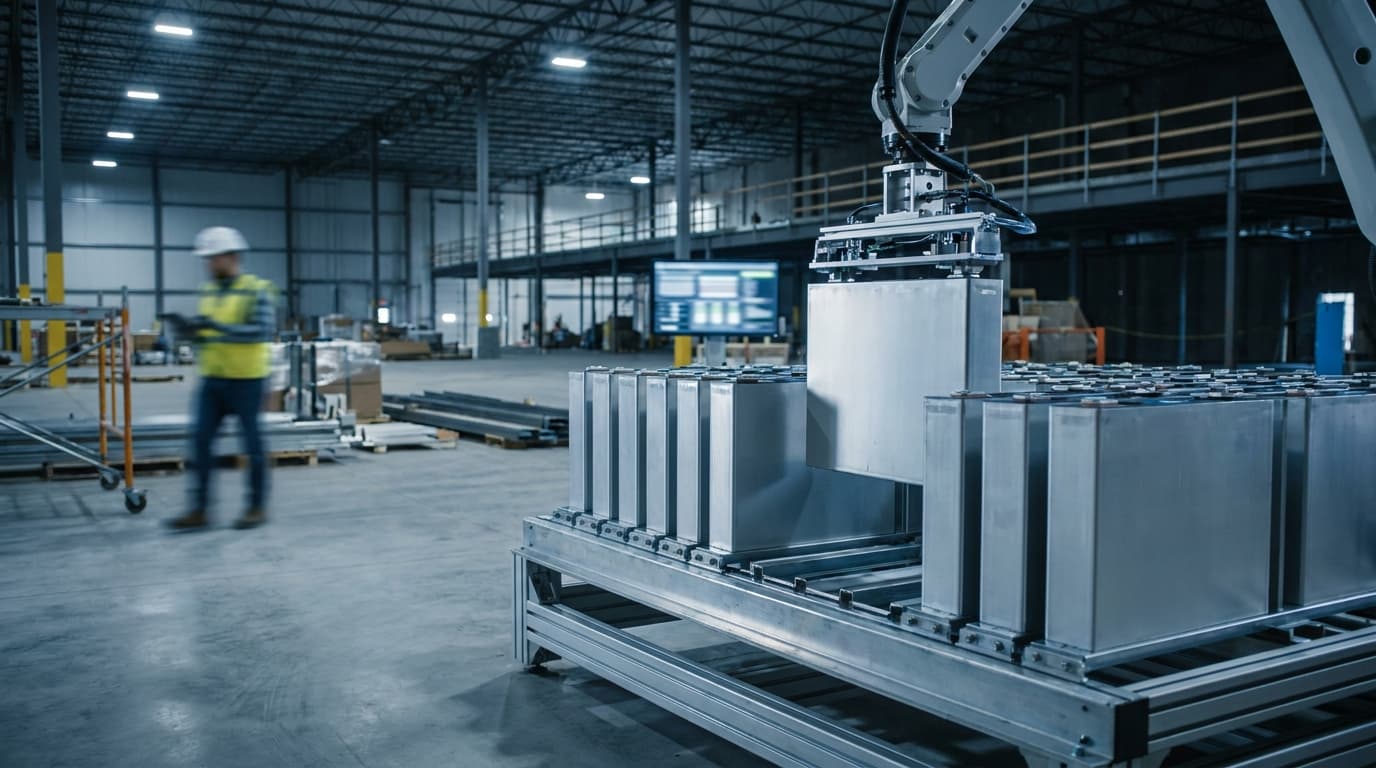
A half-built cell plant on roughly 680 acres of St. Joseph County farmland changed hands this month, and changed purpose with it. On August 11, 2026, Samsung SDI announced it had acquired General Motors' 49.99% stake in SynergyCells — the $3.5 billion New Carlisle, Indiana joint venture — taking sole ownership of a facility that is still under construction and will now be completed with an energy storage system (ESS) battery line alongside its original automotive tooling. Bloomberg had the transaction a day earlier; the company announcement and GM's disclosure landed on the 11th. Terms were not disclosed.
The easy read is that GM retreated and Samsung SDI absorbed the wreckage. The paperwork supports that framing. Samsung SDI's own stated rationale is that the ownership change was made "in consideration of market changes since the joint venture was announced, including the slower-than-expected growth of EV demand." The JV was announced in April 2023 and finalized in 2024. It lasted about two years.
But the timeline undercuts the easy read, and that is the more useful story for anyone allocating capital against announced U.S. cell capacity.
The pivot was contracted eight months before the buyout
On December 10, 2025, Samsung SDI announced a contract worth more than KRW 2 trillion — roughly $1.35 billion — to supply prismatic LFP ESS cells in Samsung Battery Box (SBB) 2.0 containers to an undisclosed U.S. customer. Three-year term. Deliveries beginning in 2027. Cells produced at its Indiana facility.

Same site. Same start year as the plant's targeted mass production date. And GM was still a 49.99% partner when it was signed.
That reorders the causality. The August buyout did not trigger the ESS pivot; it ratified a pivot that was already under contract and already had a delivery schedule attached to it. What GM sold was not an option on an EV cell plant that had gone bad. It was a minority position in a facility whose output had, at least in part, already been re-pointed at the grid. For operators reading the announced-capacity map, that distinction matters: the automotive label on a plant is a weaker signal than the offtake underneath it.
New Carlisle also becomes Samsung SDI's first wholly-owned North American cell site. Its other U.S. capacity is StarPlus Energy, the Stellantis JV in Kokomo, Indiana — a 33 GWh first plant with a second 34 GWh plant targeted for 2027, backed by a $7.54 billion DOE loan. Full ownership at New Carlisle means Samsung SDI can re-spec the line without a partner's approval, and can sell its output to whoever it wants.
The same-township fact nobody connected
New Carlisle is also home to Amazon Web Services' Project Rainier campus. As of July 23, 2026, AWS had invested $13.8 billion there, past its original $11 billion commitment, with roughly 18 buildings operating and more under construction on the way to about 30. Over 1,000 people hired, 800-plus of them Indiana residents and roughly 450 from St. Joseph County; the construction workforce peaked near 4,000. Trade coverage of the groundbreaking put the full build at roughly 32 buildings, about 6.5 million square feet, and approximately 2.25 GW of grid draw. The campus trains and serves Anthropic models.

So one Indiana township is simultaneously building one of the largest single concentrations of new electrical demand in the country and a wholly-owned plant that will produce grid-storage cells starting in 2027.
To be explicit about what is not established: the December 2025 ESS customer is undisclosed. There is no public evidence identifying AWS, or any hyperscaler, as the buyer. What is verified is the geography, the load, the contract, and the overlapping buildout window. Anyone who closes that loop for you is guessing. The verified version is interesting enough — the supply side and the demand side of the domestic grid-storage trade are now being poured within a few miles of each other, which is a siting fact with real logistics and interconnection implications regardless of who signs the offtake.
What actually changes on the line
The plant was specified for automotive prismatic cells — 27 GWh of initial annual capacity, scalable to 36 GWh, across about 2.5 million square feet, with mass production targeted for 2027. Repointing an automotive line toward stationary storage generally means moving from high-nickel NMC toward LFP, and that is the chemistry Samsung SDI named in the December contract.
The economics of the swap are straightforward. ESS buyers optimize cycle life, calendar life, safety, and dollars per kilowatt-hour. Without a vehicle's mass and packaging constraints, gravimetric energy density and fast-charge capability stop being the binding requirements they are in automotive. LFP wins that trade. Samsung SDI's ESS marketing leans on "No Thermal Propagation" (No TP) technology — insulation between cells intended to stop a thermal event from cascading — which is a safety-led selling point aimed squarely at rack and container buyers, not at vehicle programs.
What carries over from an automotive build: the building shell, the utility service, the dry rooms, and the core electrode process equipment. What has to change: cathode supply, cell format and thermal architecture, and formation and aging capacity. It is worth being precise here — the general engineering contours of an NMC-to-LFP conversion are industry knowledge; Samsung SDI has not published a line-by-line conversion plan for New Carlisle, and the announcement describes an added ESS line rather than a wholesale replacement of the site's automotive capability.
The incentive question, corrected
The reflexive assumption is that a plant built for EVs forfeits its federal manufacturing credits when it stops building EV cells. That is wrong, and it is worth killing before it propagates.
The Section 45X advanced manufacturing production credit attaches to eligible components produced and sold in the United States — battery cells at $35 per kWh, modules at $10 per kWh — and eligibility is not conditioned on downstream end use. A cell that goes into a rack earns the same per-kWh credit as a cell that goes into a truck. See the Congressional Research Service primer on 45X for the mechanics. The ESS pivot does not, by itself, cost Samsung SDI a dollar of 45X.
The live federal risk is elsewhere. The 2025 One Big Beautiful Bill Act layered prohibited-foreign-entity (PFE) restrictions onto 45X, including a "material assistance cost ratio" test. As Morgan Lewis lays out, PFE status can trigger through six pathways: Covered Nation organization (China, Russia, North Korea, Iran), single-entity equity at 25% or multi-entity at 40%, debt at 15%, covered officer appointment rights, effective control by contract, or material assistance. The firm's key point for this story is that storage faces more stringent material assistance standards than other technologies, precisely because the legacy LFP supply chain is China-dominated. U.S. assembly does not confer compliance on its own — exposure can run through ownership, upstream cell and precursor sourcing, or technology licensing.
Samsung SDI is Korean-headquartered and is not a Covered Nation entity, so the sharp question is not its cap table. It is the LFP cathode and licensing chain feeding an Indiana line. IRS Notice 2026-15, issued February 12, 2026, provided interim guidance with safe harbors that practitioners have generally read as favorable to 45X producers — but the specific threshold percentages are the kind of number that gets garbled in secondary coverage, and readers should confirm them against the statute or the Notice before relying on any figure.
Where the real exposure probably sits: Indianapolis and South Bend
The state and local package is the genuinely unresolved piece. Indiana's State Budget Committee approved $100 million in incentives for the project and then another $35 million in June 2023, roughly $135 million in total. The St. Joseph County Council unanimously approved a 100% property tax abatement running through 2038, with the JV obligated to pay $4.5 million annually toward infrastructure expansion, plus utility incentives from Indiana Michigan Power and NIPSCO. It was announced as the largest EV investment in state history, on a site originally described as 656 acres — current coverage says 680 — with 1,700 manufacturing jobs attached.
An abatement horizon of 2038 was written against an EV production thesis that changed in 2026. Whether those agreements contain EV-specific performance conditions, use restrictions, or job-count clawbacks that an ESS-focused plant would breach is not publicly established, and this piece does not assert that it does. It is the single highest-value document request in the story. The St. Joseph County Council and the Indiana Economic Development Corporation hold the agreement text; the South Bend Regional Chamber maintains the project page and is the practical starting point for local comment.
De-risking, not divorce
GM did not sever the relationship. Alongside the stake sale, the two companies signed a joint development agreement on next-generation prismatic batteries for potential future EV use. GM retains a development and supply relationship with no ownership stake and no remaining capex exposure at New Carlisle.
That is the emerging OEM posture in plain form: buy cells, don't own cell plants. It is also expensive to arrive at. By one widely circulated tally, automakers have written off roughly $70 billion as EV strategies reset — Stellantis around $25 billion, Ford $19.5 billion, Honda around $16 billion, GM $6 billion — though the components of that tally sum closer to $66.5 billion, and it is a media aggregation rather than an official figure. GM's own number is larger than the $6 billion in that list: it took a separate $1.6 billion EV capacity realignment charge in October 2025 ($1.2 billion non-cash impairment plus $400 million cash for contract cancellations), then guided to $7.1 billion in total fourth-quarter 2025 charges — $6 billion in North America ($1.8 billion non-cash write-down plus $4.2 billion to settle supplier contracts, primarily battery supply deals) and $1.1 billion tied to China JV restructuring. GM has said 2026 EV charges will be significantly smaller.
The counterweight: ESS is not a safe harbor
It would be a mistake to read New Carlisle as proof that stranded automotive capacity has somewhere safe to land. Stationary storage manufacturing is running its own cancellation wave. Clean Energy Associates recorded roughly 21 GWh of U.S. battery storage factory cancellations in 2025 alone, including KORE Power's 9.6 GWh Arizona project and FREYR's 10.2 GWh Georgia project, with additional delays across smaller Midwest and Southeast projects. The cost gap driving those decisions is brutal: Chinese systems at roughly $65/kWh against U.S. systems at $230–320/kWh.
Repurposing into ESS is a bet on domestic content requirements, tariff policy, and hyperscale demand holding up long enough to close that gap. It is not a rescue.
The operator question
What New Carlisle actually establishes is a template, and the template has three parts: take full ownership so you can re-spec unilaterally, secure the new offtake before the pivot is public, and sit next to the load. Samsung SDI did all three in that order.
The question that follows is how much announced U.S. cell capacity is nominally automotive but functionally uncommitted — plants with EV press releases and no binding offtake behind them. The watch list starts with StarPlus Kokomo's second plant and extends to any JV site where an OEM partner has already booked EV impairments. Those are the balance sheets where the next stake sale gets negotiated, and the tell will be a storage supply contract signed months before anyone announces a change of ownership.
Related reading
-
[Two to Three Years of Samarium: The Magnet the Pentagon Can't Tariff Its Way Out Of](/article/two-to-three-years-samarium-magnet-pentagon-cant-tariff)
-
Chip Revenue Grew 35% in a Single Quarter. Nobody Poured More Concrete.
-
[$1.966 Trillion Announced, 22% Less Built: The Reshoring Boom Is a Press-Release Boom](/article/reshoring-announcements-vs-census-construction-spending-2026)
-
What Tier-3 Foundries Should Expect From the GE Castings Deal
Sources
-
Samsung SDI Clinches Over KRW 2 Trillion Deal for ESS LFP Battery Supply in U.S. — Samsung SDI, Dec. 10, 2025
-
GM exits $3.5B Indiana battery plant as Samsung SDI takes full control — Electrek, Aug. 11, 2026
-
Samsung SDI Takes Full Ownership of GM Battery Joint Venture in Indiana — Battery-News, Aug. 13, 2026
-
Samsung SDI buys out GM's stake in the Indiana battery plant, which will make ESS cells — Charged EVs
-
AWS investment in St. Joseph County data center campus surpasses $13.8 billion — WNDU, Jul. 23, 2026
-
AWS breaks ground on $11bn data center campus in Indiana — Data Center Dynamics
-
The Section 45X Advanced Manufacturing Production Credit — Congressional Research Service, IF12809
-
How FEOC Rules Are Reshaping Energy Storage Tax Credit Eligibility — Morgan Lewis, March 2026
-
IRS Releases Initial FEOC Guidance, Answers Key Questions, Leaves Others Unanswered — McGuireWoods, March 2026
-
More incentives approved by state for EV battery plant in St. Joseph County — WNDU, Jul. 5, 2023
-
GM receives tax incentives to support potential $3.5 billion Indiana battery plant — The Detroit News, May 23, 2023
-
New Carlisle chosen for $3B EV battery plant — Inside INdiana Business
-
GM Samsung SDI Project FAQs — South Bend Regional Chamber of Commerce
-
GM to record $7.1 billion in fourth-quarter charges due to EV pullback, China restructuring — CNBC, Jan. 8, 2026
-
General Motors Co. Form 10-Q, quarter ended March 31, 2026 — SEC EDGAR
-
Car companies are writing off $70 billion as EV strategies reset — CarExpert
-
CEA records 21 GWh of US battery storage factory cancellations in 2025 — pv magazine
-
StarPlus Energy finalizes $7.5B DOE loan for two battery plants in Indiana — Utility Dive